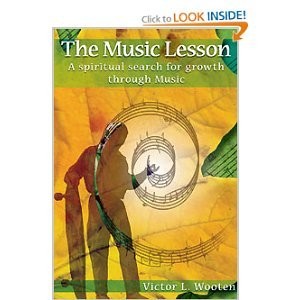
The Music Lesson: A Spiritual Search for Growth Through Music by Victor Wooten is a 2006 philosophy book about music and learning, creativity and mastery, spirituality and practice. Music is a language: it is best learned the way languages are learned — by immersion, play, and listening before speaking — not by studying rules before being allowed to express.
Summary
The Music Lesson is Victor Wooten's fable about music as a path to self-knowledge. Wooten — widely considered one of the most technically accomplished electric bass players alive — frames the book as a kind of visitation: a mysterious teacher named Michael appears in his life and proceeds to dismantle, through a series of conversations and encounters, most of what Wooten thought he knew about music, practice, and mastery. The book is explicitly not a technique manual. There is no tab, no theory, no exercises. It is about the relationship between a musician and music itself.
The central argument is that most musicians, including proficient ones, relate to music as a set of rules to be followed or techniques to be mastered. Michael repeatedly pushes Wooten toward a different orientation: music is a language, and like a language, it is best learned by immersion, by play, by listening more than speaking. A child does not learn to speak by studying grammar before being allowed to talk. The music education model — scales before improvisation, rules before expression — inverts the order in which language learning actually works, and produces musicians who are technically capable but not freely expressive.
Wooten organizes the book around ten elements: notes, articulation, technique, feel, dynamics, rhythm, tone, phrasing, space, and listening. But the structure is loose; these elements are pretexts for conversations about practice, presence, fear, and identity. Michael is a deliberately cryptic teacher who refuses to give direct answers, who demonstrates rather than explains, and who insists that Wooten's assumptions are the obstacle rather than his skills. The teaching style — maddening to some readers — is itself an argument about how learning works.
The book sits in an unusual space: part spiritual memoir, part pedagogical fable, part musical philosophy. It is not rigorous in the way a music theory text is rigorous, and readers who want specific technical guidance will not find it here. But musicians at all levels — and especially those who feel technically competent but creatively stuck — tend to respond to it strongly. The core questions it raises about the relationship between discipline, freedom, and expression are ones that practitioners of any craft will recognize.
Talk to The Music Lesson: A Spiritual Search for Growth Through Music like its author wrote you back.
Get the ideas that fit your life — not generic summaries.
- Chat with the book
- Audiobook-style main ideas
- Adapts to your life and goals
- Helps you take action
Key takeaways
- 1.
Music is a language: it is best learned the way languages are learned — by immersion, play, and listening before speaking — not by studying rules before being allowed to express.
- 2.
Most musicians mistake technique for music. Technique is the ability to say what you want to say; music is the conversation itself, which requires something beyond technical facility.
- 3.
Space and silence are as important as notes. The music happens between the sounds as much as in them. Learning to rest is as important as learning to play.
- 4.
Fear and self-consciousness are the primary obstacles to musical expression. The moment a musician starts judging their own playing mid-performance, the connection is broken.
- 5.
Listening is the most undervalued skill in music. A musician who listens deeply — to themselves, to their bandmates, to the room — will always outperform one who plays more fluently.
- 6.
Mistakes are not failures but invitations. They show where the music wants to go next, if the musician is willing to follow rather than correct.
- 7.
Every human being is already musical. The sense of rhythm, the response to melody — these are not acquired skills but native capacities that most people are taught to distrust.
- 8.
The best teachers demonstrate rather than explain. The kind of knowledge that actually changes a musician cannot be transmitted through verbal instruction alone.
Discussion questions
Use these on your own, with a book club, or as chat starters in Superbook. Book club version, ready to copy or print →
- 1.
Wooten's teacher insists music should be learned like language — through immersion and play before rules. Does this model match how you learned any skill, or did it go the other way?
- 2.
The book argues that most music education inverts the right order of learning. Based on your experience of learning anything, do you think that's a fair critique?
- 3.
Michael refuses to give direct answers and teaches primarily through demonstration and provocation. Have you had a teacher like this? Did it work — and does the method depend on the student?
- 4.
Wooten argues that space and silence are as important as notes. How does this principle apply outside of music — in conversation, in writing, in design?
- 5.
The book says mistakes are invitations, not failures. Is this advice actionable for you in your own practice, or does it feel like something easier to say than to apply?
- 6.
Victor Wooten is one of the most technically accomplished bassists alive. Does knowing that change how you read his argument that technique is secondary to expression?
- 7.
The book frames music as a spiritual practice. Does that framing open the ideas up for you or close them down?
- 8.
What does 'mastery' mean in Wooten's account — and is it the same as being very technically skilled?
- 9.
Michael as a teacher is cryptic, maddening, and refuses to simply explain. Is this an effective pedagogical approach, or is it mystification dressed up as wisdom?
- 10.
Wooten says every human is already musical. Does that feel true to you — and if so, why do so many people describe themselves as 'not musical'?
- 11.
The ten elements — notes, articulation, technique, feel, dynamics, rhythm, tone, phrasing, space, listening — overlap significantly. Is this a useful framework or an artificial one?
- 12.
If you applied the book's core argument to your own primary skill or practice, what would it suggest you should do differently?
Themes
Frequently asked questions
-
What is The Music Lesson about?
It's a fable about learning music from the inside out rather than from rules down. Victor Wooten frames it as his education by a mysterious teacher named Michael, who challenges Wooten to relate to music as a language and a living thing rather than a set of techniques to be mastered. It's philosophical and spiritual in tone, not instructional.
-
Is The Music Lesson useful if you're not a musician?
Reasonably so. The book's core arguments — about listening, space, mistakes as invitations, and the difference between technique and expression — apply to any creative practice. Non-musicians who find the musical specifics opaque may find it easier to read with that translation in mind.
-
How long does it take to read The Music Lesson?
Around three to four hours. It's about 200 pages and written in a conversational, somewhat spare style. The narrative is loose — it's a fable, not a structured argument — and most chapters are short.
-
Is this book for beginners or advanced musicians?
Both, but it works differently for each. Beginners may absorb the philosophy before technique has had a chance to calcify around it, which is arguably the ideal reading time. Advanced musicians who feel technically accomplished but creatively stuck tend to report the strongest responses.
-
What is Wooten's main argument about music education?
That standard music education gets the sequence backwards: it teaches rules and technique before allowing free expression, producing musicians who can execute but not communicate. Wooten argues this is the opposite of how language learning works, and that immersion, play, and listening should precede — or at least accompany — formal instruction.