Psychology · Book club
The Myth of Mental Illness: Foundations of a Theory of Personal Conduct book club questions
Here are 12 book club questions for The Myth of Mental Illness: Foundations of a Theory of Personal Conduct by Thomas Szasz, ordered to open easily and end somewhere worth arguing about. Copy them, print them, or bring them up one at a time.
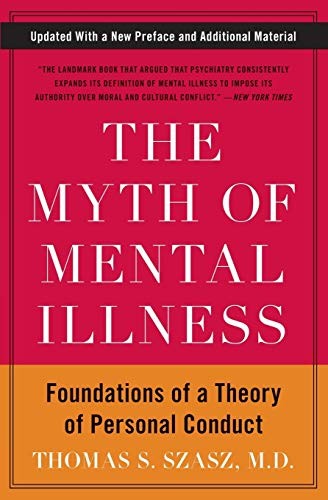
Thomas Szasz's thesis, first published in 1961, is that mental illness is a category error.
Thomas Szasz · 1961 · 5h 45m
Full summary and key takeaways →The 12 questions
- 1.
Szasz argues that mental illness is a category error, not a genuine medical concept. Do you find the distinction between biological and behavioral norms as clear as he suggests?
- 2.
If some psychiatric diagnoses are constructs that describe unwanted behavior rather than diseases, what obligations does that place on those who make diagnoses?
- 3.
The book was written in 1961. How has subsequent neuroscience — brain imaging, genetic research, psychopharmacology — strengthened or weakened Szasz's argument?
- 4.
Szasz sees involuntary psychiatric commitment as a form of coercive imprisonment. Under what circumstances, if any, do you think involuntary treatment is justified?
- 5.
Do you agree that calling someone mentally ill tends to suspend moral judgment about their conduct? What are the consequences of that suspension?
- 6.
Szasz was a libertarian who distrusted state power. How much of his argument about psychiatry depends on that political commitment, and how much stands independently?
- 7.
The book distinguishes 'problems in living' from genuine medical illness. Where would you draw that line for conditions like depression, schizophrenia, or addiction?
- 8.
Has the expansion of psychiatric diagnosis improved the lives of people who receive diagnoses, or has it primarily served other interests? What evidence would settle the question?
- 9.
Szasz argues that psychiatric treatment often substitutes medical authority for genuine moral engagement. Do you see that substitution operating in contexts you know?
- 10.
What is the difference between saying someone 'has' a mental illness and saying someone 'behaves in ways that are distressing to themselves and others'? Does the language change the ethics?
- 11.
Critics of Szasz argue that denying mental illness as a category leaves vulnerable people without access to help. How does he respond to that objection, and is his response adequate?
- 12.
The concept of hysteria, which Szasz examines at length, has largely disappeared. What does its disappearance tell us about how psychiatric categories change over time?
How to run the discussion
- Pick six to eight, not all of them. An hour of real discussion covers fewer questions than anyone expects, and racing the list is what makes a book club feel like homework.
- Open with what people noticed, not what they concluded. Asking for a verdict first hardens opinions before anyone has heard each other.
- Let the disagreement run. The questions below that split a room are the ones worth the time; the ones everyone answers the same way can be skipped.
- Ask the quiet person a specific question. A direct, narrow question is far easier to answer than an open invitation to contribute.
Themes worth steering toward
If the conversation stalls, these are the threads that usually restart it.
Common questions
What are good book club questions for The Myth of Mental Illness: Foundations of a Theory of Personal Conduct?
Here are 12 book club questions for The Myth of Mental Illness: Foundations of a Theory of Personal Conduct by Thomas Szasz, ordered to open easily and end somewhere worth arguing about. The strongest openers ask what each reader noticed rather than what they concluded, and the discussion usually turns on psychiatry, mental health, ethics.
How long should a book club discussion of The Myth of Mental Illness: Foundations of a Theory of Personal Conduct last?
Most groups run 60 to 90 minutes of actual discussion. That is roughly six to eight questions, not all of them, so pick the ones that suit your group rather than working down the list in order.
What are the main themes in The Myth of Mental Illness: Foundations of a Theory of Personal Conduct?
Psychiatry, Mental health, Ethics, Medicine, Freedom. Those are the threads most likely to divide a room, which makes them the useful places to steer a discussion that has gone quiet.
Picking the next one? See books like The Myth of Mental Illness: Foundations of a Theory of Personal Conduct or questions for other book club picks.
