Health · Book club
The Myth of Normal book club questions
Here are 12 book club questions for The Myth of Normal by Gabor Maté, ordered to open easily and end somewhere worth arguing about. Copy them, print them, or bring them up one at a time.
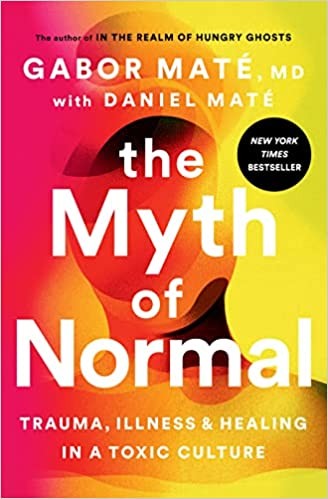
The Myth of Normal is Gabor Maté's most ambitious book, co-written with his son Daniel Maté.
Gabor Maté · 2022 · 8h 45m
Full summary and key takeaways →The 12 questions
- 1.
Maté argues that contemporary levels of chronic illness and mental health disorder are symptoms of cultural pathology, not natural variation. Do you find that framing clarifying or too sweeping?
- 2.
The book distinguishes between acute trauma and the subtler, cumulative trauma of emotional inauthenticity in childhood. Which of those do you think is less recognized, and why?
- 3.
Maté says the adaptations that helped us survive difficult childhoods often become the source of adult suffering. Can you identify an adaptation in yourself that worked then but costs you now?
- 4.
The book implicates economic and social structures — not just individual histories — in producing illness. What would it mean to take that seriously at a policy level?
- 5.
Maté is broadly skeptical of medical and psychiatric frameworks that treat mental health conditions as brain diseases to be medicated. How do you think about that tension in your own experience or the experience of people you know?
- 6.
The concept of authenticity appears throughout — the idea that genuine emotional expression is a biological need. How easy or difficult is it to be authentic in the environments you spend most of your time in?
- 7.
Maté and his son co-wrote this book. Does knowing that affect how you read the sections on parent-child relationships and intergenerational trauma?
- 8.
The book argues that healing cannot be purely individual. What would collective or cultural healing actually look like in practice?
- 9.
The title suggests that 'normal' in our culture is itself a form of illness. Do you agree? What would genuinely healthy look like as a cultural baseline?
- 10.
Compassionate inquiry involves approaching one's own behavior with curiosity rather than self-criticism. Is that possible for you, and what makes it hard?
- 11.
Maté argues that emotional suppression is rewarded by many institutions — schools, workplaces, social norms. Where have you seen that most clearly?
- 12.
The book covers a lot of ground — addiction, autoimmune disease, mental health, cultural criticism — across 500+ pages. Did the breadth strengthen or weaken the argument for you?
How to run the discussion
- Pick six to eight, not all of them. An hour of real discussion covers fewer questions than anyone expects, and racing the list is what makes a book club feel like homework.
- Open with what people noticed, not what they concluded. Asking for a verdict first hardens opinions before anyone has heard each other.
- Let the disagreement run. The questions below that split a room are the ones worth the time; the ones everyone answers the same way can be skipped.
- Ask the quiet person a specific question. A direct, narrow question is far easier to answer than an open invitation to contribute.
Themes worth steering toward
If the conversation stalls, these are the threads that usually restart it.
Common questions
What are good book club questions for The Myth of Normal?
Here are 12 book club questions for The Myth of Normal by Gabor Maté, ordered to open easily and end somewhere worth arguing about. The strongest openers ask what each reader noticed rather than what they concluded, and the discussion usually turns on trauma, mental health, culture and illness.
How long should a book club discussion of The Myth of Normal last?
Most groups run 60 to 90 minutes of actual discussion. That is roughly six to eight questions, not all of them, so pick the ones that suit your group rather than working down the list in order.
What are the main themes in The Myth of Normal?
Trauma, Mental health, Culture and illness, Authenticity, Healing. Those are the threads most likely to divide a room, which makes them the useful places to steer a discussion that has gone quiet.
Picking the next one? See books like The Myth of Normal or questions for other book club picks.
