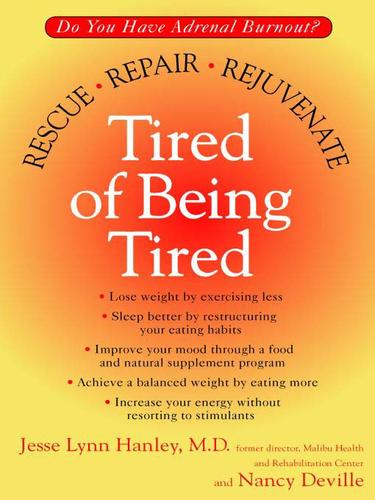
Tired of Being Tired by Jesse Hanley is a 2002 health book about fatigue, adrenal health, hormones. Chronic low-grade fatigue that conventional medicine can't explain is often rooted in adrenal dysfunction — the cumulative effect of prolonged stress on the hormonal stress-response system.
Summary
Jesse Hanley is a physician with a background in integrative and naturopathic medicine, and Tired of Being Tired is her practical guide to chronic fatigue — specifically the kind that conventional medicine often dismisses or misattributes. Hanley focuses on what she calls adrenal exhaustion: the cumulative toll of sustained physical and psychological stress on the adrenal glands, which regulate cortisol and other hormones central to the body's stress response. The book is addressed primarily to women, who she argues are disproportionately affected.
The book's diagnostic framework is built around symptoms — persistent exhaustion, difficulty sleeping, brain fog, low libido, recurrent illness, and a sense of running on empty despite rest. Hanley walks through the hormonal and physiological mechanisms she believes underlie these symptoms, including the hypothalamic-pituitary-adrenal axis and its interactions with thyroid function, blood sugar regulation, and immune response. She is forthright that conventional laboratory testing often fails to catch adrenal dysfunction at the subclinical levels she finds most common in her patients.
The prescriptions are integrative: nutritional changes, targeted supplementation, stress reduction practices, and attention to sleep and exercise pacing. Hanley is cautious about recommending supplements indiscriminately and emphasizes matching intervention to individual pattern rather than applying a single protocol. She discusses adrenal tonics, adaptogen herbs, and hormone-supportive nutrients in practical terms, with attention to quality and sourcing.
The book's limitation is that adrenal fatigue as a clinical category remains contested in mainstream medicine, and Hanley writes primarily from integrative clinical practice rather than controlled research. Readers should be aware that the framework she uses, while widely employed in functional and naturopathic medicine, is not universally accepted. For patients who feel dismissed by conventional physicians, however, the book provides a coherent model for understanding their symptoms and a set of reasonable, low-risk starting interventions.
Talk to Tired of Being Tired like its author wrote you back.
Get the ideas that fit your life — not generic summaries.
- Chat with the book
- Audiobook-style main ideas
- Adapts to your life and goals
- Helps you take action
Key takeaways
- 1.
Chronic low-grade fatigue that conventional medicine can't explain is often rooted in adrenal dysfunction — the cumulative effect of prolonged stress on the hormonal stress-response system.
- 2.
The hypothalamic-pituitary-adrenal axis connects psychological stress to physical health outcomes through cortisol, adrenaline, and related hormones that affect virtually every organ system.
- 3.
Conventional laboratory tests often miss subclinical adrenal insufficiency. Symptom patterns and functional tests may provide better diagnostic signal for many patients.
- 4.
Blood sugar regulation and adrenal health are tightly linked: unstable blood sugar from poor diet creates repeated cortisol spikes that degrade adrenal function over time.
- 5.
Sleep quality, not just quantity, is critical for adrenal recovery. The body does most of its hormonal repair between approximately 10 pm and 2 am.
- 6.
Adaptogenic herbs and targeted nutritional support can support adrenal recovery, but effective intervention requires matching the specific pattern of dysfunction to the right approach.
- 7.
Pacing exercise intensity to current energy levels, rather than pushing through fatigue, is essential during recovery — high-intensity exercise during adrenal insufficiency worsens the problem.
Discussion questions
Use these on your own, with a book club, or as chat starters in Superbook.
- 1.
Adrenal fatigue is not universally recognized in mainstream medicine. How do you evaluate a health framework that has clinical support but limited controlled-trial evidence?
- 2.
Hanley focuses primarily on women. Do you think the exhaustion she describes is genuinely more prevalent in women, or are there other explanations for that pattern?
- 3.
Many people identify with the symptoms she describes. How do you distinguish between a medical explanation and a description so general it fits almost anyone?
- 4.
She argues that conventional laboratory tests often miss the problem her patients present with. When should a patient trust integrative clinical experience over standard lab ranges?
- 5.
The book was written in 2002. How much do you think our understanding of fatigue, hormones, and the stress response has changed since then?
- 6.
Hanley recommends reducing obligations and protecting rest time. In what contexts is that advice realistic, and where is it tone-deaf to actual life constraints?
- 7.
She connects emotional patterns — perfectionism, people-pleasing, difficulty saying no — to physical exhaustion. Do you find that psychological framing useful or reductive?
- 8.
What would it take for you to take a period of deliberate rest and recovery as a medical intervention rather than a luxury?
- 9.
The supplement and herbal recommendations in the book are specific. How do you evaluate herbal and nutritional recommendations that lack pharmaceutical-grade trial evidence?
- 10.
If you recognize yourself in the symptoms Hanley describes, what is the first practical step you would take based on the book?
- 11.
How does this book's approach to chronic fatigue compare to how the mainstream medical system handles complaints of exhaustion in your experience?
Themes
Frequently asked questions
-
What is Tired of Being Tired about?
It is an integrative medicine guide to chronic fatigue, focused on adrenal dysfunction as a central mechanism. Hanley explains the hormonal basis for exhaustion and offers practical dietary, supplemental, and lifestyle interventions for recovery.
-
Is adrenal fatigue a real diagnosis?
It is used widely in integrative and naturopathic medicine but is not accepted as a formal diagnosis in mainstream endocrinology. Hanley's framework is clinically useful for many patients but readers should know the underlying model is contested.
-
Who should read Tired of Being Tired?
People experiencing persistent unexplained fatigue who feel dismissed by conventional medicine, or who want an integrative perspective on hormonal health. It is addressed primarily to women but the principles apply more broadly.
-
How long is Tired of Being Tired?
Around 250 pages, roughly four hours of reading. The practical sections on nutrition and supplementation are the densest parts.
-
What is the most actionable recommendation in the book?
Stabilizing blood sugar through regular meals with adequate protein and fat, reducing caffeine dependence, protecting sleep quality, and pacing exercise to current energy rather than pushing through fatigue.