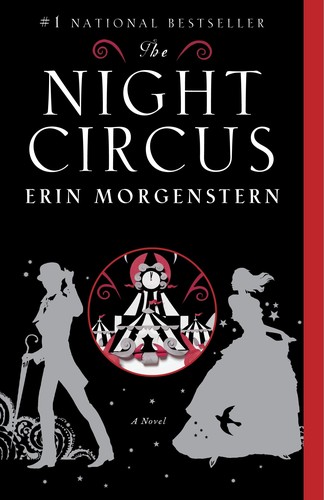
The Night Circus by Erin Morgenstern is a 2011 fantasy book about magic and competition, love and sacrifice, art and creation. The circus is a collaborative artwork built from competition — Celia and Marco's rivalry produces something neither of them could have made alone, which is the novel's central irony.
Summary
Le Cirque des Rêves appears overnight, with no announcement — black and white striped tents that smell of caramel and bonfire smoke, open only after dark, filled with impossible things. The Night Circus follows two magicians, Celia and Marco, who have been trained since childhood by rival instructors and set against each other in a competition neither of them chose, whose rules neither of them fully understands, using the circus itself as the arena. They fall in love without knowing they are competitors. The competition is a trap.
The novel is not primarily a plot machine. Morgenstern is most interested in the experience of wonder — what it feels like to encounter something genuinely extraordinary, to be inside a world that has been made with love and skill. The circus's tents get chapter-length descriptions: a cloud maze, a garden of ice, a room of infinite locks and keys. These passages are the heart of the book. The story surrounds them and gives them emotional stakes, but the circus is the real subject.
The structure is non-linear, moving between multiple timelines, and there are many named characters whose stories intersect loosely with the central competition. The secondary cast — circus performers, a mysterious clock-maker, a red-scarved fan called a rêveur — contribute to the atmosphere more than the plot. Morgenstern's prose is lush and deliberate, built for reading slowly. It is a novel you can lose yourself in rather than race through.
Where the book can be frustrating: the central competition's rules are deliberately kept vague, which creates atmosphere but can feel like a structural evasion. The love story proceeds with a gentleness that some readers find romantic and others find insufficiently tense. The ending requires a kind of logic — what the competition actually demands, and how it can be resolved — that the novel builds toward slowly and earns on emotional rather than mechanical terms. Readers who need tight plotting will struggle; readers who want to inhabit a beautifully made world will find the novel hard to leave.
Talk to The Night Circus like its author wrote you back.
Get the ideas that fit your life — not generic summaries.
- Chat with the book
- Audiobook-style main ideas
- Adapts to your life and goals
- Helps you take action
Key takeaways
- 1.
The circus is a collaborative artwork built from competition — Celia and Marco's rivalry produces something neither of them could have made alone, which is the novel's central irony.
- 2.
Wonder is treated as a serious aesthetic value, not just atmosphere; Morgenstern argues, implicitly, that the capacity to be enchanted is worth protecting.
- 3.
The non-linear structure mirrors the circus experience: you don't move through it chronologically, you drift between moments.
- 4.
The love story between Celia and Marco is about recognition — each seeing in the other someone who understands the same thing — as much as it is about romance.
- 5.
The instructors who set up the competition represent two philosophies of magic: innate power versus learned system, and the novel is ambivalent about which is superior.
- 6.
The rêveurs — fans who follow the circus and wear red as identification — are a meditation on how art creates community and how audiences participate in what they love.
- 7.
The circus has no practical purpose; it exists only to be beautiful. The novel stakes a claim that this is enough.
- 8.
The ending is satisfying on its own emotional terms, though it operates by a logic the novel withholds until late — some readers find this earned, others find it a cheat.
Discussion questions
Use these on your own, with a book club, or as chat starters in Superbook. Book club version, ready to copy or print →
- 1.
The novel keeps the rules of the competition deliberately vague. Did that ambiguity create productive tension, or did it feel like Morgenstern was avoiding a structural problem?
- 2.
The circus is described in loving detail across many chapters. Did those set-piece descriptions feel like the heart of the novel to you, or like beautiful digressions from the story?
- 3.
Celia and Marco fall in love partly by recognizing each other through their work before they know who the other is. Does that dynamic feel romantic, or more like a metaphor for artistic community?
- 4.
The instructors — Hector Bowen and Alexander — are never fully explained. Did their opacity feel appropriate to the novel's atmosphere, or like a missed opportunity?
- 5.
The non-linear timeline means the reader knows some outcomes before their causes. How did that affect your experience of the competition's tension?
- 6.
The secondary characters — Bailey, Poppet, Widget, Tsukiko — have their own arcs that weave around the central story. Did you find them as interesting as Celia and Marco?
- 7.
The novel is sometimes described as mood-driven rather than plot-driven. Is that a distinction that matters to you as a reader, or is it a false opposition?
- 8.
The rêveurs and their relationship to the circus raise questions about fan culture and the ethics of being enchanted by something you don't fully understand. Did that dimension register for you?
- 9.
The ending asks you to accept a resolution that is more metaphysical than narrative. Did it feel earned?
- 10.
The Night Circus is sometimes categorized with magical realism. Does that feel accurate, or is it doing something different?
- 11.
Compared to other lush, atmosphere-heavy fantasy — Jonathan Strange and Mr Norrell, say — where does The Night Circus land for you in terms of what it's actually trying to do?
- 12.
If you had visited Le Cirque des Rêves, which tent would you have gone to first? (This is the book club's palate-cleanser question, but it usually generates the best conversation.)
Themes
Frequently asked questions
-
Is The Night Circus a plot-driven book?
No. The central competition gives the novel structure, but Morgenstern is primarily interested in atmosphere and sensation. If you need plot momentum to stay engaged, this will test your patience. If you can enjoy inhabiting a beautifully made world, you'll find it absorbing.
-
Is the love story central?
Yes and no. The romance between Celia and Marco is structurally important, but the novel treats the circus itself as the primary love object. The love story is the novel's emotional anchor rather than its main event.
-
Is The Night Circus hard to follow?
The non-linear timeline and large cast can require some attention in the early chapters. Most readers find it clicks into place around a third of the way through. It is not difficult in a demanding literary sense — the prose is accessible and the atmosphere guides you.
-
Who shouldn't read The Night Circus?
Readers who need tight plotting, explained rules, and narrative efficiency. The novel withholds information about how the competition works until late, resolves its central conflict through a logic that some readers find unsatisfying, and spends significant page time on atmosphere rather than story. These are features, not bugs, but they are not for every reader.
-
Is there a sequel?
No direct sequel. Morgenstern's second novel, The Starless Sea, is set in a different world and has a different cast, though it shares thematic DNA with The Night Circus — specifically its love of layered stories, constructed wonders, and the relationship between art and devotion.