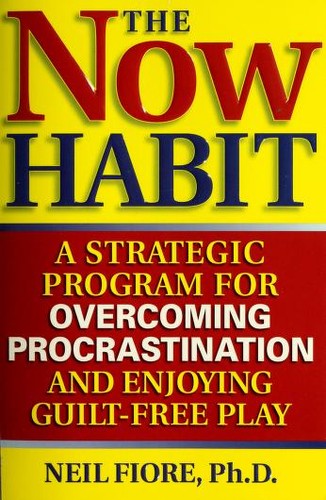
The Now Habit by Neil Fiore is a 1988 self-help book about procrastination, productivity, anxiety. Procrastination is not laziness or poor time management. It is a coping strategy for managing anxiety about performance, criticism, and the possibility of failure.
Summary
The Now Habit is psychologist Neil Fiore's reframe of procrastination as a coping mechanism rather than a character flaw. Published in 1988 and updated periodically since, it remains one of the most psychologically grounded books on the topic. Fiore's argument is that procrastination is a symptom of perfectionism, fear of failure, and the misalignment between how we tell ourselves we "should" be spending time and how we actually spend it — and that addressing these underlying causes is more effective than willpower and guilt.
The book introduces the Unschedule: a weekly planner that starts by filling in leisure, social activities, and self-care before any work time. The Unschedule is counterintuitive — it looks like giving up on discipline — but Fiore argues that the guilt cycle (I should be working; I'm not working; I feel guilty; I seek relief from guilt through more avoidance) is what makes procrastination self-reinforcing. By scheduling guilt-free leisure first, you eliminate the guilt that drives the avoidance.
Fiore also addresses the language of procrastination: replacing "I have to" with "I choose to," "I should finish" with "I can start," and "this project" with "this task" — small linguistic changes that reduce the sense of overwhelming obligation and return agency to the procrastinator. The distinction between big, undefined projects (which trigger avoidance) and small, specific tasks (which are startable) is central to his approach.
The book was written before smartphones and social media, which means its treatment of distraction is dated. But the psychological mechanics of procrastination it describes — fear of failure, perfectionism, overwhelm from undefined work — have not changed. It is one of the more clinically sound books in the genre.
Talk to The Now Habit like its author wrote you back.
Get the ideas that fit your life — not generic summaries.
- Chat with the book
- Audiobook-style main ideas
- Adapts to your life and goals
- Helps you take action
Key takeaways
- 1.
Procrastination is not laziness or poor time management. It is a coping strategy for managing anxiety about performance, criticism, and the possibility of failure.
- 2.
The Unschedule reverses conventional time management: fill in leisure, social activities, and self-care first, then let work fill the remaining time. This breaks the guilt cycle that reinforces procrastination.
- 3.
Guilt-free play is not a reward for finishing — it is a prerequisite for sustained work. People who plan no leisure never feel they've earned it and work in a chronic state of resentment.
- 4.
Replace 'I have to' with 'I choose to.' This simple linguistic shift returns agency and reduces the resentful, overwhelmed feeling that triggers avoidance.
- 5.
Replace 'finish the project' with 'start the task for thirty minutes.' Procrastination is triggered by the size and vagueness of projects; small, defined tasks are startable.
- 6.
Perfectionism is a form of performance anxiety. The perfectionist avoids starting because the risk of imperfect output feels unbearable. The antidote is lowering the stakes of the first draft.
- 7.
The inner critic speaks in absolutes ('always,' 'never,' 'completely') and catastrophizes the consequences of imperfect work. Recognizing these patterns weakens their hold.
- 8.
Work begins when you start, not when you feel ready. Readiness is a feeling that procrastinators wait for; producers create it by acting.
Discussion questions
Use these on your own, with a book club, or as chat starters in Superbook. Book club version, ready to copy or print →
- 1.
Fiore argues that procrastination is anxiety management rather than laziness. Does that reframe feel accurate for your own procrastination patterns?
- 2.
What specific fear underlies your most consistent procrastination? Fear of failure? Fear of success? Fear of criticism? Fear of the work being harder than you can handle?
- 3.
The Unschedule asks you to fill in leisure before work. What is your reaction to that instruction? What does your reaction reveal?
- 4.
What would it feel like to have a week where all leisure was guilt-free — not earned, just planned? Would that actually change your work?
- 5.
Fiore's linguistic shifts — 'I choose to' instead of 'I have to' — are small. Do you think they would make a measurable difference for you? Why or why not?
- 6.
What is the project you're most procrastinating on right now? Can you identify the first five-minute task within it that you could start immediately?
- 7.
He describes the inner critic as speaking in absolutes. What are the specific absolute statements your inner critic makes about your most important work?
- 8.
The book was published in 1988, before social media. How would Fiore's framework need to be updated to account for digital distraction as a procrastination vehicle?
- 9.
What is your guilt cycle — the sequence that runs from avoided work through guilt through relief-seeking that brings you back to more avoidance? Can you name each step?
- 10.
Fiore argues that planning guilt-free leisure is not indulgence but essential recovery. How much unscheduled, guilt-free time do you currently have each week?
- 11.
If you replaced 'I should finish this project' with 'I can work on this task for thirty minutes,' what would you start today?
Themes
Frequently asked questions
-
Is The Now Habit worth reading?
Yes if procrastination is a genuine obstacle rather than an occasional inconvenience. The book's reframe of procrastination as anxiety management is psychologically more accurate than most treatments, and the Unschedule is an unusually practical tool. The writing is accessible and the advice is specific.
-
How long does it take to read The Now Habit?
About three to four hours at average pace. The book is shorter than most productivity titles and organized around practical exercises at the end of each chapter.
-
What is the Unschedule?
A weekly calendar that you fill in with leisure, social activities, and fixed obligations before scheduling any work. The goal is to ensure that leisure is planned and guilt-free rather than squeezed in around work, breaking the guilt cycle that drives chronic procrastination.
-
Does The Now Habit actually work?
The framework is well-supported by behavioral psychology principles — particularly the research on how guilt and anxiety reinforce avoidance cycles. Whether the specific tools work for you depends on which of the underlying causes (perfectionism, fear of failure, overwhelm) is driving your procrastination.
-
Who should read The Now Habit?
People whose procrastination is driven by perfectionism, anxiety, or a chronic sense of guilt about work rather than simple distraction or poor organization. If you feel you should be working every moment and can never relax, the Unschedule is specifically designed for you.