Psychology · Book club
The Paradox of Choice: Why More Is Less book club questions
Here are 11 book club questions for The Paradox of Choice: Why More Is Less by Barry Schwartz, ordered to open easily and end somewhere worth arguing about. Copy them, print them, or bring them up one at a time.
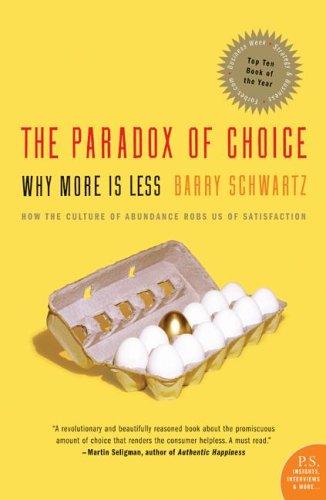
Barry Schwartz argues that the expansion of consumer choice in wealthy societies has not produced the freedom and happiness it promised.
Barry Schwartz · 2004 · 4h 20m
Full summary and key takeaways →The 11 questions
- 1.
Are you a maximizer or a satisficer? Can you identify domains where you satisfice and others where you maximizer, and what makes the difference?
- 2.
Schwartz argues that constraints make people happier. Can you think of a constraint in your life — a rule, a commitment, a limitation — that has actually improved your experience rather than limited it?
- 3.
The book predates social media and recommendation algorithms. How have those technologies interacted with the paradox of choice — resolved it or made it worse?
- 4.
Think of a decision you made recently that left you less satisfied than you expected. Can you trace which mechanisms Schwartz describes were operating?
- 5.
He argues that maximizing and satisficing are partly personality traits and partly learned tendencies. Is there a domain where you would like to become more of a satisficer?
- 6.
The opportunity cost argument says that unchosen alternatives detract from satisfaction with what you chose. Is there something you chose that you would enjoy more if you stopped imagining alternatives?
- 7.
Self-blame rises with choice because you could have chosen differently. How does this interact with how we evaluate outcomes in areas like career, relationship, and health?
- 8.
Schwartz recommends pre-committing to rules that remove certain decisions. What decisions in your life would benefit from being converted into rules?
- 9.
The political dimension of the book is that consumer choice has been conflated with human freedom. Do you agree with that critique? What are the limits of that equation?
- 10.
He discusses adaptation — our tendency to return to a baseline of satisfaction after both good and bad outcomes. What implications does adaptation have for how you think about major life decisions?
- 11.
Which of Schwartz's prescriptions do you find most plausible and which most difficult to apply to your actual life?
How to run the discussion
- Pick six to eight, not all of them. An hour of real discussion covers fewer questions than anyone expects, and racing the list is what makes a book club feel like homework.
- Open with what people noticed, not what they concluded. Asking for a verdict first hardens opinions before anyone has heard each other.
- Let the disagreement run. The questions below that split a room are the ones worth the time; the ones everyone answers the same way can be skipped.
- Ask the quiet person a specific question. A direct, narrow question is far easier to answer than an open invitation to contribute.
Themes worth steering toward
If the conversation stalls, these are the threads that usually restart it.
Common questions
What are good book club questions for The Paradox of Choice: Why More Is Less?
Here are 11 book club questions for The Paradox of Choice: Why More Is Less by Barry Schwartz, ordered to open easily and end somewhere worth arguing about. The strongest openers ask what each reader noticed rather than what they concluded, and the discussion usually turns on decision-making, choice, happiness.
How long should a book club discussion of The Paradox of Choice: Why More Is Less last?
Most groups run 60 to 90 minutes of actual discussion. That is roughly six to eight questions, not all of them, so pick the ones that suit your group rather than working down the list in order.
What are the main themes in The Paradox of Choice: Why More Is Less?
Decision-making, Choice, Happiness, Regret, Autonomy. Those are the threads most likely to divide a room, which makes them the useful places to steer a discussion that has gone quiet.
Picking the next one? See books like The Paradox of Choice: Why More Is Less or questions for other book club picks.
