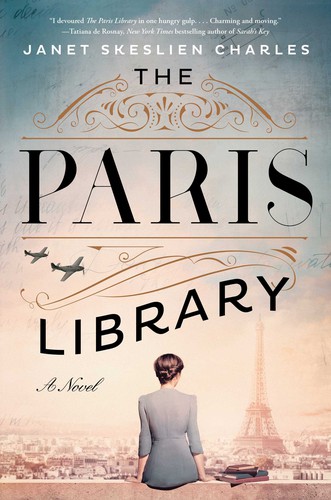
The Paris Library by Janet Skeslien Charles is a 2021 historical fiction book about resistance and complicity, friendship across difference, occupation and survival. The American Library of Paris really did operate under Occupation, and its librarians really did deliver books to Jewish subscribers. The historical core of this novel is true.
Summary
The Paris Library moves between two timelines: Paris in 1939–1944, where young Odile Souchet becomes a librarian at the American Library of Paris just as war is approaching; and rural Montana in the 1980s, where a teenage girl named Lily befriends her French neighbor, the now-elderly Odile, and slowly uncovers the history Odile has never spoken about. The novel is based on the real history of the American Library of Paris, which continued operating under German Occupation and delivered books to Jewish subscribers who were banned from public life.
The historical strand is the more powerful half. Charles spent years researching the library and the people who worked there, and that research is evident in the texture of daily life in Occupied Paris — the small negotiations, the fear, the moments of collaboration and cowardice alongside the genuine heroism. Odile is not a simple resistance figure. The novel is honest about the full range of choices people made, and about the cost of being found on the wrong side of moral history.
The Montana timeline functions as a frame: Lily is a coming-of-age protagonist who mirrors Odile's younger self, and her relationship with Odile provides the emotional delivery mechanism for the historical material. Charles writes both timelines with warmth, though the contemporary strand is thinner and the stakes feel proportionally smaller. The big revelation about what Odile did — or didn't do — during the Occupation takes most of the novel to reach, and how you feel about it will determine whether the book's emotional payoff lands for you.
This will appeal strongly to readers who loved The Nightingale, All the Light We Cannot See, or similar historical fiction set in World War II France. It is carefully researched, emotionally intelligent, and interested in moral complexity rather than clean heroism. The pacing is deliberate and the length is earned. It is not an action novel; it is a novel about how people live through history, and what gets passed on and what gets buried.
Talk to The Paris Library like its author wrote you back.
Get the ideas that fit your life — not generic summaries.
- Chat with the book
- Audiobook-style main ideas
- Adapts to your life and goals
- Helps you take action
Key takeaways
- 1.
The American Library of Paris really did operate under Occupation, and its librarians really did deliver books to Jewish subscribers. The historical core of this novel is true.
- 2.
Charles is interested in the difference between heroism and complicity, and the uncomfortable space in between where most people actually live during wartime.
- 3.
The dual timeline structure is a common device in historical fiction, and Charles uses it to draw parallels across generations without forcing them.
- 4.
Books and libraries in this novel are not merely symbols — they are practical sites of resistance, community, and humanity under conditions designed to strip all of those away.
- 5.
Odile is a character shaped by things she did and didn't do, and the novel understands that silence and inaction are also choices with consequences.
- 6.
The friendship between Odile and the young Montana teenager is the novel's warmest strand, and it functions as an intergenerational transmission of buried history.
- 7.
Occupied Paris as a setting demands a reckoning with ordinary collaboration, and Charles does not look away from the people who made accommodations, small and large.
- 8.
The novel asks whether forgiveness is owed, whether understanding obligates it, and whether the answer differs depending on who is being asked.
- 9.
The research underlying the novel shows in the best way — as specificity and confidence, not display.
Discussion questions
Use these on your own, with a book club, or as chat starters in Superbook. Book club version, ready to copy or print →
- 1.
Odile makes a choice during the Occupation that defines the rest of her life. Did you find it understandable? Forgivable?
- 2.
The novel is based on real history — the American Library of Paris genuinely continued operating under Occupation. Does knowing that change how you read the fictional elements?
- 3.
The Montana timeline frames everything we learn about Odile. Did Lily feel like a fully realized character to you, or more like a narrative device?
- 4.
Charles draws a range of French characters — resisters, collaborators, people trying to survive without doing either. Which of them stayed with you, and why?
- 5.
Books and libraries are central to the novel's symbolism. Did that register as earned resonance or as the kind of thing book-lovers are meant to love?
- 6.
Odile's silence over decades is treated as a burden rather than a protection. What does the novel say about the costs of keeping secrets from people you love?
- 7.
Compared to The Nightingale or All the Light We Cannot See, where does The Paris Library land in the sub-genre of WWII women's fiction? What does it do differently?
- 8.
The dual timeline creates a 'when will we find out' structure. Did the revelation feel proportionate to the buildup, or was the secret smaller than expected?
- 9.
The female friendships in the novel — both in Paris and in Montana — are central. How does the novel characterize female solidarity?
- 10.
The novel ends in a particular emotional register. Did it feel earned?
- 11.
Who in the novel do you most want to have known in person, and who do you think you would have been — which character are you most honest with yourself about resembling?
- 12.
Charles researched this book for years and worked at the American Library of Paris herself. Does the depth of research show, and does it ever feel like it gets in the way of the story?
Themes
Frequently asked questions
-
Is The Paris Library historically accurate?
The core institutional history — that the American Library of Paris continued operating under German Occupation and delivered books to Jewish subscribers — is accurate. The major fictional characters are invented, though inspired by real people. Charles includes a detailed author's note on the history.
-
How does The Paris Library compare to The Nightingale?
Both are WWII France novels centered on women and moral choices. The Nightingale is faster-paced and more plot-driven; The Paris Library is quieter and more focused on the gray areas of survival and complicity. The Nightingale is more of a thriller; this is more of a character study.
-
Is the Montana storyline as interesting as the Paris one?
Most readers find the Paris timeline more compelling. The Montana strand is warmer and lighter, and it earns its place by providing the emotional delivery mechanism for Odile's history, but it's the weaker half of the book.
-
Who shouldn't read this book?
Readers who prefer fast-paced plots, or who are fatigued by the WWII France sub-genre in women's historical fiction, will find the pace slow and the territory familiar. It is a book that rewards patience and engagement with moral complexity rather than action.
-
Is there an adaptation?
As of 2024, no major adaptation had been produced, though the book's success in reading groups made it a candidate.