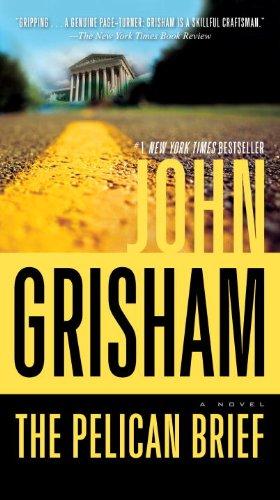
The Pelican Brief by John Grisham is a 1992 thriller book about political conspiracy, environmental law, power and vulnerability. The brief itself is the novel's central device: a piece of legal reasoning that is correct becomes a death sentence the moment it is taken seriously.
Summary
Two Supreme Court justices are assassinated in a single night. Darby Shaw, a brilliant second-year Tulane law student, writes a speculative brief identifying the likely motive: an oil billionaire with financial interests in the Louisiana wetlands, and political connections that run straight to the White House. Her brief finds its way to the FBI, and within days people who have read it are dying. Darby goes on the run, accompanied by a Washington reporter named Gray Grantham who begins to understand that her theory is correct.
Grisham's third novel is his most structurally efficient. The premise is clean — woman writes memo that gets her hunted — and the mechanics are kept tight. The conspiracy involves the highest levels of American government without becoming satirical, and the threat to Darby feels real because Grisham is meticulous about what she actually knows versus what she suspects. She is not a superhero; she is a frightened, sleep-deprived law student who has to stay alive and credible simultaneously.
The novel is a product of the Bush I administration and the early 1990s environmental debates, and some of its political mechanics are period-specific. But the essential story — powerful interests using the legal and political system to protect themselves at any cost — has not aged at all. The paranoia is functional; Grisham earns it by showing you exactly how the machinery of power operates rather than relying on vague menace.
Julia Roberts and Denzel Washington starred in the 1993 film adaptation, which captures the plot efficiently but softens some of the novel's darker corners. The book is a more effective exercise in sustained dread. Readers who want Grisham at full pace should start here; readers who want Grisham at his most morally serious should start with A Time to Kill. This is where the two impulses — entertainment and argument — are most perfectly balanced.
Talk to The Pelican Brief like its author wrote you back.
Get the ideas that fit your life — not generic summaries.
- Chat with the book
- Audiobook-style main ideas
- Adapts to your life and goals
- Helps you take action
Key takeaways
- 1.
The brief itself is the novel's central device: a piece of legal reasoning that is correct becomes a death sentence the moment it is taken seriously.
- 2.
Darby Shaw is a more compelling protagonist than many Grisham heroes because she has no power — only intelligence and the ability to stay moving.
- 3.
Grisham's conspiracy is not cartoonishly evil: the power it depicts is recognizable precisely because it operates through legitimate channels — legal, political, financial.
- 4.
The press functions as the novel's only functioning democratic institution — Grantham's insistence on verification is what makes the story publishable rather than just deadly.
- 5.
Environmental protection as a motive for Supreme Court assassination is a pointed political argument: what is at stake is not abstract but specific, mappable, and financially quantifiable.
- 6.
The novel is built around a simple asymmetry: Darby knows something; everyone who matters wants her not to tell it. Grisham is a master of this single-variable tension.
- 7.
The ending is tidy in ways reality isn't. Grisham is honest enough to acknowledge this: publishing the truth and escaping the consequences are two different things.
Discussion questions
Use these on your own, with a book club, or as chat starters in Superbook. Book club version, ready to copy or print →
- 1.
Darby writes the brief almost as an academic exercise. At what point does she realize it is more than that, and what does her response tell you about her?
- 2.
The President of the United States in this novel is not the villain but is complicit. How does Grisham frame that distinction, and is it convincing?
- 3.
The FBI Director is corrupt; the press is trustworthy. Is that an intentional inversion of expectations, or just the requirements of this particular plot?
- 4.
Grantham insists on independent verification before publishing — journalism ethics under extreme pressure. Does the novel treat that as heroic or merely professional?
- 5.
Darby has no institutional protection for most of the novel. How does that vulnerability shape the reading experience compared to a protagonist who has resources?
- 6.
The environmental motive — protecting oil drilling at the expense of the Louisiana coast — is the kind of conspiracy that could plausibly have happened. Does the political specificity strengthen or date the novel?
- 7.
Grisham's villains in this novel are wealthy, powerful, and politically connected. The novel assumes that such people are capable of murder. Does that feel like insight or paranoia?
- 8.
By the end, the truth is published but accountability is partial. Is Grisham being realistic or pessimistic about how power protects itself?
- 9.
How does Darby's relationship with her professor, Thomas Callahan, function in the novel? Is it essential to the plot, or is it also doing something else?
- 10.
If you were in Darby's position — holding information that powerful people want suppressed — what would you actually do?
- 11.
The 1993 film removes the romantic subplot and changes some character dynamics. How do those choices affect the story's emotional logic?
Themes
Frequently asked questions
-
Is The Pelican Brief worth reading?
Yes — it's one of Grisham's most focused thrillers. The premise is clean, the protagonist is compelling, and the conspiracy is specific enough to feel plausible. At 400 pages it moves faster than A Time to Kill and has more moral texture than some of his later work.
-
What is The Pelican Brief about, without spoilers?
A law student writes a speculative memo identifying who might be behind the assassination of two Supreme Court justices. When people who have read it start dying, she goes on the run while trying to get the information to someone who can publish it.
-
Is the film as good as the book?
The 1993 film with Julia Roberts and Denzel Washington is a well-made adaptation that captures the plot but removes the romantic subplot and smooths some of the novel's edges. It's a good film; the book has more dread.
-
Do I need to read The Firm first?
No — each Grisham legal thriller is completely standalone. The Pelican Brief is a natural companion to The Firm but requires no prior reading.
-
Who shouldn't read this book?
Readers who want literary ambition or moral complexity on the level of A Time to Kill will find this more purely mechanical. It's a very well-made thriller, but it's primarily interested in plot architecture rather than character or political argument.
Similar books
The Firm
John Grisham
A Time to Kill
John Grisham
Bad Blood: Secrets and Lies in a Silicon Valley Startup
John Carreyrou
The Spy and the Traitor: The Greatest Espionage Story of the Cold War
Ben Macintyre
