Psychology · Book club
The Power of Bad: How the Negativity Effect Rules Us and How We Can Rule It book club questions
Here are 12 book club questions for The Power of Bad: How the Negativity Effect Rules Us and How We Can Rule It by John Tierney and Roy F. Baumeister, ordered to open easily and end somewhere worth arguing about. Copy them, print them, or bring them up one at a time.
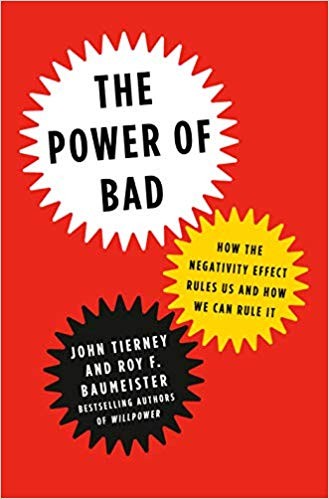
Roy Baumeister is a social psychologist who co-authored the most-cited paper in the field — "Bad Is Stronger Than Good" — and this book is his attempt, with science writer John Tierney, to explain that finding to a general audience and draw out its practical implications.
John Tierney and Roy F. Baumeister · 2019 · 5h 15m
Full summary and key takeaways →The 12 questions
- 1.
Can you identify a relationship or situation in your life where a single bad event has defined your memory of an otherwise positive experience?
- 2.
Baumeister cites the five-to-one ratio for relationship stability. Think about a close relationship. Does this ratio describe what you actually experience?
- 3.
The negativity bias shapes news consumption: bad news spreads faster. How deliberately do you curate your information environment to counteract this?
- 4.
Think of a piece of negative feedback you received that stuck with you disproportionately. Was it accurate? Useful? Why did it carry so much weight?
- 5.
The book argues the negativity bias is an evolutionary adaptation, not a flaw. Does knowing its origin change how you relate to your own negative emotional reactions?
- 6.
Where in your workplace does the negativity effect operate most visibly — in how feedback is given, how decisions are made, or how crises are managed?
- 7.
Tierney and Baumeister suggest 'critical positivity' as a corrective: not fake positivity but structural awareness of the asymmetry. What would this look like in practice in your life?
- 8.
Research shows that consumer reviews are disproportionately influenced by negative ratings. How does this change how you read reviews, or how you write them?
- 9.
The book discusses how bad experiences in childhood tend to be more forming than positive ones. Is that consistent with your experience, or do positive experiences stand out as equally defining?
- 10.
In politics, negative advertising works. How does the negativity effect shape your own political beliefs and what you attend to?
- 11.
If bad feedback is harder to ignore, how do you give feedback to others in a way that's honest without triggering avoidance or defensiveness?
- 12.
What's a domain in your life where you think the negativity bias is currently costing you something — a relationship, a decision, a creative project?
How to run the discussion
- Pick six to eight, not all of them. An hour of real discussion covers fewer questions than anyone expects, and racing the list is what makes a book club feel like homework.
- Open with what people noticed, not what they concluded. Asking for a verdict first hardens opinions before anyone has heard each other.
- Let the disagreement run. The questions below that split a room are the ones worth the time; the ones everyone answers the same way can be skipped.
- Ask the quiet person a specific question. A direct, narrow question is far easier to answer than an open invitation to contribute.
Themes worth steering toward
If the conversation stalls, these are the threads that usually restart it.
Common questions
What are good book club questions for The Power of Bad: How the Negativity Effect Rules Us and How We Can Rule It?
Here are 12 book club questions for The Power of Bad: How the Negativity Effect Rules Us and How We Can Rule It by John Tierney and Roy F. Baumeister, ordered to open easily and end somewhere worth arguing about. The strongest openers ask what each reader noticed rather than what they concluded, and the discussion usually turns on negativity bias, cognitive bias, resilience.
How long should a book club discussion of The Power of Bad: How the Negativity Effect Rules Us and How We Can Rule It last?
Most groups run 60 to 90 minutes of actual discussion. That is roughly six to eight questions, not all of them, so pick the ones that suit your group rather than working down the list in order.
What are the main themes in The Power of Bad: How the Negativity Effect Rules Us and How We Can Rule It?
Negativity bias, Cognitive bias, Resilience, Decision-making, Relationships. Those are the threads most likely to divide a room, which makes them the useful places to steer a discussion that has gone quiet.
Picking the next one? See books like The Power of Bad: How the Negativity Effect Rules Us and How We Can Rule It or questions for other book club picks.
