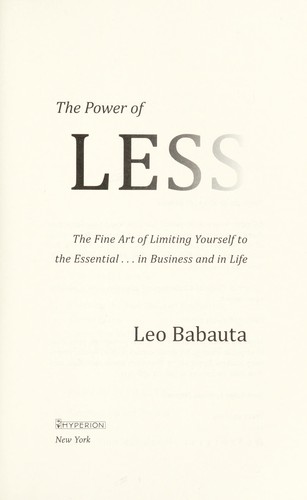
The Power of Less by Leo Babauta is a 2008 self-help book about simplicity, focus, minimalism. Focus on one goal at a time rather than pursuing multiple goals simultaneously. Spreading attention thins progress on everything.
Summary
Leo Babauta's central argument is that doing less, not more, is the path to meaningful accomplishment. Most people work from a growing list of tasks, commitments, and possessions that expands faster than they can address it, and the expansion itself becomes the problem. The Power of Less is Babauta's case for ruthless prioritization: identify what actually matters, then protect that focus from everything else.
The book is organized around a single principle repeated in different contexts: set essential limits on what you pursue, then do those things completely before adding more. Babauta applies this to daily tasks, goals, projects, email, and physical clutter. In each domain, the practice is the same — define the three most important things, work on one at a time, and resist the pull toward multitasking and endless queuing.
What distinguishes this from generic time-management advice is the insistence on constraint as a feature, not a bug. Babauta argues that limits force clarity. When you can only pick one goal, you pick the right one. When you allow yourself three tasks for the day, you choose the ones that genuinely move things forward rather than ones that merely feel productive. The framework is simple enough to actually use — which is partly why it resonates with readers who've bounced off more complex systems.
The writing is lean and direct, which suits the subject. The book won't surprise anyone already steeped in minimalism or productivity writing, and some chapters feel repetitive. But for readers overwhelmed by an everything-all-at-once approach to life and work, the book delivers a usable alternative. The limits Babauta prescribes are less about efficiency than about deciding, on purpose, what kind of work and life you want.
Talk to The Power of Less like its author wrote you back.
Get the ideas that fit your life — not generic summaries.
- Chat with the book
- Audiobook-style main ideas
- Adapts to your life and goals
- Helps you take action
Key takeaways
- 1.
Focus on one goal at a time rather than pursuing multiple goals simultaneously. Spreading attention thins progress on everything.
- 2.
Identify your three most important tasks each day and do those before anything else. Everything else is optional.
- 3.
Constraints create clarity. When you can only pick one thing, you choose more carefully and commit more fully.
- 4.
Limit your commitments deliberately. Every yes to one thing is a no to several others, whether you acknowledge it or not.
- 5.
Single-tasking beats multitasking every time. Context-switching between tasks costs more attention than most people realize.
- 6.
Simplify systems before optimizing them. Adding features to a broken workflow makes it harder to diagnose what's actually wrong.
- 7.
Small, consistent habits compound. Babauta's own transformation — quitting smoking, running marathons, building his blog — came through incremental changes, not overhauls.
- 8.
Email and information consumption are attention expenses, not just time expenses. Treat your inbox as an input to be batched, not a stream to monitor.
Discussion questions
Use these on your own, with a book club, or as chat starters in Superbook. Book club version, ready to copy or print →
- 1.
Babauta argues that most people operate from a default of more. Where in your life are you adding more when subtracting would serve you better?
- 2.
What would your three most important tasks be today, and how different are they from what you actually spent time on?
- 3.
Which commitments in your life have you kept out of inertia rather than genuine desire or value?
- 4.
Babauta built his blog and ran marathons using the same incremental-habit approach. Where have you seen small consistent actions compound in your own experience?
- 5.
If you could only pursue one goal for the next six months, which one would it be, and what does that answer reveal about how you currently allocate time?
- 6.
What's your relationship with your inbox? Does it drive your day or do you drive it?
- 7.
Babauta says single-tasking is more effective than multitasking. What's a situation where you've noticed the cost of switching contexts?
- 8.
The book is written for people who feel overwhelmed. What's a domain of your life where overwhelm is the default mode?
- 9.
What would you have to say no to in order to protect one hour a day for your most important work?
- 10.
The 'less' in the title applies to possessions, tasks, and commitments. Which of those three would be hardest for you to reduce, and why?
- 11.
Which of Babauta's limits — one goal, three tasks, batch email — feels most immediately applicable to your life?
- 12.
Are there goals you've been pursuing simultaneously that would benefit from being done sequentially?
Themes
Frequently asked questions
-
Is The Power of Less worth reading?
It's a short, useful read if you feel scattered or overcommitted. The ideas aren't novel — single-tasking, limiting goals, batching distractions — but Babauta presents them accessibly and with personal credibility. Readers already familiar with essentialism or minimalism will find little new ground.
-
How long does it take to read The Power of Less?
Around two to three hours. The book is under 200 pages and the chapters are brief. Most people read it in one or two sittings.
-
What is the main argument of The Power of Less?
That doing fewer things with full attention produces better results than doing many things poorly. Babauta applies this to goals, daily tasks, commitments, email, and physical possessions.
-
Who should read The Power of Less?
People who feel overwhelmed by their to-do lists and commitments, or who have tried more complex productivity systems and found them unsustainable. It's especially useful as a first exposure to minimalist productivity thinking.
-
How does The Power of Less compare to Essentialism?
Both argue for doing less and choosing deliberately. Essentialism is more strategic and detailed; The Power of Less is shorter, more personal, and easier to start applying immediately. Essentialism reads like a business book; The Power of Less reads like a personal manifesto.