Psychology · Book club
The Procrastination Equation book club questions
Here are 11 book club questions for The Procrastination Equation by Piers Steel, ordered to open easily and end somewhere worth arguing about. Copy them, print them, or bring them up one at a time.
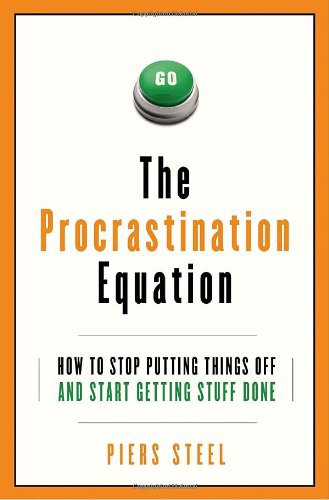
The Procrastination Equation is Piers Steel's attempt to apply a decade of academic research on procrastination to a popular audience.
Piers Steel · 2010 · 4h 15m
Full summary and key takeaways →The 11 questions
- 1.
Steel's equation breaks motivation into four variables: expectation, value, impulsiveness, and delay. Which of these is most often responsible for your procrastination?
- 2.
Think of a task you've been putting off for weeks. What specifically makes it aversive — uncertainty, boredom, fear of failure, or something else?
- 3.
Have you ever used a commitment device — a bet, a public declaration, a deposit — to force yourself to follow through? Did it work?
- 4.
Steel distinguishes impulsiveness from laziness. Do you think you're genuinely high in impulsiveness, or is the procrastination driven more by task aversion?
- 5.
What implementation intention could you write right now for a task you're avoiding? Be specific: if-then, not when-then.
- 6.
How do you typically respond to a procrastination episode — with self-criticism or self-forgiveness? Does that response help or hurt the next day?
- 7.
Where in your physical environment are the most powerful sources of immediate gratification (phone, snacks, streaming platforms)? How close are they to where you try to do serious work?
- 8.
Steel's research shows procrastination has increased substantially over recent decades. What structural or cultural forces do you think are driving that?
- 9.
Think of a period in your life when you were highly self-disciplined. What structural factors made that possible? Can any of them be recreated?
- 10.
Is there a task you've been putting off that you now realize you may simply not value enough to prioritize? What would it mean to explicitly drop it?
- 11.
Steel argues that deadline pressure works by manipulating the delay variable. What would it look like to create artificial deadline pressure for a task without an external deadline?
How to run the discussion
- Pick six to eight, not all of them. An hour of real discussion covers fewer questions than anyone expects, and racing the list is what makes a book club feel like homework.
- Open with what people noticed, not what they concluded. Asking for a verdict first hardens opinions before anyone has heard each other.
- Let the disagreement run. The questions below that split a room are the ones worth the time; the ones everyone answers the same way can be skipped.
- Ask the quiet person a specific question. A direct, narrow question is far easier to answer than an open invitation to contribute.
Themes worth steering toward
If the conversation stalls, these are the threads that usually restart it.
Common questions
What are good book club questions for The Procrastination Equation?
Here are 11 book club questions for The Procrastination Equation by Piers Steel, ordered to open easily and end somewhere worth arguing about. The strongest openers ask what each reader noticed rather than what they concluded, and the discussion usually turns on procrastination, motivation, self-regulation.
How long should a book club discussion of The Procrastination Equation last?
Most groups run 60 to 90 minutes of actual discussion. That is roughly six to eight questions, not all of them, so pick the ones that suit your group rather than working down the list in order.
What are the main themes in The Procrastination Equation?
Procrastination, Motivation, Self-regulation, Behavior change, Productivity. Those are the threads most likely to divide a room, which makes them the useful places to steer a discussion that has gone quiet.
Picking the next one? See books like The Procrastination Equation or questions for other book club picks.
