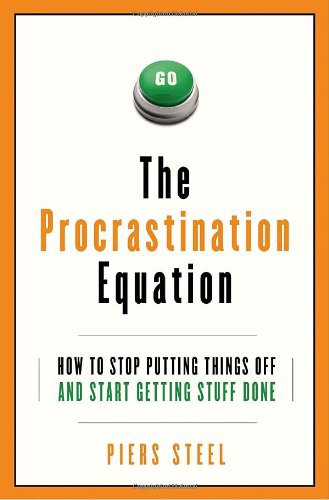
The Procrastination Equation by Piers Steel is a 2010 psychology book about procrastination, motivation, self-regulation. Procrastination is a motivation failure, not a time management failure. The temporal motivation theory explains it as what happens when low expectation, low value, high impulsiveness, and long delay combine.
Summary
The Procrastination Equation is Piers Steel's attempt to apply a decade of academic research on procrastination to a popular audience. Steel, a professor of organizational behavior, argues that procrastination is not a time management problem or a character flaw but a failure of motivation rooted in how humans discount future rewards. His central formula — called the temporal motivation theory — expresses this mathematically: motivation to do a task is a function of the expectation of success multiplied by the value of completing it, divided by impulsiveness multiplied by the delay until completion. When a task feels uncertain, unpleasant, or far off, motivation collapses.
The value of the formula is that it makes explicit what most self-help advice treats as a black box. Why does a deadline help? Because it reduces the denominator. Why do rewards help? They increase the numerator. Why does a task feeling too hard hurt? It lowers the expectation of success. Steel's framework translates every piece of procrastination advice into a specific mechanical intervention: you're not just "being more disciplined," you're adjusting a particular variable in a motivation equation.
The book covers the primary drivers of procrastination in detail: impulsiveness and its relationship to the brain's reward circuitry, the role of optimism and failure expectations, task aversion and how it arises from boredom and frustration, and the social and structural factors that exacerbate delay. Steel is particularly good on impulsiveness: he marshals research showing it is partly heritable, substantially trainable, and distinct from laziness. The implication is that chronic procrastinators aren't morally weaker than non-procrastinators; their brains respond more strongly to immediate temptation.
The remedies Steel offers follow directly from his analysis: implementation intentions (pre-decided "if-then" plans), commitment devices, environment redesign, and attention-management techniques. Some material overlaps with other productivity books, but the theoretical grounding makes the prescriptions more coherent. The book is more academic in voice than most popular psychology, but it pays off for readers who want to understand why the techniques work rather than just following instructions.
Talk to The Procrastination Equation like its author wrote you back.
Get the ideas that fit your life — not generic summaries.
- Chat with the book
- Audiobook-style main ideas
- Adapts to your life and goals
- Helps you take action
Key takeaways
- 1.
Procrastination is a motivation failure, not a time management failure. The temporal motivation theory explains it as what happens when low expectation, low value, high impulsiveness, and long delay combine.
- 2.
Impulsiveness — sensitivity to immediate rewards relative to future ones — is the single strongest predictor of procrastination. It is partly biological and substantially trainable.
- 3.
Task aversion drives procrastination as much as delay. When a task is unpleasant, boring, or anxiety-inducing, the brain's time preference for immediate relief overrides rational planning.
- 4.
Commitment devices — pre-commitments that raise the cost of delay — work by changing the structure of the future reward calculation before willpower is tested.
- 5.
Implementation intentions ('When X happens, I will do Y') dramatically increase follow-through by converting vague plans into specific, pre-decided responses.
- 6.
Self-forgiveness after a procrastination episode predicts less future procrastination. Guilt tends to generate avoidance rather than correction.
- 7.
Environmental design matters. Removing the physical and digital proximity of temptation (the open browser, the visible phone) reduces the number of willpower battles that need to be won.
- 8.
Optimism about timelines is procrastination's close cousin. Most people systematically underestimate how long tasks take, which delays starting to a dangerous degree.
Discussion questions
Use these on your own, with a book club, or as chat starters in Superbook. Book club version, ready to copy or print →
- 1.
Steel's equation breaks motivation into four variables: expectation, value, impulsiveness, and delay. Which of these is most often responsible for your procrastination?
- 2.
Think of a task you've been putting off for weeks. What specifically makes it aversive — uncertainty, boredom, fear of failure, or something else?
- 3.
Have you ever used a commitment device — a bet, a public declaration, a deposit — to force yourself to follow through? Did it work?
- 4.
Steel distinguishes impulsiveness from laziness. Do you think you're genuinely high in impulsiveness, or is the procrastination driven more by task aversion?
- 5.
What implementation intention could you write right now for a task you're avoiding? Be specific: if-then, not when-then.
- 6.
How do you typically respond to a procrastination episode — with self-criticism or self-forgiveness? Does that response help or hurt the next day?
- 7.
Where in your physical environment are the most powerful sources of immediate gratification (phone, snacks, streaming platforms)? How close are they to where you try to do serious work?
- 8.
Steel's research shows procrastination has increased substantially over recent decades. What structural or cultural forces do you think are driving that?
- 9.
Think of a period in your life when you were highly self-disciplined. What structural factors made that possible? Can any of them be recreated?
- 10.
Is there a task you've been putting off that you now realize you may simply not value enough to prioritize? What would it mean to explicitly drop it?
- 11.
Steel argues that deadline pressure works by manipulating the delay variable. What would it look like to create artificial deadline pressure for a task without an external deadline?
Themes
Frequently asked questions
-
Is The Procrastination Equation worth reading?
Yes, if you want to understand procrastination scientifically rather than just pick up more productivity tips. The temporal motivation theory gives you a framework that explains why any given technique works or doesn't, which is more durable than a list of habits.
-
How is this different from other books on procrastination?
Most procrastination books are self-help with light scientific backing. Steel's book starts from peer-reviewed research and builds prescriptions from theory. It's denser and more academic in places, but the theoretical foundation makes the advice more coherent and the diagnoses more precise.
-
What is the procrastination equation?
Motivation = (Expectation x Value) / (Impulsiveness x Delay). Tasks feel worth starting when you expect to succeed, the outcome matters, you're not highly impulsive, and the payoff isn't far off. Procrastination happens when any of the negative factors dominate.
-
Who should read The Procrastination Equation?
Chronic procrastinators who've tried generic productivity advice and found it doesn't stick, and anyone interested in the psychology of motivation and self-regulation. It's also useful for coaches, managers, and educators trying to understand why certain people consistently delay.
-
How long is The Procrastination Equation?
About 250 pages, readable in four to five hours. The early chapters covering the theory are the most important; the later chapters on specific interventions can be read selectively based on which variables in the equation are most relevant to your situation.
Similar books
Atomic Habits
James Clear
The Willpower Instinct
Kelly McGonigal
Indistractable: How to Control Your Attention and Choose Your Life
Nir Eyal
Drive: The Surprising Truth About What Motivates Us
Daniel H. Pink
