Economics · Book club
The Rational Optimist: How Prosperity Evolves book club questions
Here are 12 book club questions for The Rational Optimist: How Prosperity Evolves by Matt Ridley, ordered to open easily and end somewhere worth arguing about. Copy them, print them, or bring them up one at a time.
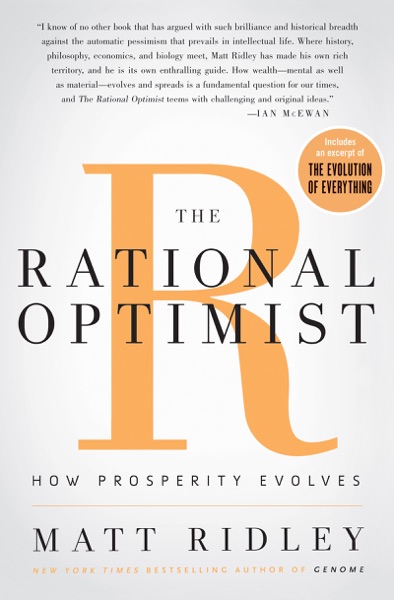
Matt Ridley's argument in The Rational Optimist is evolutionary in the literal sense: he treats the expansion of human prosperity as the result of a Darwinian process operating at the cultural level, where ideas combine, compete, and recombine to produce innovations that raise living standards.
Matt Ridley · 2010 · 7h 15m
Full summary and key takeaways →The 12 questions
- 1.
Ridley's core mechanism is the exchange of ideas embedded in goods. Can you think of innovations in your own field that emerged from that kind of unexpected combination?
- 2.
He argues the historical record shows innovation solving resource constraints. Does climate change seem qualitatively different from previous resource challenges, or of the same type?
- 3.
The book is deliberately optimistic as a corrective to what Ridley sees as systematic media pessimism. Is that a legitimate intellectual stance, or does it introduce its own bias?
- 4.
Ridley draws a direct line from exchange to prosperity. Are there kinds of prosperity that do not depend on trade — communal, subsistence, or spiritual forms of flourishing?
- 5.
The collective brain idea implies that restricting exchange restricts innovation. Which restrictions on exchange — intellectual property, trade barriers, monopoly — seem most costly by this measure?
- 6.
Ridley is less interested in distribution than in aggregate growth. Who tends to be left out of his story of expanding prosperity?
- 7.
The book was published in 2010. Has the subsequent decade and a half vindicated or complicated its optimism about technology solving climate and resource problems?
- 8.
Ridley's second half is notably more polemical than his first. Why do you think he made that shift, and how does it affect the book's credibility?
- 9.
He argues that pessimists have been consistently wrong throughout history. Is being historically wrong a good reason to expect someone to be wrong about the future?
- 10.
The evolutionary framework treats cultural and economic change as Darwinian. What does that metaphor illuminate, and what might it obscure?
- 11.
Which historical period or civilization's experience did you find most illuminating in Ridley's account?
- 12.
Ridley is a hereditary peer who ran a bank that failed in 2007. Does that context affect how you read his arguments about markets and regulation?
How to run the discussion
- Pick six to eight, not all of them. An hour of real discussion covers fewer questions than anyone expects, and racing the list is what makes a book club feel like homework.
- Open with what people noticed, not what they concluded. Asking for a verdict first hardens opinions before anyone has heard each other.
- Let the disagreement run. The questions below that split a room are the ones worth the time; the ones everyone answers the same way can be skipped.
- Ask the quiet person a specific question. A direct, narrow question is far easier to answer than an open invitation to contribute.
Themes worth steering toward
If the conversation stalls, these are the threads that usually restart it.
Common questions
What are good book club questions for The Rational Optimist: How Prosperity Evolves?
Here are 12 book club questions for The Rational Optimist: How Prosperity Evolves by Matt Ridley, ordered to open easily and end somewhere worth arguing about. The strongest openers ask what each reader noticed rather than what they concluded, and the discussion usually turns on human progress, trade and exchange, innovation.
How long should a book club discussion of The Rational Optimist: How Prosperity Evolves last?
Most groups run 60 to 90 minutes of actual discussion. That is roughly six to eight questions, not all of them, so pick the ones that suit your group rather than working down the list in order.
What are the main themes in The Rational Optimist: How Prosperity Evolves?
Human progress, Trade and exchange, Innovation, Specialization, Optimism. Those are the threads most likely to divide a room, which makes them the useful places to steer a discussion that has gone quiet.
Picking the next one? See books like The Rational Optimist: How Prosperity Evolves or questions for other book club picks.
