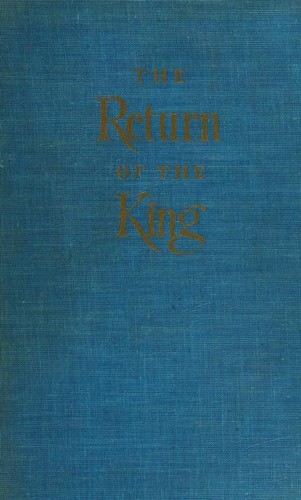
The Return of the King by J.R.R. Tolkien is a 1955 fantasy book about sacrifice and loss, the cost of victory, eucatastrophe and sudden hope. Eucatastrophe — Tolkien's coined term for the sudden, unexpected turn from certain loss to joy — describes the moment the Ring is destroyed: not through heroism, but through the mercy Frodo showed Gollum in allowing him to live.
Summary
The Return of the King concludes The Lord of the Rings in two distinct phases. The first three books follow the war across Middle-earth: Pippin's service to Gondor, the siege of Minas Tirith, the Battle of the Pelennor Fields, Aragorn's use of the Paths of the Dead, and the final desperate march to the Black Gate to distract Sauron while Frodo completes the real task in Mordor. The last two books follow Frodo and Sam's agonizing final miles to Mount Doom — and then, after the destruction of the Ring, the long aftermath.
The book's most structurally unusual section is also its most important: the Scouring of the Shire. After the Ring is destroyed and Aragorn crowned, the hobbits return home to find it occupied and ruined by Saruman's men. They have to fight to reclaim it, and they do so with the skills and confidence they've accumulated across three volumes. The point is both personal — this is the hobbits' final exam — and elegiac. The Shire is changed by their absence, and their home is not what it was. Tolkien refuses to give his heroes a clean homecoming.
The appendices run to over a hundred pages of history, genealogy, calendars, and language. For many readers they are the most important part of the book — the proof of the world's reality behind the story. Others have never read them. Both responses are valid; they are optional enrichment, not required material.
The Return of the King is widely considered the most emotionally powerful volume in the trilogy. The final pages, where the Ring-bearers sail to the Undying Lands and Sam returns to a home that is still changed despite the Scouring, carry a sadness that has remained unsurpassed in the fantasy genre. The word Tolkien used for the narrative structure — eucatastrophe, a sudden turn from despair to joy — describes not just the plot but the emotional experience of reading it.
Talk to The Return of the King like its author wrote you back.
Get the ideas that fit your life — not generic summaries.
- Chat with the book
- Audiobook-style main ideas
- Adapts to your life and goals
- Helps you take action
Key takeaways
- 1.
Eucatastrophe — Tolkien's coined term for the sudden, unexpected turn from certain loss to joy — describes the moment the Ring is destroyed: not through heroism, but through the mercy Frodo showed Gollum in allowing him to live.
- 2.
The Scouring of the Shire refuses the clean happy ending. Victory over Sauron doesn't restore the hobbits' home; they have to fight for it again, and some of what was lost stays lost.
- 3.
Éowyn's killing of the Witch-king — 'I am no man' — is the trilogy's most celebrated single moment: it works as a plot twist, as character revelation, and as commentary on the limits of prophesied restriction.
- 4.
Frodo fails at the Crack of Doom. He is unable to destroy the Ring when the moment comes. The Ring is destroyed anyway, through Gollum, through Bilbo's pity decades earlier — the moral is about which acts matter in the long run.
- 5.
The Grey Havens is the trilogy's most powerful passage. Frodo's departure is treated with the sorrow of death, because for Sam it essentially is one: the person he knew is gone to a place Sam cannot follow yet.
- 6.
Sam's final line — 'Well, I'm back' — is one of the most perfectly calibrated endings in English literature: domestic, understated, and carrying the weight of everything that came before.
- 7.
Aragorn's coronation is handled quickly by Tolkien, who is far more interested in what happens afterward: the restored relationships, the changed Shire, the departures. The triumph is the frame, not the content.
- 8.
The destruction of the One Ring means the fading of the Three Elven Rings and the end of elven influence in Middle-earth. The victory comes at the price of beauty — Tolkien is explicit about this exchange.
Discussion questions
Use these on your own, with a book club, or as chat starters in Superbook. Book club version, ready to copy or print →
- 1.
Frodo cannot destroy the Ring at the final moment. Sam can't either. Does that failure change how you read the entire trilogy — what it says about heroism and the limits of will?
- 2.
The eucatastrophe depends on Bilbo having shown Gollum mercy decades earlier. Tolkien structures the whole trilogy around an act of pity as the ultimate causal factor. Is that a satisfying moral architecture?
- 3.
The Scouring of the Shire is sometimes cut from film and adaptation. What does its inclusion add to the story? What would be lost without it?
- 4.
Éowyn disguises herself as a man to fight, violates direct orders from Theoden, and kills the Witch-king. The book treats her as a hero. Does it fully reckon with the complexity of her situation, or does it just celebrate the outcome?
- 5.
Aragorn's claim to the throne is partly magical and partly hereditary. He demonstrates his fitness through the Paths of the Dead and through healing in the Houses of Healing. Do those demonstrations satisfy you as arguments for his fitness to rule?
- 6.
The Grey Havens ending is deliberately bittersweet. Frodo's departure is presented as necessary for his healing, but Sam is left behind. Do you read the ending as happy, sad, or something more complicated?
- 7.
Tolkien famously disliked allegory. But The Return of the King contains what reads like clear commentary on industrialization (the ruined Shire), propaganda (Saruman's voice), and political legitimacy. Is he being consistent in rejecting allegorical readings?
- 8.
Sam is elected Mayor of the Shire seven times in the appendices and lives a long, full life. Frodo leaves for the Undying Lands wounded and diminished. Is the novel more Sam's story or Frodo's?
- 9.
The appendices give Aragorn and Arwen a full narrative that is barely present in the main text — including Aragorn's death and Arwen's grief. Does the novel shortchange their relationship, or is restraint appropriate?
- 10.
Several characters who sacrifice significantly — Éowyn, Merry, Pippin — receive satisfying conclusions. Frodo does not, exactly. What does the novel say about the price some people pay that cannot be repaid?
- 11.
The Return of the King was published in 1955, a decade after World War II. How much does that context affect your reading? Do Tolkien's losses — the friends killed in the Battle of the Somme — feel present in the text?
- 12.
If you've read the full trilogy: does the ending feel like the right one? Would you change anything about how Tolkien resolved the fates of the characters you cared about most?
Themes
Frequently asked questions
-
Does The Return of the King have a happy ending?
Yes and no. Sauron is defeated, Aragorn is crowned, the Shire is restored. But Frodo is permanently wounded, can't stay in the Shire, and sails West. Tolkien called this eucatastrophe — sudden joy that doesn't erase loss. The ending is earned and bittersweet rather than triumphant.
-
What is the Scouring of the Shire?
A final chapter where the hobbits return home to find the Shire occupied by Saruman's ruffians and industrialized against its nature. They have to fight to reclaim it. Many film adaptations cut it; Tolkien considered it essential to show the hobbits' growth and to deny the reader an easy homecoming.
-
Are the appendices worth reading?
Depends entirely on your interest in world-building. They contain the complete chronology of Middle-earth history, the Aragorn-Arwen story in full, and detailed notes on languages and calendars. Tolkien fans typically love them; casual readers can safely skip them without losing the main story.
-
How do the Jackson films compare to this volume?
The films are excellent on the battle sequences and largely faithful to the major plot beats, but they cut the Scouring of the Shire entirely and compress the emotional texture of the ending. The Grey Havens sequence is more affecting in the book.
-
Who shouldn't read The Return of the King?
If you got to this volume and still find Tolkien's pacing frustrating, the opening books move no faster. The Paths of the Dead and the siege of Minas Tirith are more kinetic than much of the earlier material, but the book also contains the slow, elegiac aftermath. If you've made it this far, you already know if you're the right reader.