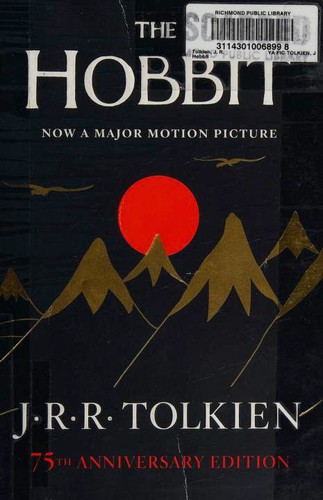
The Hobbit by J.R.R. Tolkien is a 1937 fantasy book about reluctant heroism, greed and dragon-sickness, home and adventure. Bilbo's growth as a character is the book's moral center: he begins as someone who values comfort above all and ends as someone capable of courage, generosity, and sacrifice, without losing his love of home.
Summary
Bilbo Baggins is a thoroughly respectable hobbit who has no interest in adventures, danger, or anything that might interfere with his meals. When the wizard Gandalf and thirteen dwarves arrive at his door and recruit him as their "burglar" for an expedition to reclaim the dwarves' stolen mountain kingdom from the dragon Smaug, Bilbo goes — partly because Gandalf has vouched for him and partly because something unexpected stirs in him. The journey takes him through encounters with trolls, goblins, wood-elves, giant spiders, and a creature called Gollum who owns a very unusual ring.
The Hobbit is a lighter, younger story than The Lord of the Rings, written as a bedtime story and narrated in a voice that addresses the reader directly and reassures them that things will be all right. But it is also where the Ring enters the story, where Bilbo's character is established, and where the geography and peoples of Middle-earth are first described. The relationship between the two books is something like the relationship between a children's fairy tale and the larger mythology it spawned — The Hobbit is the accessible entry point, The Lord of the Rings is where those seeds grow into something more complicated.
Tolkien's dwarves are vivid characters individually, and Thorin Oakenshield is a genuinely interesting study in how the desire to reclaim what was lost can corrupt the judgment of an otherwise admirable leader. The book's darkest section — the Battle of Five Armies, the death of Smaug, and the prolonged standoff over the dragon's hoard — explores how quickly the discovery of treasure converts allies into adversaries. "Dragon-sickness," as Tolkien calls it, is one of the book's most resonant concepts.
The Hobbit is appropriate for children who are comfortable with sustained narrative and light violence, but it works equally well for adults reading it for the first time or re-reading it as context for The Lord of the Rings. It is shorter, funnier, and kinder than its sequel, and it has a specific quality of coziness in its adventure that the larger trilogy deliberately sacrifices. Bilbo's return to Bag-End at the end is one of Tolkien's most satisfying pages.
Talk to The Hobbit like its author wrote you back.
Get the ideas that fit your life — not generic summaries.
- Chat with the book
- Audiobook-style main ideas
- Adapts to your life and goals
- Helps you take action
Key takeaways
- 1.
Bilbo's growth as a character is the book's moral center: he begins as someone who values comfort above all and ends as someone capable of courage, generosity, and sacrifice, without losing his love of home.
- 2.
Dragon-sickness — the irrational hoarding behavior that possession of great treasure produces — affects Thorin and changes him from a proud leader into something frightening. It's the book's sharpest piece of psychology.
- 3.
Gollum's riddle contest with Bilbo is the chapter that connects directly to The Lord of the Rings; it's also one of Tolkien's best set-pieces, genuinely tense and with an ambiguous moral resolution.
- 4.
Bilbo uses the Ring to escape danger repeatedly but is fully established as the Ring's master in this book — not corrupted, not possessive in the destructive sense. The corruption comes later, and the contrast matters.
- 5.
The dwarves are simultaneously sympathetic — their home was stolen, their people scattered — and difficult, because their culture prizes gold and status in ways that lead them toward bad decisions.
- 6.
Gandalf is deliberately enigmatic about his reasons for selecting Bilbo. The implication, revisited in The Lord of the Rings, is that he saw something the hobbit himself did not see.
- 7.
The Battle of Five Armies is treated almost in summary — Bilbo is knocked unconscious and misses most of it. Tolkien's point seems to be that heroism is not always about being present for the decisive moment.
- 8.
The book's ending is explicitly domestic: Bilbo returns to find his belongings being auctioned off, his reputation damaged, and his neighbors skeptical of his story. The adventure does not make him respectable; it makes him interesting, which is better.
Discussion questions
Use these on your own, with a book club, or as chat starters in Superbook. Book club version, ready to copy or print →
- 1.
Bilbo is selected as the expedition's burglar by Gandalf, over the dwarves' objections, for reasons that aren't entirely clear. By the end of the book, is the selection vindicated, and in what way?
- 2.
Thorin's dragon-sickness — the sudden possessiveness and irrationality that overcomes him when he reclaims his treasure — is described as an almost physical transformation. Does the novel explain it adequately, or does it need more psychological grounding?
- 3.
Bilbo steals the Arkenstone from Thorin and gives it to Bard and the elves as a bargaining chip. Is that the right thing to do? Does the novel clearly endorse it?
- 4.
Gollum's riddle contest operates under rules that Bilbo arguably breaks. The book treats Bilbo's winning as legitimate. Do you agree, and what does that say about how the book views cleverness versus fair play?
- 5.
The dwarves treat Bilbo as a servant and specialist for most of the journey, and he saves them repeatedly. At what point, if any, do they fully accept him as an equal?
- 6.
Smaug's conversation with Bilbo is the novel's most surprising chapter — the dragon is intelligent, vain, and genuinely dangerous precisely because he can reason. What does the scene add to the book that a dumber dragon couldn't?
- 7.
The Hobbit is narrated in a voice that speaks to the reader directly and maintains a tone of gentle reassurance. Does that narrative voice limit the book, or is it exactly right for what it is?
- 8.
Bilbo uses the Ring mostly to avoid being killed. He is never shown resisting its pull or being harmed by it. Does that make his later willingness to give it up in The Lord of the Rings more impressive, or does it make the Ring's power seem inconsistent?
- 9.
The eagles arrive at the Battle of Five Armies to tip the outcome, as they do repeatedly in Tolkien. Is that a satisfying narrative device, or does it undercut the stakes by creating a pattern of deus ex machina?
- 10.
The Hobbit was written as a children's book and The Lord of the Rings as an adult one. Does it feel like a children's book to you? What specifically marks the difference in tone and intent?
- 11.
Bilbo returns home to find his reputation damaged and his neighbors presuming him dead. He is permanently changed by the adventure but cannot fully share it. Is that a sad ending or a satisfying one?
Themes
Frequently asked questions
-
Is The Hobbit a children's book?
It was written as one and reads like one — the narrative voice is gentler, the violence is minimized, and the tone is broadly reassuring. But it works for adults who haven't read it, especially as an introduction to Middle-earth. The Lord of the Rings is the adult version of the same world.
-
Do I need to read The Hobbit before The Lord of the Rings?
Not strictly required. The Lord of the Rings provides necessary backstory. But The Hobbit introduces Bilbo, the Ring, and several characters and settings that The Lord of the Rings refers back to, and starting here is the natural order. Most readers who bounced off The Fellowship of the Ring's opening chapters wish they'd started with The Hobbit.
-
How does the book compare to the Peter Jackson trilogy?
The three films (2012–2014) expand a single 300-page novel into nine hours of screen time by adding material from Tolkien's appendices and inventing new characters and subplots. The book is tighter, funnier, and significantly more modest in scale. Both are worth experiencing, but they're telling different stories.
-
Is The Hobbit as serious as The Lord of the Rings?
No, and deliberately so. It's lighter, more whimsical, and less interested in tragedy. The Battle of Five Armies and Thorin's death introduce genuine grief near the end, but the book maintains its tone of gentle adventure throughout. Readers expecting the weight of The Lord of the Rings will find it conspicuously absent.
-
What age is The Hobbit appropriate for?
Children who can read chapter books comfortably — roughly ages 8 and up — handle The Hobbit well. The vocabulary is challenging in places but not overwhelming. The violence is present but restrained. The emotional sophistication is accessible without being simplistic.