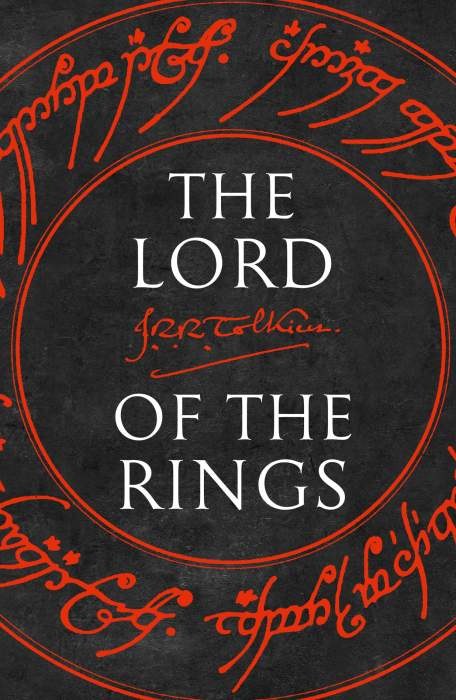
The Fellowship of the Ring by J.R.R. Tolkien is a 1954 fantasy book about temptation and power, fellowship and loyalty, the weight of small lives. The Ring tempts through each character's specific virtue: Boromir's protectiveness, Gandalf's wisdom, Galadriel's benevolence. The corruption comes precisely from the desire to do good with great power.
Summary
The Fellowship of the Ring is the first volume of The Lord of the Rings, following Frodo Baggins from the safety of the Shire into a world of accelerating danger. After his uncle Bilbo passes on the One Ring — a device of immense power forged by the Dark Lord Sauron — Frodo learns from the wizard Gandalf that the Ring must be destroyed in the fires of Mount Doom before Sauron can reclaim it and conquer all of Middle-earth. The book follows Frodo and his companions through the Shire, the Prancing Pony inn at Bree, Rivendell, the mines of Moria, and the forest of Lothlórien, ending with the breaking of the Fellowship itself as the company scatters.
The book is about the weight that ordinary people carry when they are drawn into events larger than themselves. Tolkien's hobbits — comfortable, unheroic, suspicious of adventure — are the lens through which Middle-earth is seen, and that choice is deliberate: the story's emotional claim is that smallness and decency have their own form of courage, one that great warriors and sorcerers cannot provide. The Ring's specific danger is that it amplifies the desire for power in the user; the characters who are most at risk are precisely the most capable and noble, not the weak.
Tolkien invented the template for secondary-world fantasy fiction. The languages, the appendices, the cosmology, the deep history — all of it was real to him before the story began. The effect on the prose is that Middle-earth feels like a place that existed before the narrative and will continue after it. The writing is uneven — some passages are mythically beautiful, some are tedious to anyone without patience for linguistic elvish poetry — but the world itself is the achievement. Almost every fantasy novel written since 1954 is in some way a response to what Tolkien built here.
The Fellowship of the Ring rewards patience and punishes impatience. The first hundred pages, set entirely in the Shire, are deliberately slow. The mythology can feel impenetrable. But readers who give the book what it requires discover something that has not been replicated: a secondary world that feels genuinely ancient, in which good and evil are metaphysically real without being simple, and in which the stakes are cosmological without losing their human scale.
Talk to The Fellowship of the Ring like its author wrote you back.
Get the ideas that fit your life — not generic summaries.
- Chat with the book
- Audiobook-style main ideas
- Adapts to your life and goals
- Helps you take action
Key takeaways
- 1.
The Ring tempts through each character's specific virtue: Boromir's protectiveness, Gandalf's wisdom, Galadriel's benevolence. The corruption comes precisely from the desire to do good with great power.
- 2.
Tolkien's hobbits are the moral center of the story not despite their smallness but because of it — their lack of ambition is what makes them the only safe bearers of the Ring.
- 3.
The world feels lived-in because it was: Tolkien had developed the languages, histories, and geographies of Middle-earth for decades before writing The Lord of the Rings. The novel is the surface of something much larger.
- 4.
The Council of Elrond chapter is Tolkien's most impressive piece of sustained narrative architecture — an enormous amount of backstory is delivered dramatically, through disagreement, rather than as exposition.
- 5.
Gandalf's apparent death in Moria is the book's emotional fulcrum. His instruction to 'fly, you fools' is one of the most quoted lines in fantasy fiction and functions as a small, desperate heroism.
- 6.
The breaking of the Fellowship is not a failure — it is the necessary shape of the story. The quest is too heavy for any one group; the story splits because the threat has multiple dimensions.
- 7.
Evil in the book is not irrational. Sauron, Saruman, and the Nazgûl all have coherent motivations; what makes them evil is the specific corruption of their capacity for good into something totalizing and controlling.
- 8.
Tolkien wrote the book partly as an elegy for a world already lost — the mythological England he felt his country lacked. The pervasive sadness about beautiful things passing is present from the first pages.
Discussion questions
Use these on your own, with a book club, or as chat starters in Superbook. Book club version, ready to copy or print →
- 1.
Tolkien's Ring is dangerous specifically because it amplifies the desire to do good. Boromir wants it to save his people; Gandalf refuses it because he knows he would use it well. Is that a coherent theory of how power corrupts?
- 2.
The hobbits' virtue is their ordinariness — their love of comfort and food and the familiar. Is the book romanticizing ordinary life, or is it actually making an argument about what kind of courage matters most?
- 3.
Tolkien was a devout Catholic, and the book's moral framework has roots in Christian theology. How visible is that framework? Does it require Christian belief to work, or does it function independently?
- 4.
The Council of Elrond gives the Ring's history through argument and testimony rather than straight narration. Is that an effective way to deliver backstory, or does it feel like an information dump with dramatic framing?
- 5.
The Shire chapters at the beginning are deliberately paced slowly. What does that slowness do for the rest of the book? Could the story begin at a faster pace and still work?
- 6.
Galadriel's temptation scene — where she is offered the Ring and refuses it — is one of the book's most intense passages. What does her vision of what she would become tell you about what she actually is?
- 7.
The Fellowship breaks because Boromir's attempt to take the Ring drives Frodo to act alone. Is Boromir a villain, a tragic figure, or something the book doesn't have a category for?
- 8.
Middle-earth is populated by elves who are fading and going West, a world that is literally losing its magic. Why does Tolkien make his world elegiac? What does that mood do to the story?
- 9.
Tolkien was criticized by some contemporaries (C.S. Lewis's circle included) for writing fantasy that lacked allegory. Is The Lord of the Rings allegorical? If not, what is it doing with its moral architecture?
- 10.
The appendices to the full novel run to nearly a hundred pages of history, genealogy, and language. Does knowing that material is there change how you read the main text?
- 11.
Almost every fantasy written after 1954 is responding to Tolkien — either emulating him or reacting against him. What specific elements of this book became the genre's defaults, and which are specifically Tolkienian?
- 12.
The women in The Fellowship of the Ring — Arwen, Galadriel, Goldberry — are powerful but distant. Does their limited presence diminish the book, or is it consistent with its mythological register?
Themes
Frequently asked questions
-
Is The Fellowship of the Ring accessible to first-time Tolkien readers?
Yes, but it requires patience. The opening section in the Shire moves slowly by design. Give it a hundred pages. The world-building pays off once the characters leave home, and the prose acquires real momentum in the second half.
-
Do I need to read The Hobbit first?
It helps. The Hobbit introduces the Ring, Bilbo, and several key characters and locations. The Lord of the Rings refers back to it frequently. That said, many readers have read The Fellowship of the Ring first without feeling lost — necessary context is provided, if sometimes obliquely.
-
Why does The Lord of the Rings have so much singing and poetry?
Tolkien was a philologist who loved language as sound and rhythm, and his characters — especially elves and hobbits — express themselves through song in ways their cultures require. Some readers love it; many skip those sections. Skipping them doesn't break the narrative.
-
How does the book compare to the Peter Jackson films?
The films are an excellent adaptation of the plot but necessarily compress, cut, and alter tone. The book is slower, more elegiac, and substantially more interested in language and world-building than any film can be. They're different experiences; both are worth having.
-
Who shouldn't read The Fellowship of the Ring?
Readers who want fast-paced action from page one, who have no patience for extended world-building and description, or who find high fantasy conventions alienating will struggle. The book demands time and a willingness to live in the world it builds. That is either the point or a dealbreaker.