Psychology · Book club
The Righteous Mind: Why Good People Are Divided by Politics and Religion book club questions
Here are 12 book club questions for The Righteous Mind: Why Good People Are Divided by Politics and Religion by Jonathan Haidt, ordered to open easily and end somewhere worth arguing about. Copy them, print them, or bring them up one at a time.
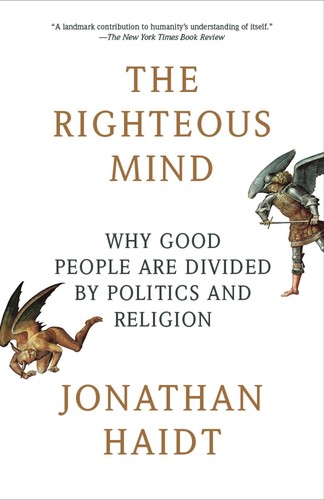
The Righteous Mind is Jonathan Haidt's argument that moral reasoning is not the source of our moral judgments — it's the press secretary for them.
Jonathan Haidt · 2012 · 7h 15m
Full summary and key takeaways →The 12 questions
- 1.
Haidt claims that moral reasoning usually follows moral intuition rather than leading it. Can you think of a time when careful reasoning actually changed your moral view, rather than just reinforcing it?
- 2.
Which of the six moral foundations — Care, Fairness, Loyalty, Authority, Sanctity, Liberty — do you find most compelling? Which feels least like a genuine moral concern to you, and why?
- 3.
If your political views are primarily grounded in two or three foundations, what would it take to genuinely hear the moral concerns of someone drawing on different ones?
- 4.
Haidt describes 'moral dumbfounding' — the experience of holding a strong moral conviction you cannot rationally justify. What examples come to mind from your own moral beliefs?
- 5.
The rider-and-elephant model implies that most of what we call moral argument is rationalization after the fact. Does that feel accurate in your own experience? What are the implications for how we argue?
- 6.
Haidt argues that religion evolved to bind communities, not to explain the world. Does that functional account change how you think about religious practice — your own or others'?
- 7.
Do you think political polarization in your country reflects genuine moral disagreement, or something else — like media incentives, economic anxiety, or identity performance?
- 8.
Haidt suggests that exposing yourself to the best version of the other side's moral argument is more useful than arguing with its worst version. What is the strongest version of a moral position you usually oppose?
- 9.
The book argues that group selection shaped human psychology for tribalism. Does knowing this make tribalism feel more forgivable, or does it make it more urgent to counteract?
- 10.
Haidt is more diagnostic than prescriptive. After reading his account, do you feel more or less hopeful about productive disagreement across political lines? What changed?
- 11.
Cross-cutting relationships — friendships with people who hold opposing moral frameworks — are described as one of the few reliable moderating forces. How many of those do you actually have?
- 12.
Haidt's model suggests that moral outrage often functions as in-group signaling rather than genuine ethical engagement. Can you think of a recent example — public or personal — that fits that pattern?
How to run the discussion
- Pick six to eight, not all of them. An hour of real discussion covers fewer questions than anyone expects, and racing the list is what makes a book club feel like homework.
- Open with what people noticed, not what they concluded. Asking for a verdict first hardens opinions before anyone has heard each other.
- Let the disagreement run. The questions below that split a room are the ones worth the time; the ones everyone answers the same way can be skipped.
- Ask the quiet person a specific question. A direct, narrow question is far easier to answer than an open invitation to contribute.
Themes worth steering toward
If the conversation stalls, these are the threads that usually restart it.
Common questions
What are good book club questions for The Righteous Mind: Why Good People Are Divided by Politics and Religion?
Here are 12 book club questions for The Righteous Mind: Why Good People Are Divided by Politics and Religion by Jonathan Haidt, ordered to open easily and end somewhere worth arguing about. The strongest openers ask what each reader noticed rather than what they concluded, and the discussion usually turns on moral psychology, political polarization, intuition.
How long should a book club discussion of The Righteous Mind: Why Good People Are Divided by Politics and Religion last?
Most groups run 60 to 90 minutes of actual discussion. That is roughly six to eight questions, not all of them, so pick the ones that suit your group rather than working down the list in order.
What are the main themes in The Righteous Mind: Why Good People Are Divided by Politics and Religion?
Moral psychology, Political polarization, Intuition, Religion and community, Tribalism. Those are the threads most likely to divide a room, which makes them the useful places to steer a discussion that has gone quiet.
Picking the next one? See books like The Righteous Mind: Why Good People Are Divided by Politics and Religion or questions for other book club picks.
