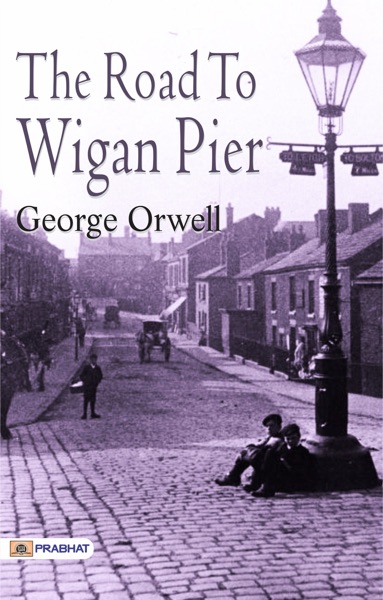
The Road to Wigan Pier by George Orwell is a 1937 history book about working class, poverty, class consciousness. The physical conditions of industrial poverty in 1930s Britain were not merely uncomfortable but structurally incompatible with the comfort and cleanliness that middle-class commentators assumed were within reach of 'effort.'
Summary
The Road to Wigan Pier is George Orwell's two-part investigation into industrial poverty in the north of England and a confessional essay on the failures of the British left to connect with the working class it claimed to represent. Published in 1937 by the Left Book Club — which added a distancing preface by Victor Gollancz — the book remains one of the most honest documents produced by a middle-class intellectual confronting the limits of his own political sympathies.
The first part is reportage. Orwell spent weeks in the mining districts of Yorkshire and Lancashire in early 1936, living in lodging houses, visiting homes, and descending into working coal mines. His descriptions of the physical environment are precise and unsparing: the back-to-back housing with no hot water or indoor toilets, the diet of white bread and margarine, the miner's body shaped by decades of work in seams too low to stand in. The centerpiece is a long passage describing the experience of actually getting to and from the coalface — a walk of several miles underground, often at a near-crouch, before the working shift begins. Most readers have never thought about coal in those terms.
The second part is more controversial and was the source of Gollancz's discomfort. Orwell turns on the socialist movement itself, arguing that it attracts cranks, vegetarians, sandal-wearers, and people who smell of the library rather than the factory, and that working people can smell the condescension from a distance. He argues that socialism has identified itself with modernity, centralization, and the machine in ways that repel the natural conservatism of the working class. His own position — pro-working class, skeptical of socialists — is deliberately unstable and self-aware.
The tone throughout is that of a man who will not look away and will not pretend to conclusions he hasn't earned. Orwell is not a sociologist; the observations are impressionistic and sometimes generalized. But the intellectual honesty, especially in the second part where he examines his own class prejudices with unusual directness, makes this one of the more valuable political essays of the twentieth century.
Talk to The Road to Wigan Pier like its author wrote you back.
Get the ideas that fit your life — not generic summaries.
- Chat with the book
- Audiobook-style main ideas
- Adapts to your life and goals
- Helps you take action
Key takeaways
- 1.
The physical conditions of industrial poverty in 1930s Britain were not merely uncomfortable but structurally incompatible with the comfort and cleanliness that middle-class commentators assumed were within reach of 'effort.'
- 2.
The work of coal mining, as Orwell experienced it, was physically extraordinary and almost entirely invisible to the people whose lives depended on it. The distance between consumption and production is not accidental.
- 3.
The British working class had a genuine culture — preferences, aesthetics, social structures — that socialist intellectuals failed to respect or understand, and that failure was part of socialism's inability to build a mass movement.
- 4.
Class in Britain was primarily about smell, accent, and manners rather than income. Orwell observed that he himself carried class markers that could not be shed by changing politics.
- 5.
The left's association with vegetarianism, nudism, and progressive fads gave it a countercultural identity that functioned as a class signal, alienating working people who shared its economic interests.
- 6.
Orwell's argument that the machinery of socialist progress — centralization, industrial efficiency, scientific rationalism — was itself aesthetically repellent to many workers anticipates later critiques of technocratic liberalism.
- 7.
Intellectual honesty about one's own class position is rare in political writing. Orwell's willingness to examine his own revulsions — toward the poor, toward fellow socialists — is part of what makes this book different from most political journalism.
- 8.
The gap between stated political solidarity and actual felt solidarity remains one of the structural problems of left politics. Orwell identified it clearly in 1937 and it has not been resolved.
Discussion questions
Use these on your own, with a book club, or as chat starters in Superbook. Book club version, ready to copy or print →
- 1.
Orwell goes underground into a coal mine specifically to see the labor his comfortable life depends on. What labor that supports your own life have you never seen close up?
- 2.
The first part of the book is descriptive; the second is polemical and self-critical. Which did you find more valuable, and does the shift in register change your trust in him as a narrator?
- 3.
Orwell argues that middle-class socialists condescend to the working class even while claiming to represent it. Can you identify analogues to that dynamic in contemporary politics?
- 4.
He describes the working-class culture of the 1930s as having genuine value that progressive ideology failed to take seriously. What aspects of that culture does he portray most sympathetically?
- 5.
Orwell's class identity shaped his perceptions regardless of his political commitments. How much do you think your own class background shapes what you notice and what you miss?
- 6.
The Left Book Club added a preface distancing itself from Orwell's critique. What does that response say about the relationship between political movements and honest internal criticism?
- 7.
Orwell says working people can detect condescension through manner and smell rather than content. Has that observation aged well, or does it romanticize working-class discernment?
- 8.
The book was written in 1937. How much of the class landscape it describes — the markers, the distances, the resentments — persists in a form you recognize today?
- 9.
Orwell is ambivalent about mechanization and industrial progress throughout. Is that ambivalence an intellectual strength or a limitation?
- 10.
The poverty Orwell describes was material and measurable. What contemporary forms of poverty are harder to see from the outside because they don't map onto 1930s categories?
- 11.
Orwell uses himself as a data point repeatedly — his feelings of revulsion, his discomfort, his prejudices. Is that method more or less reliable than attempting to write objectively?
Themes
Frequently asked questions
-
Is The Road to Wigan Pier worth reading?
Yes, particularly the second half where Orwell examines why the political left fails to connect with the class it claims to represent. The first part is vivid reportage, but the self-critical essay that follows is what distinguishes this from ordinary journalism.
-
How long does it take to read?
About six hours at average pace for the roughly 230-page text. The first part, being descriptive, moves faster; the second part's argumentative density slows things down slightly.
-
Is this primarily a book about poverty or about politics?
Both, but they're not equal in Orwell's framing. The poverty documentation is the foundation; the political analysis is the point. Orwell used what he saw to argue something about the British left's fundamental disconnect from its supposed constituency.
-
Why did the Left Book Club publisher object to the book?
Victor Gollancz objected to the second part's withering critique of the socialist movement — its cultural oddness, its intellectual condescension, its alienation from working-class values. He published the book but added a preface distancing himself from the argument.
-
How does this compare to Orwell's other nonfiction?
It sits alongside Homage to Catalonia and Down and Out in Paris and London as the core of his nonfiction. The Road to Wigan Pier is more polemical than the others and more directly political. Readers who respond to his self-examination in this book often find Homage to Catalonia the natural next read.
Similar books
A People's History of the United States
Howard Zinn

Evicted: Poverty and Profit in the American City
Matthew Desmond

Hillbilly Elegy: A Memoir of a Family and Culture in Crisis
J. D. Vance

Strangers in Their Own Land: Anger and Mourning on the American Right
Arlie Russell Hochschild
