History · Book club
The Science of Conjecture book club questions
Here are 12 book club questions for The Science of Conjecture by James Franklin, ordered to open easily and end somewhere worth arguing about. Copy them, print them, or bring them up one at a time.
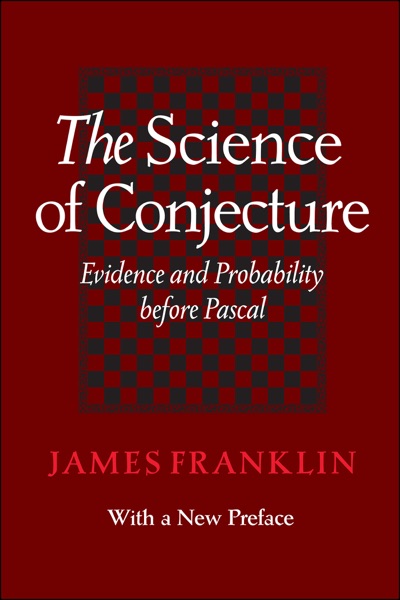
The Science of Conjecture is James Franklin's history of probable reasoning from classical antiquity through the seventeenth century, the period traditionally treated as the starting point for mathematical probability.
James Franklin · 2001 · 8h 45m
Full summary and key takeaways →The 12 questions
- 1.
Franklin argues that mathematical probability formalized reasoning that had existed for centuries. Does knowing this history change how you think about the relationship between formal and informal reasoning?
- 2.
Roman law's concepts of 'half-proof' and 'violent presumption' were practical tools for courts. How do contemporary legal standards of evidence — beyond reasonable doubt, balance of probabilities — relate to these older concepts?
- 3.
Medieval casuistry asked when a person is morally permitted to act on an uncertain belief. Is that a question philosophy takes seriously enough today?
- 4.
The book argues that focusing on mathematical probability has caused us to miss a rich tradition of qualitative reasoning about evidence. Does the standard history of science have a systematic bias toward quantitative methods?
- 5.
Insurance markets required actuarial reasoning before probability theory existed. What does that suggest about the relationship between formal theory and practical innovation?
- 6.
Franklin covers law, theology, commerce, and science as parallel traditions of probable reasoning. Which of these fields do you think has developed the most sophisticated tools for reasoning under uncertainty?
- 7.
The history of probability is often told as intellectual heroism — Pascal's wager, the problem of points. Does Franklin's longer view change the cast of characters who deserve credit?
- 8.
Casuistry fell into disrepute as a word after Jesuit confessors were accused of using it to rationalize anything. Is that reputation deserved, or is it a smear of a legitimate practice?
- 9.
Franklin is an Australian mathematician and philosopher, and the book does not have an easy genre. How does work that falls between disciplines — history, philosophy, mathematics — get read and evaluated?
- 10.
The book covers a period from classical antiquity to the seventeenth century. What would a companion volume covering the eighteenth century to the present look like?
- 11.
Franklin's thesis has implications for how we think about AI systems that reason under uncertainty. If probabilistic reasoning is not just mathematical but also qualitative, what does that say about current approaches?
- 12.
What surprised you most about the pre-mathematical history of probability? Which figure or tradition covered in the book seemed most important to you?
How to run the discussion
- Pick six to eight, not all of them. An hour of real discussion covers fewer questions than anyone expects, and racing the list is what makes a book club feel like homework.
- Open with what people noticed, not what they concluded. Asking for a verdict first hardens opinions before anyone has heard each other.
- Let the disagreement run. The questions below that split a room are the ones worth the time; the ones everyone answers the same way can be skipped.
- Ask the quiet person a specific question. A direct, narrow question is far easier to answer than an open invitation to contribute.
Themes worth steering toward
If the conversation stalls, these are the threads that usually restart it.
Common questions
What are good book club questions for The Science of Conjecture?
Here are 12 book club questions for The Science of Conjecture by James Franklin, ordered to open easily and end somewhere worth arguing about. The strongest openers ask what each reader noticed rather than what they concluded, and the discussion usually turns on probability, reasoning under uncertainty, history of ideas.
How long should a book club discussion of The Science of Conjecture last?
Most groups run 60 to 90 minutes of actual discussion. That is roughly six to eight questions, not all of them, so pick the ones that suit your group rather than working down the list in order.
What are the main themes in The Science of Conjecture?
Probability, Reasoning under uncertainty, History of ideas, Law and evidence, Epistemology. Those are the threads most likely to divide a room, which makes them the useful places to steer a discussion that has gone quiet.
Picking the next one? See books like The Science of Conjecture or questions for other book club picks.
