Psychology · Book club
The Seven Sins of Memory book club questions
Here are 11 book club questions for The Seven Sins of Memory by Daniel Schacter, ordered to open easily and end somewhere worth arguing about. Copy them, print them, or bring them up one at a time.
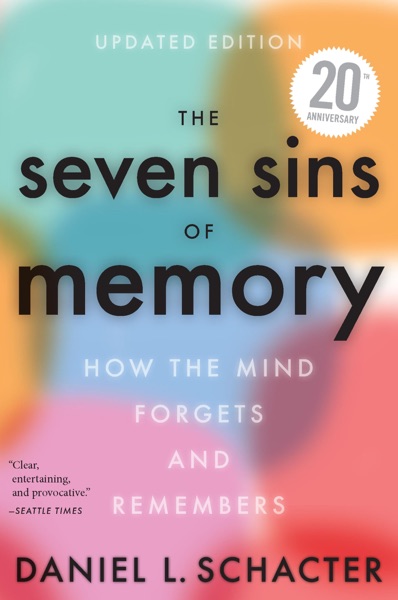
The Seven Sins of Memory is Daniel Schacter's account of the ways human memory routinely fails, organized around a taxonomy he developed to make the failures legible.
Daniel Schacter · 2001 · 4h 40m
Full summary and key takeaways →The 11 questions
- 1.
Schacter argues the seven sins are features, not bugs — byproducts of what makes memory useful. Does reframing failures as adaptive byproducts change how you think about your own memory errors?
- 2.
Absent-mindedness is caused by divided attention at the moment of encoding. What habits in your daily life are most likely to cause you to fail to encode important information?
- 3.
The suggestibility chapter suggests that the way questions are phrased after an event can alter memories of the event. How should this affect how we think about therapy, interrogation, and casual conversation about shared experiences?
- 4.
Misattribution underlies many wrongful convictions. Do you think the criminal justice system has adequately incorporated what cognitive science knows about eyewitness memory? What would need to change?
- 5.
Schacter describes bias as the tendency for memory to conform to current beliefs. Can you think of a belief you currently hold that might be shaping how you remember earlier experiences?
- 6.
Persistence — the involuntary return of unwanted memories — is treated as the seventh sin. What's the evolutionary logic of a mechanism that keeps bringing back painful experiences? Does Schacter's explanation satisfy you?
- 7.
The book was published in 2001. In the decades since, digital recording has made it possible to check memories against objective records. Has that changed how you relate to your own memory?
- 8.
Schacter uses the term 'sins' metaphorically — these aren't moral failures. But does moral language change how people feel about their own memory failures? Does it create shame where there should be just understanding?
- 9.
Blocking — the tip-of-the-tongue state — is described as a competition between similar memories. Have you noticed any patterns in when it happens to you that align with Schacter's explanation?
- 10.
False memory implantation in laboratory settings has been used to argue against recovered memory therapy. How do you evaluate that argument? Does it prove too much, or is the implication unavoidable?
- 11.
If you could reliably eliminate one of the seven sins from your memory, which would it be? What would you gain, and what might you lose?
How to run the discussion
- Pick six to eight, not all of them. An hour of real discussion covers fewer questions than anyone expects, and racing the list is what makes a book club feel like homework.
- Open with what people noticed, not what they concluded. Asking for a verdict first hardens opinions before anyone has heard each other.
- Let the disagreement run. The questions below that split a room are the ones worth the time; the ones everyone answers the same way can be skipped.
- Ask the quiet person a specific question. A direct, narrow question is far easier to answer than an open invitation to contribute.
Themes worth steering toward
If the conversation stalls, these are the threads that usually restart it.
Common questions
What are good book club questions for The Seven Sins of Memory?
Here are 11 book club questions for The Seven Sins of Memory by Daniel Schacter, ordered to open easily and end somewhere worth arguing about. The strongest openers ask what each reader noticed rather than what they concluded, and the discussion usually turns on memory, cognition, neuroscience.
How long should a book club discussion of The Seven Sins of Memory last?
Most groups run 60 to 90 minutes of actual discussion. That is roughly six to eight questions, not all of them, so pick the ones that suit your group rather than working down the list in order.
What are the main themes in The Seven Sins of Memory?
Memory, Cognition, Neuroscience, Human fallibility, False memories. Those are the threads most likely to divide a room, which makes them the useful places to steer a discussion that has gone quiet.
Picking the next one? See books like The Seven Sins of Memory or questions for other book club picks.
