Science · Book club
The Shallows: What the Internet Is Doing to Our Brains book club questions
Here are 12 book club questions for The Shallows: What the Internet Is Doing to Our Brains by Nicholas Carr, ordered to open easily and end somewhere worth arguing about. Copy them, print them, or bring them up one at a time.
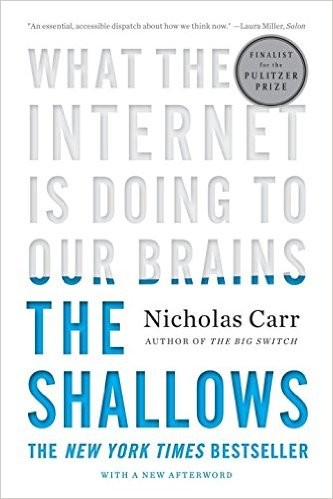
The Shallows is Nicholas Carr's argument that the internet — and the way we habitually use it, skimming hyperlinked text, watching short videos, checking feeds — is reshaping the neural circuits responsible for deep reading and sustained concentration.
Nicholas Carr · 2010 · 6h 0m
Full summary and key takeaways →The 12 questions
- 1.
Carr argues internet habits are physically rewiring your brain. Does that framing change how you think about your phone or computer use?
- 2.
Neuroplasticity applies to all habits, not just internet use. Does it make sense to worry specifically about internet-induced neural change?
- 3.
He argues that deep reading — sustained, linear engagement with long texts — is a specific and valuable cognitive practice. Do you agree? Is there something deep reading provides that other information practices don't?
- 4.
Every generation has worried that the new communication technology will damage cognition — Plato worried about writing, 18th-century critics worried about novels. Is Carr's worry different in kind?
- 5.
The internet gives fast access to vast information at the cost of depth. Is that trade-off obviously bad, or does it depend on what you need the information for?
- 6.
Carr says he noticed his own reading habits changing and this triggered the book's inquiry. Have you noticed similar changes in your own ability to focus?
- 7.
Working memory is limited and context-switching is costly. Does that neuroscience insight change how you think about multitasking?
- 8.
Google's business model depends on people returning frequently with new questions. Does that model create incentives that are systematically bad for deep thinking?
- 9.
The printing press expanded the practice of linear reading. Could the internet equally be creating new kinds of thinking that are valuable but different from what print cultivated?
- 10.
Which technology do you think has most changed your own cognitive habits, and would you give it up if you could?
- 11.
Is the concern about deep reading specifically a concern about class and cultural privilege — the ability to read long books — or a genuine cognitive issue that affects everyone?
- 12.
How does reading The Shallows itself — a long, linear argument — bear on the book's thesis?
How to run the discussion
- Pick six to eight, not all of them. An hour of real discussion covers fewer questions than anyone expects, and racing the list is what makes a book club feel like homework.
- Open with what people noticed, not what they concluded. Asking for a verdict first hardens opinions before anyone has heard each other.
- Let the disagreement run. The questions below that split a room are the ones worth the time; the ones everyone answers the same way can be skipped.
- Ask the quiet person a specific question. A direct, narrow question is far easier to answer than an open invitation to contribute.
Themes worth steering toward
If the conversation stalls, these are the threads that usually restart it.
Common questions
What are good book club questions for The Shallows: What the Internet Is Doing to Our Brains?
Here are 12 book club questions for The Shallows: What the Internet Is Doing to Our Brains by Nicholas Carr, ordered to open easily and end somewhere worth arguing about. The strongest openers ask what each reader noticed rather than what they concluded, and the discussion usually turns on neuroscience, internet, cognition.
How long should a book club discussion of The Shallows: What the Internet Is Doing to Our Brains last?
Most groups run 60 to 90 minutes of actual discussion. That is roughly six to eight questions, not all of them, so pick the ones that suit your group rather than working down the list in order.
What are the main themes in The Shallows: What the Internet Is Doing to Our Brains?
Neuroscience, Internet, Cognition, Technology, Attention. Those are the threads most likely to divide a room, which makes them the useful places to steer a discussion that has gone quiet.
Picking the next one? See books like The Shallows: What the Internet Is Doing to Our Brains or questions for other book club picks.
