The Snowman by Jo Nesbø is a 2007 thriller book about serial violence and pattern, self-destruction, fatherhood and abandonment. Harry's alcoholism is not a quirk or a vice — it is the price his psychology extracts for the intensity that makes him effective, and Nesbø refuses to romanticize either side of that exchange.
Summary
Detective Harry Hole of the Oslo Police is drawn to a series of disappearances connected by one detail: a snowman appears outside each woman's home before she vanishes. Women who leave their families, women with complicated domestic lives — someone has decided they deserve to disappear. Harry, who is himself a self-destructive alcoholic with a fractured relationship to the son who is not biologically his, pursues the case with the specific focus that other cases can't reliably produce in him. The Snowman is Nesbø's most structurally ambitious Harry Hole novel and the one that gave the series its widest international audience.
The book works on two registers simultaneously. On the surface it is a serial killer thriller with an unusually patient predator and a protagonist who barely holds himself together long enough to catch him. Below the surface it is a novel about paternity — biological and chosen, present and absent — and what men who feel they have failed their children will do to escape that knowledge. Harry's relationship to his partner Rakel's son Oleg is the emotional spine of the series, and it is under particular pressure here.
Nesbø writes in the Nordic noir tradition but is less interested than Larsson in institutional critique or social commentary. His subject is individual psychology — specifically the psychology of men who are genuinely good at one thing and genuinely destructive about everything else. Harry is not a broken man who is brilliant despite his damage; he is a man whose damage and brilliance are the same thing. The investigation requires the same intensity that makes him impossible to live with.
This is the seventh Harry Hole novel and works better with the series context than as an entry point, though Nesbø provides enough background to get a newcomer oriented. The plotting is intricate and Nesbø plays fair with the clues. The reveal is genuinely surprising. A 2017 film adaptation starring Michael Fassbender has significant differences from the novel and is widely considered inferior. The book is what to read.
Talk to The Snowman like its author wrote you back.
Get the ideas that fit your life — not generic summaries.
- Chat with the book
- Audiobook-style main ideas
- Adapts to your life and goals
- Helps you take action
Key takeaways
- 1.
Harry's alcoholism is not a quirk or a vice — it is the price his psychology extracts for the intensity that makes him effective, and Nesbø refuses to romanticize either side of that exchange.
- 2.
The killer's selection logic — women who leave or are perceived to have left their families — is the novel's dark mirror to Harry's own history of leaving.
- 3.
Nesbø structures the reveal so that rereaders find the groundwork everywhere; the novel is more impressively plotted after you know the solution than before.
- 4.
Norwegian social silence — the cultural norm against direct confrontation with difficult truths — is both setting detail and thematic material.
- 5.
The snowman as signature is more psychologically rich than most serial killer totems: it is built and then melts, a monument to impermanence and exposure.
- 6.
Oleg's role in the novel forces Harry to examine himself as a father figure, which is the question the novel is ultimately asking: what does a man owe a child he chose but did not make?
- 7.
The series returns repeatedly to the question of whether Harry's gift is worth his cost — to himself, to people who care about him, to cases he abandons when he collapses.
- 8.
Nordic noir tends toward systemic critique; Nesbø is more interested in the individual who carries the system's contradictions inside him.
Discussion questions
Use these on your own, with a book club, or as chat starters in Superbook. Book club version, ready to copy or print →
- 1.
Harry's alcoholism makes him unreliable in his personal life and apparently indispensable in his professional one. Does the novel ask us to evaluate that trade-off, or does it accept it?
- 2.
The killer targets women who left their families. Does the novel maintain enough distance from that logic to interrogate it, or does it risk endorsing the predator's framework?
- 3.
Nesbø's Harry is among the most self-destructive of the great series detectives. Compare him to Bosch, Wallander, or any other detective you've read. What does the self-destruction add to the character?
- 4.
The snowman as a calling card is highly theatrical. Does that theatricality make the killer feel more or less real as a character?
- 5.
Harry's relationship with Oleg is the emotional center of the series, but Oleg is not biologically his. What does the novel seem to argue about chosen versus biological fatherhood?
- 6.
The Norwegian setting — the winters, the social codes, the specific texture of Oslo life — is integral rather than decorative. What does Nordic noir have that other national crime fiction traditions don't?
- 7.
The novel's reveal involves a character we have met and trusted. On reflection, were the clues fair? Did you feel cheated or satisfied?
- 8.
Harry knows he should stop drinking and largely can't. How does Nesbø keep that from becoming either a salvation narrative or a boring repeated failure?
- 9.
The 2017 film was widely considered a bad adaptation. What specifically about this novel do you think would be difficult to translate to screen?
- 10.
If this is your first Harry Hole novel, what would you want to read before or after it? If you've read others: where does this rank?
- 11.
The killer's motive connects to a very specific experience of family abandonment. Does understanding the motive make the violence more or less disturbing?
- 12.
Nesbø is often grouped with Larsson and Mankell as Nordic noir. After reading this, do you think Nordic noir is a coherent category or a marketing label?
Themes
Frequently asked questions
-
Is The Snowman the best Harry Hole book to start with?
Not ideally — it's the seventh in the series and Harry's backstory matters for the emotional weight. The first novel, The Bat, or the widely praised The Redbreast are better entry points. That said, Nesbø provides enough context that The Snowman can be entered cold, and it was the series' breakthrough for many readers.
-
How does the movie compare to the book?
The 2017 film starring Michael Fassbender is considered a significant disappointment by most who read the book first. The director acknowledged that filming was incomplete when released. The novel's intricate plotting and Harry's interior life don't translate well to the cut that was released.
-
Is this book very dark?
Yes — serial violence against women, alcoholism, fractured family life. Nesbø doesn't dwell gratuitously but he doesn't soften either. The darkness is purposeful. Readers who want crime fiction without real menace will find this too heavy.
-
Do I need to read the series in order?
The series benefits from order but each novel is largely self-contained as a mystery. Harry's personal arc — his relationship with Rakel, his alcoholism, his estranged son — is cumulative. Reading in order gives you that arc; starting here gives you a thriller with adequate context.
-
Who shouldn't read The Snowman?
Readers who want a detective who has things together, or who want a mystery that resolves cleanly into restored order. Harry solves the case and is no more functional as a human being than when he started. If that feels like failure rather than honesty, the book will frustrate you.
Similar books
The Girl with the Dragon Tattoo
Stieg Larsson
The Poet
Michael Connelly
In Cold Blood
Truman Capote
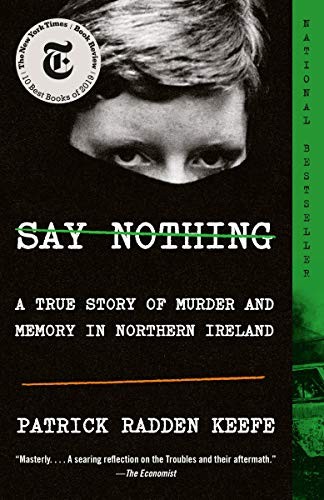
Say Nothing: A True Story of Murder and Memory in Northern Ireland
Patrick Radden Keefe
