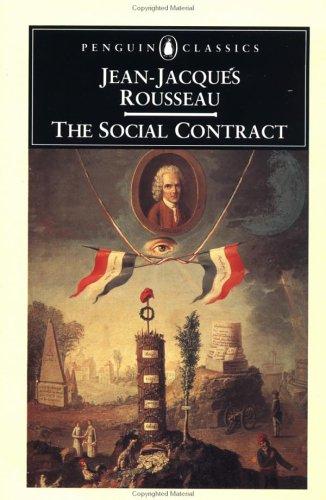
The Social Contract by Jean-Jacques Rousseau is a 1762 philosophy book about political legitimacy, sovereignty, freedom. Political authority is only legitimate when it derives from a genuine social contract among citizens, not from conquest, tradition, or divine right.
Summary
The Social Contract opens with one of philosophy's most famous sentences: "Man is born free, and everywhere he is in chains." Rousseau's 1762 treatise sets out to explain how political authority can be legitimate rather than merely imposed by force. The question was urgent in an age of absolute monarchy, but the answer Rousseau gave would feed into both democratic revolutions and, critics argue, later forms of political totalitarianism.
The central idea is the social contract: a hypothetical agreement through which individuals surrender natural freedom in exchange for civil freedom under a government they have collectively authorized. Crucially, Rousseau argues that genuine sovereignty resides only in the people as a whole, not in any monarch, aristocracy, or representative assembly. The "general will" — the common interest of citizens rather than the sum of private interests — is the only legitimate basis for law. A government that fails to express the general will has lost its legitimacy.
The details of Rousseau's republic are demanding. Citizens must participate actively, not just delegate to representatives. Private interests must be subordinated to the common good. The general will cannot be transferred or represented — which Rousseau takes as a critique of parliamentary systems like England's. He allows for executive governments of various forms (monarchy, aristocracy, democracy), but insists all of them are merely agents of sovereign popular will. When a government usurps sovereignty, the people have the right — and duty — to reclaim it.
Rousseau's influence on the French Revolution was enormous; Robespierre cited him repeatedly. But the text is harder than its reputation suggests. The general will is not the same as majority opinion; Rousseau says a citizen who votes against it may be "forced to be free" — a phrase that has troubled liberal readers ever since. Whether that phrase opens a door to authoritarianism or simply describes the logic of any binding law is a debate that has lasted two and a half centuries and shows no sign of ending.
Talk to The Social Contract like its author wrote you back.
Get the ideas that fit your life — not generic summaries.
- Chat with the book
- Audiobook-style main ideas
- Adapts to your life and goals
- Helps you take action
Key takeaways
- 1.
Political authority is only legitimate when it derives from a genuine social contract among citizens, not from conquest, tradition, or divine right.
- 2.
Sovereignty belongs permanently to the people and cannot be transferred, alienated, or represented. Rousseau uses this to criticize parliamentary government as a form of popular abdication.
- 3.
The 'general will' is not majority preference but the common interest of citizens as citizens — what each person would want if they were thinking about the community rather than themselves alone.
- 4.
Civil freedom, under law that citizens have collectively authorized, is more genuinely free than natural freedom, because it is rational and self-governed rather than subject to appetite.
- 5.
A government (executive power) is always an agent of the sovereign people, never the sovereign itself. When it forgets this, the people have the right to reconstitute it.
- 6.
Rousseau is deeply skeptical of large states and representative government. His ideal polity is small, direct, and participatory — closer to ancient Sparta or Geneva than to modern nation-states.
- 7.
The phrase 'forced to be free' describes Rousseau's logic that a citizen who refuses to obey the law they helped create is contradicting their own will as a member of the sovereign. It remains the most contested sentence in the text.
- 8.
Religion poses a problem for Rousseau's republic: traditional Christianity is other-worldly and divisive, so he proposes a civic religion of minimal shared beliefs to hold the community together.
Discussion questions
Use these on your own, with a book club, or as chat starters in Superbook. Book club version, ready to copy or print →
- 1.
Rousseau says sovereignty cannot be represented. Does that argument apply to any modern democracy you know, or has the problem of scale made it irrelevant?
- 2.
The general will is not the same as the will of the majority. How would you go about identifying what the general will actually is in a diverse society?
- 3.
Rousseau is skeptical of large states. Given that we live in them anyway, what elements of his vision can still be applied locally or institutionally?
- 4.
The phrase 'forced to be free' has been used to defend both democratic citizenship and authoritarian coercion. Where do you think the line is?
- 5.
'Man is born free, and everywhere he is in chains.' Is Rousseau's diagnosis of political chains still accurate? What form do those chains take today?
- 6.
Rousseau distinguishes civil freedom from natural freedom and argues the former is superior. Do you find that argument convincing?
- 7.
How does Rousseau's concept of the general will compare to how we currently think about public interest or the common good in political debate?
- 8.
Rousseau says citizens must participate actively, not merely vote occasionally. What would genuine political participation look like in your own community?
- 9.
The French Revolution invoked Rousseau constantly. Do you think the Terror was a logical consequence of his ideas, or a distortion of them?
- 10.
Rousseau proposes a civic religion to provide social cohesion. Is there an equivalent in modern pluralist democracies, and is that good or dangerous?
- 11.
Which institutions in a contemporary democracy do you think Rousseau would approve of, and which would he reject as illegitimate?
- 12.
How does the social contract framework apply to global problems — climate, trade, migration — that operate beyond the scale of any single nation?
Themes
Frequently asked questions
-
What is The Social Contract mainly arguing?
That political authority is only legitimate when it derives from a genuine agreement among free citizens, and that sovereignty always resides with the people as a whole, never with any government or monarch. The general will — the common interest of the community — is the only valid basis for law.
-
How difficult is The Social Contract to read?
Moderately difficult. The writing is clear by eighteenth-century philosophical standards, but the key concepts — general will, sovereignty, the social contract itself — require careful attention because Rousseau uses them in specific, technical ways that differ from everyday usage.
-
Is The Social Contract the origin of democracy?
It's one important source among several. Rousseau's concept of popular sovereignty deeply influenced the French Revolution. But his vision was actually anti-parliamentary and required small, direct democracies — quite different from modern representative government. Locke and Montesquieu were more direct influences on American constitutional design.
-
What does 'general will' mean?
The common interest of citizens considered as citizens — what each person would want for the community if they set aside purely private interests. It is not the same as majority opinion, and Rousseau insists it is always aimed at the common good, never just the benefit of a faction.
-
Who should read The Social Contract?
Anyone studying political theory, democratic thought, or the intellectual background of the French Revolution. It's also worth reading for anyone who wants to think carefully about what makes government legitimate, and why the question still matters.