Science · Book club
The Tangled Tree: A Radical New History of Life book club questions
Here are 12 book club questions for The Tangled Tree: A Radical New History of Life by David Quammen, ordered to open easily and end somewhere worth arguing about. Copy them, print them, or bring them up one at a time.
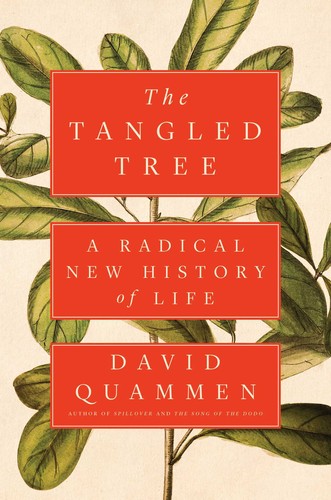
The Tangled Tree is David Quammen's account of how molecular biology overturned the traditional picture of the tree of life — the branching diagram, familiar since Darwin, that represents the evolution of all living things from a common ancestor.
David Quammen · 2018 · 7h 20m
Full summary and key takeaways →The 12 questions
- 1.
Woese spent years being ignored by the mainstream biology community. What does his story suggest about how science should handle heterodox researchers doing genuinely important work?
- 2.
The tree of life is one of biology's most iconic images. How do you feel about replacing it with something messier — a web or a ring? Does it make evolution feel more or less comprehensible?
- 3.
If eight percent of the human genome comes from ancient viral infections, how does that change your intuition about what it means to be human?
- 4.
Horizontal gene transfer is a major mechanism for spreading antibiotic resistance. Does understanding it change how you think about antibiotic use or the antibiotic resistance crisis?
- 5.
Quammen profiles Woese, Doolittle, and Margulis as scientists who were ahead of their fields for years. What do they have in common, and what does their experience suggest about the sociology of science?
- 6.
The book argues that early life on earth was so dominated by horizontal gene transfer that the concept of distinct species barely applies. Does that kind of deep strangeness in biological history interest or destabilize you?
- 7.
Lynn Margulis was also dismissed early in her career. How much of the resistance she and Woese faced do you think was about the science, and how much was about other factors?
- 8.
The book implies that our sense of individual biological identity — your genome is yours — is complicated by acquired DNA. How much does that matter philosophically?
- 9.
Quammen writes narrative science aimed at general readers. What does framing science through individual scientists gain or lose compared to a more conventional textbook approach?
- 10.
If horizontal gene transfer makes species boundaries blurry at the molecular level, does that affect how you think about conservation, biodiversity, or the value of preserving distinct species?
- 11.
Which finding in the book was most surprising to you? Did it change anything about your prior understanding of evolution?
- 12.
Quammen ends with questions rather than a tidy resolution. Is that an honest reflection of scientific uncertainty, or does it leave too much unresolved for a general reader?
How to run the discussion
- Pick six to eight, not all of them. An hour of real discussion covers fewer questions than anyone expects, and racing the list is what makes a book club feel like homework.
- Open with what people noticed, not what they concluded. Asking for a verdict first hardens opinions before anyone has heard each other.
- Let the disagreement run. The questions below that split a room are the ones worth the time; the ones everyone answers the same way can be skipped.
- Ask the quiet person a specific question. A direct, narrow question is far easier to answer than an open invitation to contribute.
Themes worth steering toward
If the conversation stalls, these are the threads that usually restart it.
Common questions
What are good book club questions for The Tangled Tree: A Radical New History of Life?
Here are 12 book club questions for The Tangled Tree: A Radical New History of Life by David Quammen, ordered to open easily and end somewhere worth arguing about. The strongest openers ask what each reader noticed rather than what they concluded, and the discussion usually turns on evolution, molecular biology, tree of life.
How long should a book club discussion of The Tangled Tree: A Radical New History of Life last?
Most groups run 60 to 90 minutes of actual discussion. That is roughly six to eight questions, not all of them, so pick the ones that suit your group rather than working down the list in order.
What are the main themes in The Tangled Tree: A Radical New History of Life?
Evolution, Molecular biology, Tree of life, Horizontal gene transfer, Scientific discovery. Those are the threads most likely to divide a room, which makes them the useful places to steer a discussion that has gone quiet.
Picking the next one? See books like The Tangled Tree: A Radical New History of Life or questions for other book club picks.
