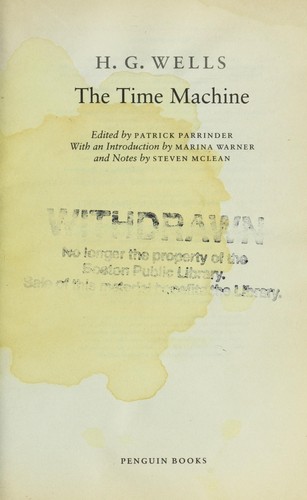
The Time Machine by H. G. Wells is a 1895 science fiction book about class and inequality, evolution and degeneration, progress and its limits. The Eloi-Morlock split is a direct projection of Victorian class structure into evolutionary time — Wells asks what happens when the leisure class and the laboring class diverge for eight hundred millennia.
Summary
H. G. Wells's 1895 novella sends an unnamed Victorian inventor — called only the Time Traveller — eight hundred thousand years into the future, where he discovers that humanity has split into two species: the Eloi, beautiful and idle, living above ground in crumbling palaces; and the Morlocks, pale and simian, who maintain the machinery underground and emerge at night to feed on the Eloi. The discovery upends the Time Traveller's initial assumptions. He arrives expecting progress. He finds devolution.
Wells wrote the book as a class allegory, and the allegory is not subtle. The Eloi are the Victorian leisure class, grown soft and purposeless through generations of ease. The Morlocks are the Victorian working class, driven underground — literally — and transformed by resentment into predators. The Time Traveller's horror at what he finds is the horror of a Victorian progressive realizing where the logic of his own society leads. The novel doesn't argue for socialism directly; it argues that the class division of 1895 is literally monstrous in its implications.
What makes the book more than polemic is Wells's sense of deep time. After the Eloi-Morlock section, the Time Traveller pushes millions of years further forward, to a dying Earth where the sun has cooled and life has retreated to giant crabs on a darkening beach. These final pages are among the bleakest in Victorian fiction — Wells was a trained biologist and Darwinian, and he understood that evolution has no direction, that there is no guarantee of human exceptionalism, and that entropy wins. The Time Traveller brings back two flowers as proof, and that's all.
At a hundred pages, this is a brisk read that rewards attention. It established Wells as a serious writer of scientific romance and influenced almost everything that came after it in the genre. Readers expecting a narrative adventure will find it spare; readers interested in ideas will find it dense. The prose is late-Victorian and formal, but the ideas remain genuinely disturbing.
Talk to The Time Machine like its author wrote you back.
Get the ideas that fit your life — not generic summaries.
- Chat with the book
- Audiobook-style main ideas
- Adapts to your life and goals
- Helps you take action
Key takeaways
- 1.
The Eloi-Morlock split is a direct projection of Victorian class structure into evolutionary time — Wells asks what happens when the leisure class and the laboring class diverge for eight hundred millennia.
- 2.
Progress is not guaranteed. Wells's Darwinian training made him skeptical of Victorian optimism, and the novel's trajectory is explicitly downward.
- 3.
The Time Traveller's sympathy for Weena (an Eloi) complicates the allegory — he's attached to the helpless leisure class even while recognizing its parasitism.
- 4.
The deep-time sections near the end of the book, where Earth is dying and life has retreated to primitive forms, are Wells at his most philosophically serious.
- 5.
Time travel in this novel is not adventure — it's a thought experiment about social and evolutionary consequence.
- 6.
The framing device (the Time Traveller tells his story to a group of dinner guests) creates deliberate distance from the events, making the reader uncertain how much to trust the account.
- 7.
The novel established the template for nearly all subsequent time travel fiction — the machine, the paradox, the altered future — while caring much less about mechanics than about meaning.
Discussion questions
Use these on your own, with a book club, or as chat starters in Superbook. Book club version, ready to copy or print →
- 1.
Wells uses the Eloi and Morlocks as a class allegory for 1895 England. Does the allegory still work, or has capitalism's configuration changed enough to break the parallel?
- 2.
The Time Traveller initially sympathizes with the Eloi and is repelled by the Morlocks — then revises that view. What triggers his revision, and does it change his behavior?
- 3.
Wells was a Fabian socialist. Does knowing that change how you read the novel's politics?
- 4.
The final vision of a dying Earth extends the novel's pessimism into deep time. Is that ending a natural consequence of the novel's argument, or does it feel like a different book grafted on?
- 5.
The Time Traveller brings back flowers as evidence. Why flowers? What does Wells achieve with that specific detail?
- 6.
The framing narrator tells us the Time Traveller has disappeared. The story ends without resolution or return. What effect does that open ending produce?
- 7.
Compare the Eloi-Morlock split to a modern equivalent — gig economy workers and technology consumers, perhaps. Does the allegory translate, or do you need to update it significantly?
- 8.
Wells trained as a biologist and was influenced by T. H. Huxley. How does that background shape the novel's vision of what evolution can do to humans?
- 9.
The Time Traveller forms an emotional attachment to Weena despite knowing she is effectively livestock. What is Wells doing with that attachment?
- 10.
The novel is only a hundred pages. Does its brevity serve the ideas or does it leave too much undeveloped?
- 11.
Science fiction has spent 130 years reworking Wells's premise. Which subsequent time travel story do you think has interrogated his ideas most seriously?
Themes
Frequently asked questions
-
Is The Time Machine worth reading in 2026?
Yes, particularly for its ideas rather than its plot. As narrative it's thin; as thought experiment about class and evolution it remains sharp. It's also a foundational text — you can't fully understand the science fiction genre without it.
-
How long does it take to read?
About two to two and a half hours. It's a novella, roughly a hundred pages. Many readers finish it in a single sitting.
-
Is the class allegory too obvious?
Wells intended it to be obvious — he wasn't writing a subtle literary novel but a political argument in fictional form. Whether that bothers you depends on what you're looking for. The allegory is more interesting when you read it as Wells's warning to his own class rather than as satire of someone else's.
-
Are there film adaptations?
Yes. The 1960 George Pal film is the most celebrated adaptation, with a strong visual imagination for the far-future sequences. A 2002 film with Guy Pearce updates the premise but loses most of the political bite.
-
Who shouldn't read The Time Machine?
Readers expecting a plot-driven adventure with character development and narrative tension will be disappointed. The characters are thinly drawn — Wells cared about ideas, not interiority. If you want science fiction with deep characterization, this is not your entry point.