Psychology · Book club
The Time Paradox book club questions
Here are 12 book club questions for The Time Paradox by Philip Zimbardo and John Boyd, ordered to open easily and end somewhere worth arguing about. Copy them, print them, or bring them up one at a time.
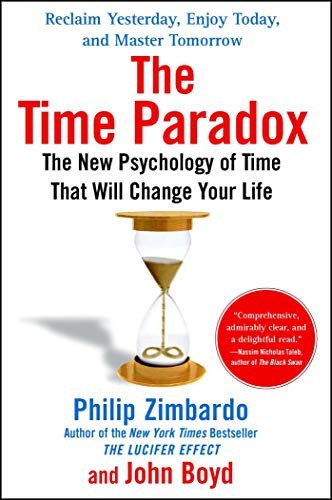
The Time Paradox is built on a single, counterintuitive claim: that the most powerful force shaping your decisions is not your values, your personality, or your intelligence — it's your habitual time perspective.
Philip Zimbardo and John Boyd · 2008 · 6h 0m
Full summary and key takeaways →The 12 questions
- 1.
Take the Zimbardo Time Perspective Inventory mentally. Which time zone dominates your decision-making — past, present, or future? Has it shifted at different stages of your life?
- 2.
Zimbardo argues that future-orientation drives achievement but damages relationships and present enjoyment. Where have you felt that tension personally?
- 3.
Past-negative orientation is linked to depression and resentment. Is there a past experience you return to that still shapes your present behavior more than it should?
- 4.
The book claims culture shapes collective time perspective. Do you recognize a cultural time bias in how your family, workplace, or national culture approaches planning versus enjoying the present?
- 5.
Which relationship in your life suffers most from a time-perspective mismatch — one person planning while the other wants to be present?
- 6.
Zimbardo's 'balanced time perspective' sounds appealing but is hard to define precisely. What would it actually look like in a typical week of your life?
- 7.
Think of a decision you regret. Was the regret caused by over-weighting the present, under-weighting the future, or something else entirely?
- 8.
Present-fatalistic people feel the future is fixed and effort is pointless. Where in your life do you hold that belief, even partially?
- 9.
The book argues that procrastination is often a time-perspective problem, not a laziness problem. Does that reframe how you think about something you've been avoiding?
- 10.
What does your relationship with past-positive memory look like? Do you have rituals for preserving and revisiting good memories, or do they fade quickly?
- 11.
How would you design a day that genuinely integrates all three time orientations — learning from the past, enjoying the present, and building toward the future?
- 12.
Zimbardo uses time-perspective theory to explain social problems like addiction and poverty. Is that framing useful or does it risk excusing structural factors?
How to run the discussion
- Pick six to eight, not all of them. An hour of real discussion covers fewer questions than anyone expects, and racing the list is what makes a book club feel like homework.
- Open with what people noticed, not what they concluded. Asking for a verdict first hardens opinions before anyone has heard each other.
- Let the disagreement run. The questions below that split a room are the ones worth the time; the ones everyone answers the same way can be skipped.
- Ask the quiet person a specific question. A direct, narrow question is far easier to answer than an open invitation to contribute.
Themes worth steering toward
If the conversation stalls, these are the threads that usually restart it.
Common questions
What are good book club questions for The Time Paradox?
Here are 12 book club questions for The Time Paradox by Philip Zimbardo and John Boyd, ordered to open easily and end somewhere worth arguing about. The strongest openers ask what each reader noticed rather than what they concluded, and the discussion usually turns on time perspective, decision-making, behavior.
How long should a book club discussion of The Time Paradox last?
Most groups run 60 to 90 minutes of actual discussion. That is roughly six to eight questions, not all of them, so pick the ones that suit your group rather than working down the list in order.
What are the main themes in The Time Paradox?
Time perspective, Decision-making, Behavior, Psychology, Well-being. Those are the threads most likely to divide a room, which makes them the useful places to steer a discussion that has gone quiet.
Picking the next one? See books like The Time Paradox or questions for other book club picks.
