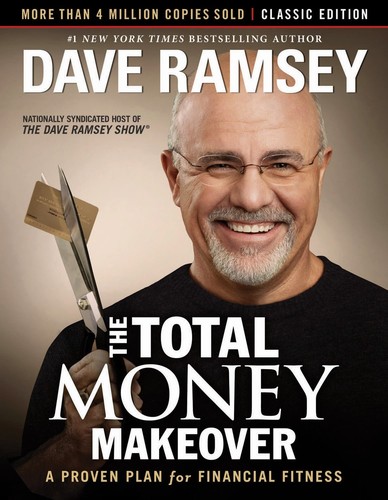
The Total Money Makeover by Dave Ramsey is a 2003 self-help book about debt elimination, budgeting, emergency fund. The seven baby steps provide a sequential path out of debt and toward wealth. The sequence is intentional: don't start step four until step three is complete.
Summary
The Total Money Makeover is Dave Ramsey's step-by-step program for eliminating debt and building wealth, structured around seven sequential "baby steps." Ramsey is a Christian personal finance personality who built his following through a syndicated radio show, and the book reflects his background: the approach is moral as well as financial, framing debt as slavery and personal financial responsibility as a form of integrity. For readers who have significant consumer debt and feel overwhelmed by where to start, the book provides a concrete, actionable sequence that has helped millions of people get out of debt.
The seven baby steps move from building a $1,000 starter emergency fund, to paying off all non-mortgage debt using the "debt snowball" method, to building a fully funded three-to-six month emergency fund, to investing 15 percent of income in retirement, to saving for college, to paying off the mortgage early, and finally to building wealth and giving generously. The sequence is deliberately linear — Ramsey believes most people need a clear, simple path more than they need an optimized one.
The debt snowball is the book's most distinctive contribution and its most debated. Mathematically, you pay off debt fastest by tackling the highest-interest balance first. Ramsey recommends paying off the smallest balance first to generate psychological momentum — the "snowball" builds as each paid-off debt frees cash flow for the next. Financial economists point out this costs money. Ramsey's counter is that the personal finance problem is primarily behavioral, not mathematical, and that momentum and wins matter more than theoretical optimality for people who have failed multiple times to get out of debt.
The prescriptions are strict and sometimes at odds with mainstream financial advice. Ramsey opposes credit cards categorically, advises against investing before debt is paid off (regardless of interest rates), and recommends a debt-free mortgage — positions that create real friction in a system built around credit scores. His approach works best for people with consumer debt, behavioral money problems, and a need for structure. It is less suitable as a universal framework, and readers in good financial shape who are trying to optimize between debt paydown and investing will find his rules too blunt.
Talk to The Total Money Makeover like its author wrote you back.
Get the ideas that fit your life — not generic summaries.
- Chat with the book
- Audiobook-style main ideas
- Adapts to your life and goals
- Helps you take action
Key takeaways
- 1.
The seven baby steps provide a sequential path out of debt and toward wealth. The sequence is intentional: don't start step four until step three is complete.
- 2.
The debt snowball pays off smallest balances first, not highest-interest first. The psychological wins build momentum and sustain the behavior change.
- 3.
A starter emergency fund of $1,000 protects the debt payoff plan from small unexpected expenses without diverting resources from debt elimination.
- 4.
A fully funded emergency fund of three to six months of expenses prevents the financial crises that drive most people back into debt after getting out.
- 5.
Consumer debt — car loans, credit cards, student loans — is the primary barrier to wealth building for most middle-income Americans. Eliminating it changes the math dramatically.
- 6.
Investing 15 percent of gross income in tax-advantaged accounts, once debt is cleared and the emergency fund is built, produces significant wealth over a career.
- 7.
Ramsey argues that behavior is the problem, not knowledge. Most people know they should spend less than they earn; they fail because of emotion, not ignorance.
- 8.
The paid-off mortgage is the final debt elimination goal. Owning a home free and clear before retirement dramatically reduces the income required to sustain a comfortable lifestyle.
Discussion questions
Use these on your own, with a book club, or as chat starters in Superbook. Book club version, ready to copy or print →
- 1.
Ramsey argues the debt snowball works better than the avalanche for most people because behavior is the real problem. Have you ever tried a mathematically optimal approach and failed, then tried a simpler approach that stuck? What made the difference?
- 2.
The seven baby steps are sequential. Ramsey says don't invest until the emergency fund is complete and debt is gone. Do you agree with that rigidity, or does your situation argue for doing things in parallel?
- 3.
Ramsey's approach is specifically designed for people who have made significant money mistakes. Does his framing around debt as a moral and behavioral failure feel motivating or shaming to you?
- 4.
The book recommends not using credit cards at all. Is that practical in the current financial system, or does it create more problems than it solves for people with good self-control?
- 5.
Where are you in the seven baby steps right now? What would reaching the next step actually require you to change?
- 6.
Ramsey's approach explicitly trades mathematical optimization for behavioral simplicity. Do you think that's the right trade for most people, or does it leave too much money on the table?
- 7.
The book is deeply influenced by Ramsey's Christian faith and his personal experience with bankruptcy. Does that context strengthen or weaken the advice for you?
- 8.
What would it feel like to have no consumer debt and a fully funded emergency fund? Have you ever been in that position?
- 9.
The emergency fund recommendation — three to six months of expenses — feels large to many people. What would it take to build that fund in your current situation?
- 10.
Ramsey's radio show stories feature dramatic financial turnarounds. How much of your motivation to change financial behavior comes from inspiring examples, and how much from intellectual conviction?
- 11.
The book opposes investing before debt is paid off, even when interest rates on the debt are low and investment returns are potentially higher. Do you agree with that rule, or is it too blunt?
- 12.
Paying off a mortgage early is Ramsey's final goal. Given current interest rates and opportunity costs, is that still the right goal, or does investing excess cash flow produce better outcomes?
Themes
Frequently asked questions
-
Who is The Total Money Makeover best for?
People who have significant consumer debt, feel overwhelmed by where to start, and need a clear structured path rather than an optimized one. The book's behavioral focus and sequential steps are specifically designed for people who have tried and failed to get out of debt before. It is less well-suited for people who are already debt-free and trying to optimize investments.
-
What is the debt snowball method?
Paying off your smallest debt balance first, regardless of interest rate, while making minimum payments on all others. Once the smallest is eliminated, you roll that payment to the next-smallest. The sequence is designed to generate psychological momentum through early wins rather than to minimize total interest paid.
-
Is Dave Ramsey's advice mathematically optimal?
Not always. The debt snowball costs more in interest than the avalanche method. Avoiding all investing until debt is paid off may sacrifice significant returns in accounts with employer matches. Ramsey acknowledges the mathematical tradeoffs but argues that behavioral sustainability matters more than theoretical optimality for people who have demonstrated they struggle with money.
-
Does The Total Money Makeover recommend any specific investments?
Ramsey recommends growth stock mutual funds in four categories: growth, growth and income, aggressive growth, and international. He does not recommend index funds explicitly, which puts him at odds with most evidence-based personal finance. His investment philosophy is not the book's strongest element.
-
Is The Total Money Makeover religious?
It reflects Ramsey's Christian faith through its framing of debt as slavery, financial responsibility as integrity, and generosity as a final goal. The advice is not theologically dependent — it works as a secular program — but readers who are uncomfortable with occasional religious framing should know it is present.