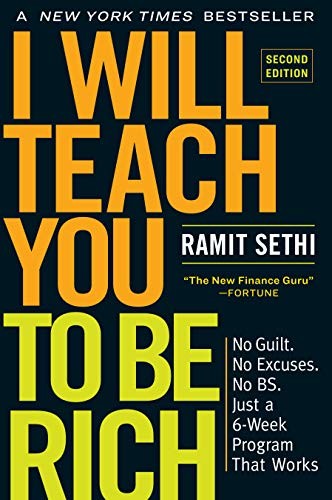
I Will Teach You to Be Rich by Ramit Sethi is a 2009 self-help book about automation, credit optimization, investing basics. Automate your finances so that saving and investing happen without relying on willpower. Set up automatic transfers on payday, before the money hits your checking account.
Summary
I Will Teach You to Be Rich is Ramit Sethi's six-week program for getting your basic financial infrastructure in order — automating savings, optimizing credit, setting up the right accounts, and beginning to invest — written specifically for people in their twenties and thirties who haven't yet dealt with any of this. First published in 2009, with a revised edition in 2019, the book is notable for its refusal to moralize about spending and its focus on systems over willpower.
Sethi's core argument is that personal finance should be automated so that doing the right thing happens without conscious effort. Set up automatic transfers to retirement accounts, savings, and investments on payday, before you can spend the money. Pay your bills automatically. The system runs in the background while you spend freely on things you actually care about — what Sethi calls "conscious spending." The goal is not to budget every category but to make the important financial moves happen automatically and then give yourself permission to enjoy whatever remains.
The book covers credit cards and credit scores in detail and, unusually for personal finance books, is enthusiastic about credit cards used well. Sethi argues that the right credit cards, paid in full each month, provide meaningful rewards and build credit scores without any downside for disciplined users. He provides scripts for negotiating fees and interest rates, which readers consistently report actually working. This pro-credit-card stance distinguishes the book from Ramsey's approach and reflects Sethi's view that personal finance problems are behavioral, not product-related.
The investment section recommends low-cost target-date funds for people who want a hands-off approach and a simple three-fund portfolio for those willing to do minimal ongoing maintenance. Sethi is a consistent advocate for index funds and for starting to invest early rather than waiting until you have figured out the perfect approach. The book's tone is direct and occasionally irreverent — Sethi spends time attacking the financial advice industry and framing automation as a better approach than the discipline most personal finance books demand. The 2019 revision updates the specific numbers and product recommendations for a higher-cost environment.
Talk to I Will Teach You to Be Rich like its author wrote you back.
Get the ideas that fit your life — not generic summaries.
- Chat with the book
- Audiobook-style main ideas
- Adapts to your life and goals
- Helps you take action
Key takeaways
- 1.
Automate your finances so that saving and investing happen without relying on willpower. Set up automatic transfers on payday, before the money hits your checking account.
- 2.
The 'conscious spending plan' gives you permission to spend on what you love, as long as the automated savings and investments are happening first.
- 3.
Credit cards, used well, are financial tools with real benefits. Pay in full every month, earn rewards, build credit — the risk is for people who carry balances, not for disciplined users.
- 4.
Start investing in a target-date fund or simple three-fund portfolio. The specific allocation matters less than actually starting. Perfect is the enemy of good enough.
- 5.
A small number of accounts — checking, savings, Roth IRA, workplace 401(k) — handle most of what personal finance requires. You don't need complexity.
- 6.
Negotiate your credit card fees, interest rates, and other financial charges. Sethi provides specific scripts that work more often than people expect.
- 7.
The 6-week program is deliberate: set up the infrastructure once, correctly, and then mostly ignore it. The goal is a financial system that works automatically.
- 8.
Time in the market beats timing the market. The most important investment decision is starting early, not optimizing exactly when or what.
Discussion questions
Use these on your own, with a book club, or as chat starters in Superbook. Book club version, ready to copy or print →
- 1.
Sethi's automation approach assumes that willpower is an unreliable tool for personal finance. Do you agree? What financial behaviors in your own life depend on willpower and would benefit from automation?
- 2.
The conscious spending plan allows guilt-free spending on your priorities after automation is set up. What would your ideal conscious spending allocation look like — what categories would get more and what would get less?
- 3.
Sethi is enthusiastic about credit cards, Ramsey says cut them up. Which position is more useful for you personally, and what does that reveal about your actual financial behavior?
- 4.
Have you ever negotiated a fee or interest rate with a financial institution? What happened? If you haven't tried, what's stopped you?
- 5.
The book is targeted at people in their twenties and thirties. If you are older and reading it, what parts feel less applicable, and what do you wish you had done differently at 25?
- 6.
Sethi argues that starting to invest imperfectly is better than waiting to invest perfectly. Has waiting for the right time ever cost you money in the market?
- 7.
The six-week program sets up a system and then mostly runs in the background. What would it take for you to set up that infrastructure this week?
- 8.
Sethi argues that most financial advice is designed to keep you dependent on advisors and complex products. Is that a fair characterization of the financial advice industry?
- 9.
The book recommends target-date funds as the simplest starting point. If you already invest more actively, do you think the added complexity is actually generating better returns for you?
- 10.
What is one financial task you have been avoiding that Sethi's approach would force you to confront directly?
- 11.
The 2019 revised edition updates recommendations for a higher-cost, lower-return environment. How has that changed the math on the specific approaches Sethi recommends?
- 12.
Sethi focuses on optimizing what you already earn rather than increasing your income. Is that the right framing for you, or is income growth the more important lever at this point in your life?
Themes
Frequently asked questions
-
Is I Will Teach You to Be Rich good for beginners?
Yes, it is one of the best introductions available for young adults who have never set up their financial infrastructure. The conversational tone, specific scripts, and step-by-step account setup instructions make it genuinely actionable. Readers who already have everything automated and are looking for advanced investing guidance will find it basic.
-
What is the conscious spending plan?
A framework that allocates income to four buckets: fixed costs (50-60%), investments (10%), savings goals (5-10%), and guilt-free spending (20-35%). The key principle is that you set up savings and investments first through automation, then spend freely on whatever remains in the guilt-free bucket without tracking every transaction.
-
How is this different from Dave Ramsey's approach?
Sethi and Ramsey represent opposite ends of the personal finance spectrum on credit cards. Ramsey opposes all credit cards; Sethi advocates for using them strategically for rewards and credit building. On debt, Ramsey requires paying everything off before investing; Sethi recommends investing simultaneously while carrying low-interest debt. Ramsey is better for people with serious debt problems; Sethi is better for people starting from scratch with decent incomes.
-
What investment accounts does the book recommend setting up?
A workplace 401(k) up to the employer match, then a Roth IRA to the maximum, then additional 401(k) contributions, then a regular taxable account. Within those accounts, Sethi recommends target-date funds for simplicity or a basic three-fund portfolio (US stocks, international stocks, bonds) for those who want control.
-
Does the book address how to increase income?
Briefly. The book's focus is on optimizing and automating what you already earn, not on income growth. Sethi's online courses address earning more extensively, but that content is not in the book. Readers looking primarily for income growth strategies will find the book's focus narrow.