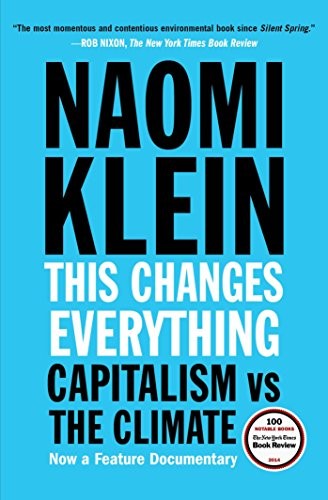
This Changes Everything: Capitalism vs. The Climate by Naomi Klein is a 2014 history book about climate change, capitalism, political economy. Climate change is not a discrete policy problem but a collision between ecological limits and an economic system built on the assumption of infinite growth.
Summary
Naomi Klein's central argument is that the climate crisis cannot be solved within the existing economic framework. The problem is not technological or even political in the narrow sense — it is systemic. Carbon emissions are a byproduct of an economic logic that prizes short-term extraction over long-term stability, and incremental reforms will not alter that logic fast enough. Klein contends that addressing climate change at the scale required would demand constraints on corporate power, limits on profit-seeking in key sectors, and a redistribution of public investment — measures that are structurally incompatible with the free-market ideology that has dominated economic policy since the 1980s.
The book spends considerable space examining why this collision has produced paralysis rather than action. Klein documents the capture of environmental institutions by corporate money, the ideological hostility of the right to any climate policy that might expand the regulatory state, and the failure of big green organizations to challenge the system rather than negotiate within it. She profiles the Heartland Institute's conferences, where climate denial functions not as a scientific position but as a political one — denial is the logical outcome of understanding that accepting the science would require accepting policies the right finds intolerable.
Klein also makes an affirmative case. Frontline communities facing flooding, drilling, and contamination have organized resistance movements that she treats as seeds of a broader transformation. The Leap Manifesto and similar initiatives point toward what she calls a "Marshall Plan for the Earth" — large-scale public investment in renewable energy, transit, and retrofitting that could create employment while reducing emissions. This section is the most optimistic and the most programmatic, drawing on the New Deal and postwar reconstruction as precedents for rapid state-directed economic change.
The book is ambitious and deliberately polemical. Critics, including some climate scientists and economists, argue that Klein understates the potential for market mechanisms and overstates the ideological obstacles to carbon pricing. The empirical case for renewables has strengthened considerably since 2014. But Klein's core diagnosis — that the political economy of fossil capitalism is the central obstacle — has proven durable, and her account of the social movements resisting extraction remains a useful record of a decade of conflict.
Talk to This Changes Everything: Capitalism vs. The Climate like its author wrote you back.
Get the ideas that fit your life — not generic summaries.
- Chat with the book
- Audiobook-style main ideas
- Adapts to your life and goals
- Helps you take action
Key takeaways
- 1.
Climate change is not a discrete policy problem but a collision between ecological limits and an economic system built on the assumption of infinite growth.
- 2.
The free-market deregulatory consensus of the past four decades has made meaningful climate action harder by shrinking the institutional capacity governments need to act at scale.
- 3.
Corporate capture of environmental organizations has produced moderate incrementalism where the crisis demands structural change.
- 4.
Climate denial on the right is primarily a political position, not a scientific one: accepting the science would require accepting policies that conservatives find ideologically unacceptable.
- 5.
Frontline communities disproportionately harmed by extraction and climate impacts are leading the most credible resistance to the fossil fuel system.
- 6.
The historical precedents for rapid state-directed economic transformation — New Deal, wartime mobilization — show that democratic governments can reorganize economies quickly when the political will exists.
- 7.
Green growth strategies that promise to decouple emissions from GDP without challenging consumption patterns have largely failed to deliver the necessary scale of change.
- 8.
The transition to renewables represents not just an energy swap but an opportunity to rebuild public infrastructure and reduce inequality — or to entrench existing power if managed by the same actors.
Discussion questions
Use these on your own, with a book club, or as chat starters in Superbook. Book club version, ready to copy or print →
- 1.
Klein argues that solving climate change requires abandoning the free-market framework. What would you need to see to be convinced she is right or wrong?
- 2.
How do you understand the relationship between economic growth and carbon emissions in your own country? Has decoupling happened at the scale Klein doubts is possible?
- 3.
Klein documents the capture of major environmental groups by corporate money. Does that change how you evaluate the policy positions those groups have taken?
- 4.
Is climate denial fundamentally ideological rather than empirical? What would it take to change the mind of someone whose denial is driven by resistance to regulation?
- 5.
The book profiles communities resisting extraction. Do local resistance movements translate into systemic change, or do they primarily buy time?
- 6.
Klein invokes the New Deal and wartime mobilization as models for rapid state action. Are those precedents genuinely applicable, or do they mislead about what is politically achievable now?
- 7.
Which is more dangerous to climate action: outright denial or moderate incrementalism that does not match the scale of the problem?
- 8.
What personal or professional investments do you have in the current energy and economic system? How does that shape how you read Klein's argument?
- 9.
Klein argues that the climate movement must ally with labor and social justice movements to build political power. What are the tensions in that coalition?
- 10.
How has the cost of renewable energy changing since 2014 affected the persuasiveness of Klein's argument? What parts of her case hold and what parts are overtaken by events?
- 11.
What do you make of Klein's framing of the crisis as an opportunity for progressive transformation? Does that framing help or hurt the political case for action?
- 12.
If Klein is correct that incremental market-based solutions are insufficient, what does a realistic path to transformation look like in your political context?
Themes
Frequently asked questions
-
What is This Changes Everything about?
Klein argues that the climate crisis cannot be solved within capitalism's current framework because the economic system's logic of extraction and short-term profit is structurally incompatible with the scale of change needed. The book diagnoses why politics has failed and points to frontline resistance movements as models for what comes next.
-
Is This Changes Everything worth reading?
Yes, particularly if you want to understand the political economy of climate inaction rather than just the science or the technology. Klein is a polemicist rather than an economist, and readers looking for policy specifics will need to supplement her account, but the structural argument has held up well.
-
How long does it take to read This Changes Everything?
At roughly 560 pages it takes around twelve hours at average reading pace. The book is densely researched, and the chapters vary in density — the opening ideological history reads quickly, the documentation of specific campaigns requires more attention.
-
Who should read This Changes Everything?
Anyone trying to understand why climate policy has stalled despite decades of scientific consensus. It is particularly useful for readers who find technocratic climate discourse unsatisfying and want a political-economic account of the obstacles.
-
What are the main criticisms of Klein's argument?
Critics argue she underestimates what carbon pricing can achieve within market systems, overstates the ideological rigidity of conservatives, and conflates distinct economic actors. Some economists note that the cost of renewables has fallen faster than her 2014 pessimism implied, weakening the case that clean energy requires anti-capitalist politics.