History · Book club
The Wealth and Poverty of Nations book club questions
Here are 12 book club questions for The Wealth and Poverty of Nations by David S. Landes, ordered to open easily and end somewhere worth arguing about. Copy them, print them, or bring them up one at a time.
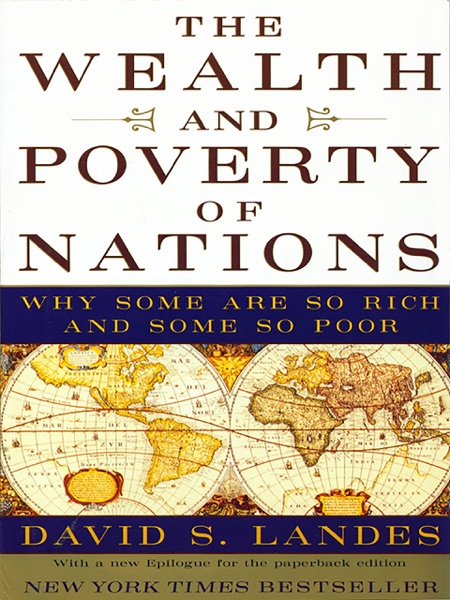
The Wealth and Poverty of Nations is David Landes's 1998 attempt to answer one of economic history's central questions: why are some nations rich and others poor?
David S. Landes · 1998 · 13h 15m
Full summary and key takeaways →The 12 questions
- 1.
Landes argues that culture is the primary explanation for long-run prosperity differences. How do you evaluate that claim against structural explanations — institutions, geography, colonial history?
- 2.
His treatment of the Protestant work ethic draws on Weber. Do you find the cultural-attitudinal explanation persuasive, or does it risk circular reasoning (successful cultures are retrospectively identified as having the right values)?
- 3.
The Wealth and Poverty of Nations came under criticism for underweighting colonial extraction and slavery. Does Landes's account give those factors adequate weight?
- 4.
Acemoglu and Robinson argue in Why Nations Fail that institutions rather than culture explain development. After reading Landes, which account seems more compelling to you, and why?
- 5.
Landes is particularly interested in the question of why China, which had significant technological advantages over Europe in the medieval period, did not industrialize first. What does his answer imply about technological determinism?
- 6.
The book's treatment of East Asia's rise attributes it partly to cultural attitudes similar to the Protestant ethic. Is that framing fair, or does it impose a Western explanatory framework on non-Western development?
- 7.
Landes's argument implies that cultural change is necessary for development in persistently poor countries. Is that a practical policy prescription, and what would it mean to pursue it?
- 8.
The resource curse — the observation that natural resource abundance often correlates with worse governance and slower development — is one of Landes's consistent themes. Why would this be?
- 9.
The book was published in 1998. Which of Landes's analyses have held up in the intervening decades, and which have been challenged by subsequent economic history?
- 10.
Landes writes with evident enthusiasm for European and particularly British economic achievement. Does that affect how you weight his analysis of non-European development trajectories?
- 11.
What does the Wealth and Poverty of Nations suggest about the role of international development aid? Would Landes's framework support or undermine conventional development economics?
- 12.
Which of the historical episodes Landes covers — the Industrial Revolution, the divergence of Latin America, the East Asian miracle, the persistence of African poverty — do you find his analysis most and least persuasive?
How to run the discussion
- Pick six to eight, not all of them. An hour of real discussion covers fewer questions than anyone expects, and racing the list is what makes a book club feel like homework.
- Open with what people noticed, not what they concluded. Asking for a verdict first hardens opinions before anyone has heard each other.
- Let the disagreement run. The questions below that split a room are the ones worth the time; the ones everyone answers the same way can be skipped.
- Ask the quiet person a specific question. A direct, narrow question is far easier to answer than an open invitation to contribute.
Themes worth steering toward
If the conversation stalls, these are the threads that usually restart it.
Common questions
What are good book club questions for The Wealth and Poverty of Nations?
Here are 12 book club questions for The Wealth and Poverty of Nations by David S. Landes, ordered to open easily and end somewhere worth arguing about. The strongest openers ask what each reader noticed rather than what they concluded, and the discussion usually turns on economic development, culture and institutions, industrialization.
How long should a book club discussion of The Wealth and Poverty of Nations last?
Most groups run 60 to 90 minutes of actual discussion. That is roughly six to eight questions, not all of them, so pick the ones that suit your group rather than working down the list in order.
What are the main themes in The Wealth and Poverty of Nations?
Economic development, Culture and institutions, Industrialization, Geography and climate, Technology and progress. Those are the threads most likely to divide a room, which makes them the useful places to steer a discussion that has gone quiet.
Picking the next one? See books like The Wealth and Poverty of Nations or questions for other book club picks.
