Economics · Book club
The Wealth of Nations book club questions
Here are 12 book club questions for The Wealth of Nations by Adam Smith, ordered to open easily and end somewhere worth arguing about. Copy them, print them, or bring them up one at a time.
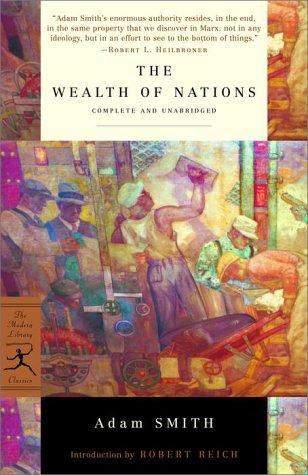
An Inquiry into the Nature and Causes of the Wealth of Nations, published in 1776, is Adam Smith's comprehensive account of how modern commercial economies work and what policies promote prosperity.
Adam Smith · 1776 · 25h 30m
Full summary and key takeaways →The 12 questions
- 1.
Smith's pin factory example has become iconic. What does the division of labor look like in an economy dominated by services and knowledge work rather than manufacturing?
- 2.
Smith argues that merchants and manufacturers systematically capture governments to protect themselves from competition. How does that argument look against the backdrop of contemporary lobbying and industrial policy?
- 3.
The invisible hand is often invoked as Smith's central claim. Having read more of the book, do you think that invocation is accurate, or does it distort what Smith actually argued?
- 4.
Smith supports free trade as beneficial to both trading partners. How do you reconcile that argument with the evidence that trade liberalization has produced concentrated losses as well as diffuse gains?
- 5.
Smith says employers have an organizational advantage that holds wages below competitive levels. What mechanisms in contemporary labor markets amplify or diminish that advantage?
- 6.
Smith was writing before industrialization fully arrived. Which of his observations depend on the specific economic conditions of the 1770s, and which feel like general claims about market economies?
- 7.
The book includes a detailed argument for public investment in education. How does Smith's rationale for public education relate to contemporary debates about human capital and inequality?
- 8.
Smith was a moral philosopher who had previously written The Theory of Moral Sentiments. Does knowing that context change how you read the Wealth of Nations?
- 9.
Smith treats self-interest as the engine of the market system. What assumptions about human psychology does that model make, and where do they hold and where do they fail?
- 10.
The Wealth of Nations is often cited by both free-market advocates and critics of capitalism. What does it mean that the same text can support such different readings?
- 11.
How does Smith's analysis of the relationship between productivity growth and wages relate to contemporary debates about whether workers share in economic growth?
- 12.
Smith argues that the wealth of nations is productive capacity, not gold reserves. How does that argument translate to contemporary debates about debt, austerity, and GDP?
How to run the discussion
- Pick six to eight, not all of them. An hour of real discussion covers fewer questions than anyone expects, and racing the list is what makes a book club feel like homework.
- Open with what people noticed, not what they concluded. Asking for a verdict first hardens opinions before anyone has heard each other.
- Let the disagreement run. The questions below that split a room are the ones worth the time; the ones everyone answers the same way can be skipped.
- Ask the quiet person a specific question. A direct, narrow question is far easier to answer than an open invitation to contribute.
Themes worth steering toward
If the conversation stalls, these are the threads that usually restart it.
Common questions
What are good book club questions for The Wealth of Nations?
Here are 12 book club questions for The Wealth of Nations by Adam Smith, ordered to open easily and end somewhere worth arguing about. The strongest openers ask what each reader noticed rather than what they concluded, and the discussion usually turns on free markets, division of labor, political economy.
How long should a book club discussion of The Wealth of Nations last?
Most groups run 60 to 90 minutes of actual discussion. That is roughly six to eight questions, not all of them, so pick the ones that suit your group rather than working down the list in order.
What are the main themes in The Wealth of Nations?
Free markets, Division of labor, Political economy, Trade, Self-interest. Those are the threads most likely to divide a room, which makes them the useful places to steer a discussion that has gone quiet.
Picking the next one? See books like The Wealth of Nations or questions for other book club picks.
