Psychology · Book club
Think Again: The Power of Knowing What You Don't Know book club questions
Here are 12 book club questions for Think Again: The Power of Knowing What You Don't Know by Adam Grant, ordered to open easily and end somewhere worth arguing about. Copy them, print them, or bring them up one at a time.
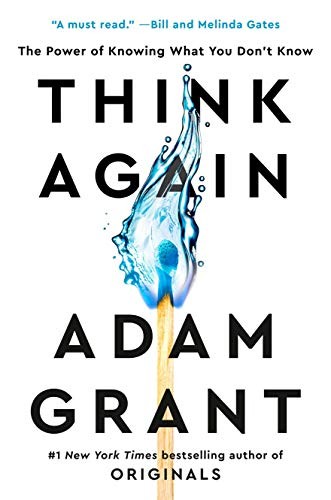
Think Again is Adam Grant's argument that the most valuable skill in a fast-changing world isn't learning faster — it's unlearning and rethinking more readily.
Adam Grant · 2021 · 5h 15m
Full summary and key takeaways →The 12 questions
- 1.
Grant identifies three default modes: preacher, prosecutor, politician. Which one do you slip into most often when your views are challenged?
- 2.
Think of a belief you've held for a long time. When did you last seriously test whether it was still accurate?
- 3.
Grant argues expertise can be a liability in fast-changing fields. Where in your professional life might your experience be holding back more than helping?
- 4.
The book distinguishes between a debate partner who helps you stress-test your thinking and one who just validates it. Which kind do you have more of?
- 5.
Have you ever changed a deeply held view? What actually caused you to update — evidence, relationships, a specific conversation?
- 6.
Grant says the most persuasive debaters ask more questions and make fewer arguments. Try applying that in a real disagreement. What changes?
- 7.
Psychological safety allows collective rethinking. Where in your work or personal life do people not feel safe surfacing dissent?
- 8.
The superforecaster research suggests most of us dramatically overcalibrate our confidence. What is something you believe with strong certainty that you should probably express more tentatively?
- 9.
Grant writes about a KKK member who changed his views through patient, curious conversation over months. What does that suggest about the timescale for real belief change?
- 10.
Motivational interviewing asks people to articulate their own reasoning. Can you think of a current disagreement where that approach would work better than presenting evidence?
- 11.
Grant talks about process feedback versus outcome feedback — being praised for how you think rather than whether you were right. Who in your life gave you that kind of feedback?
- 12.
Think of an organization or institution you're part of. What makes it more or less capable of collective rethinking when it gets something wrong?
How to run the discussion
- Pick six to eight, not all of them. An hour of real discussion covers fewer questions than anyone expects, and racing the list is what makes a book club feel like homework.
- Open with what people noticed, not what they concluded. Asking for a verdict first hardens opinions before anyone has heard each other.
- Let the disagreement run. The questions below that split a room are the ones worth the time; the ones everyone answers the same way can be skipped.
- Ask the quiet person a specific question. A direct, narrow question is far easier to answer than an open invitation to contribute.
Themes worth steering toward
If the conversation stalls, these are the threads that usually restart it.
Common questions
What are good book club questions for Think Again: The Power of Knowing What You Don't Know?
Here are 12 book club questions for Think Again: The Power of Knowing What You Don't Know by Adam Grant, ordered to open easily and end somewhere worth arguing about. The strongest openers ask what each reader noticed rather than what they concluded, and the discussion usually turns on intellectual humility, rethinking, persuasion.
How long should a book club discussion of Think Again: The Power of Knowing What You Don't Know last?
Most groups run 60 to 90 minutes of actual discussion. That is roughly six to eight questions, not all of them, so pick the ones that suit your group rather than working down the list in order.
What are the main themes in Think Again: The Power of Knowing What You Don't Know?
Intellectual humility, Rethinking, Persuasion, Learning, Open-mindedness. Those are the threads most likely to divide a room, which makes them the useful places to steer a discussion that has gone quiet.
Picking the next one? See books like Think Again: The Power of Knowing What You Don't Know or questions for other book club picks.
