Science · Book club
Thinking in Systems book club questions
Here are 12 book club questions for Thinking in Systems by Donella H. Meadows, ordered to open easily and end somewhere worth arguing about. Copy them, print them, or bring them up one at a time.
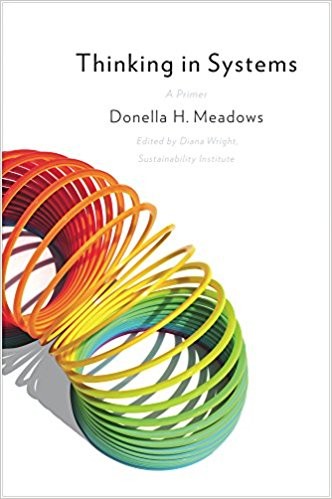
Thinking in Systems is Donella Meadows's introduction to the discipline of systems thinking — a way of understanding why complex things behave the way they do.
Donella H. Meadows · 2008 · 4h 45m
Full summary and key takeaways →The 12 questions
- 1.
Meadows argues that most social problems are system failures, not individual failures. Pick a problem you care about. What are the stocks, flows, and feedback loops that maintain it?
- 2.
Where in your own life have you experienced a balancing loop that kept pulling you back toward an old pattern no matter what you tried?
- 3.
Delays are a major cause of instability in systems. What's an example from your organization or community where feedback came too late and led to overcorrection?
- 4.
Meadows lists leverage points from least to most powerful. Think of an intervention you've witnessed that targeted a low-leverage point. What would a higher-leverage intervention have looked like?
- 5.
The tragedy of the commons describes a system where individually rational behavior produces collective harm. What real-world commons in your life is currently being depleted this way?
- 6.
She distinguishes between what a system is officially supposed to do and what it actually optimizes for. Think of an institution you interact with regularly. What does it actually optimize for?
- 7.
Reinforcing loops can produce both virtuous cycles and vicious ones. Which reinforcing loop in your own career has been most powerful — for good or ill?
- 8.
Meadows emphasizes epistemic humility: our models are always incomplete. Where has your mental model of a system led you to an intervention that made things worse?
- 9.
She argues that changing goals or paradigms is the highest leverage. What would it take to change the underlying goal of a system you're frustrated with?
- 10.
The book ends on cautious optimism. After reading it, are you more or less optimistic about the tractability of large complex problems? Why?
- 11.
Systems thinking is often described as valuable but hard to apply. What would it look like to actually use it in a real decision you face this month?
- 12.
Meadows died before finishing the manuscript. Reading it, do you feel a sense of incompleteness, or does it feel like a coherent whole? What does that say about how we assess ideas?
How to run the discussion
- Pick six to eight, not all of them. An hour of real discussion covers fewer questions than anyone expects, and racing the list is what makes a book club feel like homework.
- Open with what people noticed, not what they concluded. Asking for a verdict first hardens opinions before anyone has heard each other.
- Let the disagreement run. The questions below that split a room are the ones worth the time; the ones everyone answers the same way can be skipped.
- Ask the quiet person a specific question. A direct, narrow question is far easier to answer than an open invitation to contribute.
Themes worth steering toward
If the conversation stalls, these are the threads that usually restart it.
Common questions
What are good book club questions for Thinking in Systems?
Here are 12 book club questions for Thinking in Systems by Donella H. Meadows, ordered to open easily and end somewhere worth arguing about. The strongest openers ask what each reader noticed rather than what they concluded, and the discussion usually turns on systems thinking, feedback loops, complexity.
How long should a book club discussion of Thinking in Systems last?
Most groups run 60 to 90 minutes of actual discussion. That is roughly six to eight questions, not all of them, so pick the ones that suit your group rather than working down the list in order.
What are the main themes in Thinking in Systems?
Systems thinking, Feedback loops, Complexity, Sustainability, Mental models. Those are the threads most likely to divide a room, which makes them the useful places to steer a discussion that has gone quiet.
Picking the next one? See books like Thinking in Systems or questions for other book club picks.
