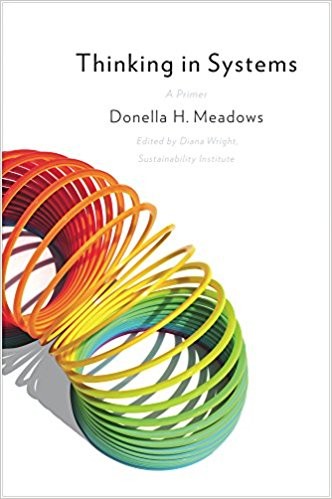
Thinking in Systems by Donella H. Meadows is a 2008 science book about systems thinking, feedback loops, complexity. A system is a set of elements, interconnections, and a function or purpose. Most complex behavior — from traffic jams to stock market crashes — emerges from system structure, not from any single actor.
Summary
Thinking in Systems is Donella Meadows's introduction to the discipline of systems thinking — a way of understanding why complex things behave the way they do. Meadows, a pioneering environmental scientist and co-author of The Limits to Growth, finished a draft of the book before her death in 2001. It was edited and published posthumously in 2008. The core argument is simple: most of the intractable problems we face — poverty, war, environmental collapse — are not failures of individual will or policy, but emergent behaviors of the systems we've built and live inside.
The book opens by defining what a system is: a set of elements connected by relationships to produce a function or purpose. Stocks and flows are the building blocks. A stock is any measurable quantity that accumulates or depletes over time — water in a bathtub, money in an account, trust between people. A flow is the rate of change in that stock. Feedback loops regulate flows: reinforcing loops amplify change and create growth or collapse; balancing loops resist change and push systems toward goals. Understanding which loops dominate a system at a given moment explains most of what happens.
The middle section catalogs common system archetypes — the tragedy of the commons, addiction, escalation, drift to low performance — with examples from ecology, economics, and public health. Meadows shows why so many well-intentioned interventions fail or make things worse: they push on variables that aren't the real leverage points, or they work with one loop while ignoring others. The leverage points chapter is the most cited section, offering a hierarchy of places to intervene in a system, from adjusting numbers (low leverage) to changing the goal or paradigm of a system (high leverage).
The final section is explicitly philosophical. Meadows argues that systems thinkers need epistemic humility: our mental models are always incomplete, systems have their own integrity worth respecting, and the goal is to work with the nature of a system rather than to force it. The book closes on a note of cautious optimism — systems can be redesigned, and understanding them deeply is the first step.
Talk to Thinking in Systems like its author wrote you back.
Get the ideas that fit your life — not generic summaries.
- Chat with the book
- Audiobook-style main ideas
- Adapts to your life and goals
- Helps you take action
Key takeaways
- 1.
A system is a set of elements, interconnections, and a function or purpose. Most complex behavior — from traffic jams to stock market crashes — emerges from system structure, not from any single actor.
- 2.
Stocks are the slow-moving memory of a system; flows change them. Most policy levers try to change flows, but the stocks determine what's actually possible in the short term.
- 3.
Reinforcing feedback loops amplify change in one direction. Balancing loops push back toward a goal. Every system is a tangle of both, and which loop dominates shifts as the system evolves.
- 4.
Delays in feedback loops are a major source of instability. When you act and don't see results, you keep acting — and then overshoot.
- 5.
The tragedy of the commons is a system archetype: shared resources get depleted because individual actors respond rationally to their own incentives, not to the system's long-term health.
- 6.
The most powerful leverage points in a system are not the parameters people usually fight over, but the goals, the rules, and — most powerful of all — the paradigm that defines what a system is for.
- 7.
Systems often behave counterintuitively. Pushing harder on an obvious solution frequently makes things worse if you're not working with the system's own logic.
- 8.
A system has its own integrity. Effective intervention requires understanding what the system is actually optimizing for, not just what you want it to do.
Discussion questions
Use these on your own, with a book club, or as chat starters in Superbook. Book club version, ready to copy or print →
- 1.
Meadows argues that most social problems are system failures, not individual failures. Pick a problem you care about. What are the stocks, flows, and feedback loops that maintain it?
- 2.
Where in your own life have you experienced a balancing loop that kept pulling you back toward an old pattern no matter what you tried?
- 3.
Delays are a major cause of instability in systems. What's an example from your organization or community where feedback came too late and led to overcorrection?
- 4.
Meadows lists leverage points from least to most powerful. Think of an intervention you've witnessed that targeted a low-leverage point. What would a higher-leverage intervention have looked like?
- 5.
The tragedy of the commons describes a system where individually rational behavior produces collective harm. What real-world commons in your life is currently being depleted this way?
- 6.
She distinguishes between what a system is officially supposed to do and what it actually optimizes for. Think of an institution you interact with regularly. What does it actually optimize for?
- 7.
Reinforcing loops can produce both virtuous cycles and vicious ones. Which reinforcing loop in your own career has been most powerful — for good or ill?
- 8.
Meadows emphasizes epistemic humility: our models are always incomplete. Where has your mental model of a system led you to an intervention that made things worse?
- 9.
She argues that changing goals or paradigms is the highest leverage. What would it take to change the underlying goal of a system you're frustrated with?
- 10.
The book ends on cautious optimism. After reading it, are you more or less optimistic about the tractability of large complex problems? Why?
- 11.
Systems thinking is often described as valuable but hard to apply. What would it look like to actually use it in a real decision you face this month?
- 12.
Meadows died before finishing the manuscript. Reading it, do you feel a sense of incompleteness, or does it feel like a coherent whole? What does that say about how we assess ideas?
Themes
Frequently asked questions
-
Is Thinking in Systems worth reading?
Yes, especially if you work on complex organizational or social problems. The book gives you a vocabulary and a set of diagrams for understanding why interventions fail. It's less a self-help book than a conceptual toolkit, and it reads quickly enough to be worth it even if you only absorb the feedback-loop chapters.
-
How long does it take to read Thinking in Systems?
About four to five hours for the 218-page text. The diagrams reward slowing down and tracing them, so allow extra time if you work through the examples carefully. Many readers re-read the leverage-points chapter more than once.
-
What is systems thinking in simple terms?
It's a way of looking at the world that focuses on the structure of relationships rather than on individual events or actors. Instead of asking 'who caused this problem,' systems thinking asks 'what structure keeps producing this pattern.'
-
Who should read Thinking in Systems?
Policy analysts, managers, educators, activists, and anyone who has tried to fix a persistent problem and watched their intervention bounce off or backfire. It's also excellent for people who found The Limits to Growth compelling but wanted a more accessible introduction to the underlying method.
-
What is the most important idea in the book?
The leverage-points chapter, which argues that the most powerful places to change a system are usually not the ones getting the most political attention. Adjusting numbers and parameters is almost always low leverage; changing goals and paradigms is almost always high leverage but far harder to do.
Similar books
Thinking, Fast and Slow
Daniel Kahneman
Antifragile: Things That Gain from Disorder
Nassim Nicholas Taleb
Algorithms to Live By: The Computer Science of Human Decisions
Brian Christian and Tom Griffiths
The Art of Thinking Clearly
Rolf Dobelli
