Thunderstruck by Erik Larson is a 2006 history book about technology, crime, innovation. Marconi succeeded by being a relentless experimenter rather than a theorist. He crossed the Atlantic by wireless before anyone could explain why the signals could follow the earth's curve.
Summary
Thunderstruck interweaves two narratives set in Edwardian England and the North Atlantic: the story of Guglielmo Marconi's obsessive drive to make wireless telegraphy work across the Atlantic Ocean, and the story of Hawley Harvey Crippen, a mild-mannered American doctor who murdered his wife in London in 1910 and fled with his mistress — only to be captured at sea because of a wireless telegraph message, the first criminal caught with the technology's help. Erik Larson constructs the dual narrative so that the two threads converge at the moment Crippen is identified on a ship.
The Marconi story is the more substantive of the two. Larson documents the years of failed experiments, skeptical investors, hostile competitors, and the peculiar technical problem of wireless transmission across the curve of the earth. Marconi was not primarily a theorist — he was a relentless empiricist who built transmitters, shipped equipment to remote headlands, and ran experiments until the physics cooperated. His eventual success in transmitting signals across the Atlantic in 1901 came before anyone fully understood why it was possible. The ionosphere was discovered later, as an explanation for something Marconi had already done.
The Crippen case reads more like a true-crime procedural. Crippen was an unremarkable figure — deferential, soft-spoken, devoted to his mistress Ethel Le Neve — who killed his overbearing wife and buried her beneath the cellar floor. His flight to Canada with Le Neve disguised as a boy triggered a transatlantic pursuit that gripped both British and American newspapers. The Scotland Yard inspector who identified him on the ship Montrose used wireless telegraphy to alert authorities in Canada, who met the ship when it docked.
Larson's dual-narrative structure works better in his Devil in the White City than here — the Marconi and Crippen threads are thematically connected but never dramatically intertwined until the very end. Readers who come for the crime story may find the technology chapters slow. Readers who come for the technology may find the murder chapters thin. But as a portrait of Edwardian anxiety about modernity — the telegraph as invisible presence, the newspaper as instrument of mass attention — the book has real intelligence.

Talk to Thunderstruck like its author wrote you back.
Get the ideas that fit your life — not generic summaries.
- Chat with the book
- Audiobook-style main ideas
- Adapts to your life and goals
- Helps you take action
Key takeaways
- 1.
Marconi succeeded by being a relentless experimenter rather than a theorist. He crossed the Atlantic by wireless before anyone could explain why the signals could follow the earth's curve.
- 2.
The ionosphere — the atmospheric layer that makes long-distance radio transmission possible — was identified as a scientific explanation for what Marconi had already empirically demonstrated.
- 3.
Crippen's case became the first instance in history where wireless telegraphy was used to capture a fugitive, making it a pivot point in the relationship between communication technology and law enforcement.
- 4.
Edwardian England had a particular appetite for technological spectacle. Marconi's demonstrations attracted enormous press and public interest, which both helped and complicated his commercial development.
- 5.
The newspaper press of the era amplified both stories — Marconi's experiments and Crippen's flight — in ways that shaped public understanding and created pressure on both scientist and police.
- 6.
Wireless telegraphy's early commercial success came from ship-to-shore communication. The technology that caught Crippen was first funded by the practical need to reach ships at sea.
- 7.
Crippen's personality — mild, deferential, devoted — defied Victorian expectations of what a murderer looked like. The case fed a cultural fascination with hidden violence beneath respectable exteriors.
- 8.
Larson shows that major technological transitions rarely arrive as single moments of invention. Marconi's transatlantic transmission required years of incremental failure, skepticism from the scientific establishment, and enormous capital.
Discussion questions
Use these on your own, with a book club, or as chat starters in Superbook. Book club version, ready to copy or print →
- 1.
Larson uses parallel narratives that converge only at the end. How well does that structure work for you, and at what point in the book did you feel the two threads genuinely belonged together?
- 2.
Marconi was an empiricist who succeeded before he understood why. What does that tell us about the relationship between experimentation and theory in technological development?
- 3.
The wireless telegraph compressed time and space in ways that seemed almost magical to contemporaries. Are there current technologies that give you a similar sense of changed possibility?
- 4.
Crippen's case was the first to use wireless for a criminal pursuit. What other first uses of communication technology to track or catch people can you think of, and what do they have in common?
- 5.
The press of the era treated both Marconi's experiments and Crippen's flight as serialized public spectacles. How does mass media attention shape the events it covers, and has that dynamic changed?
- 6.
Marconi dealt with skepticism from established scientists, hostile patent holders, and investors who doubted long-range transmission was possible. What do you think sustained him through years of failure?
- 7.
The Crippen case involved a man who fled rather than face the consequences of what he'd done. What made the wireless-enabled pursuit feel so satisfying to the public at the time?
- 8.
Larson acknowledges that the two narratives are loosely connected until the final section. Does knowing the structure is somewhat artificial change how you read the parallel chapters?
- 9.
Marconi's business decisions — exclusive contracts, patent protection, monopolistic ambitions — complicated his legacy. Where does the line fall between protecting an innovation and hoarding it?
- 10.
The Crippen case made Inspector Dew briefly famous. What does the public appetite for individual heroes in technological achievements say about how we understand collective progress?
- 11.
Have you read other Erik Larson books? How does Thunderstruck compare to The Devil in the White City or Dead Wake in terms of how well the dual-narrative structure serves the material?
- 12.
The book is set in the Edwardian era. What parallels do you see between the anxiety about wireless telegraphy then and current anxieties about surveillance and connectivity?
Themes
Frequently asked questions
-
Is Thunderstruck worth reading?
For Larson fans, yes. The Marconi sections are the strongest parts of the book — technically rich and propulsive. The Crippen sections are more conventional true crime. Readers who loved The Devil in the White City should temper expectations slightly; the two narratives here are less tightly integrated.
-
How long does it take to read Thunderstruck?
Around seven hours at average reading pace for the roughly 400-page book. The technology chapters in the Marconi thread can slow down readers less interested in the physics of wireless transmission.
-
What is the connection between Marconi and Crippen?
They are not personally connected. The link is thematic and technological: Crippen was the first criminal caught using wireless telegraphy, the technology Marconi spent years developing. The two narratives converge at the moment a Scotland Yard inspector identifies Crippen on a ship and sends a wireless message to Canada to have him arrested on arrival.
-
Did Erik Larson invent the dual-narrative format he uses?
No, but he popularized it in popular history. The format — two parallel stories in the same era, converging at the end — was established in The Devil in the White City and has become his signature approach. Thunderstruck uses it with mixed results compared to that earlier book.
-
Who should read Thunderstruck?
Readers interested in Edwardian history, the early development of wireless communication, or true crime with historical depth. It is also useful for anyone studying how new technologies get adopted — commercially, legally, and culturally — in contexts of skepticism and resistance.
Similar books

The Devil in the White City
Erik Larson

Killers of the Flower Moon
David Grann

American Prometheus
Kai Bird and Martin J. Sherwin
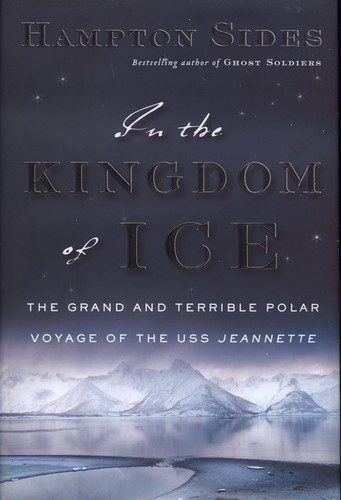
In the Kingdom of Ice: The Grand and Terrible Polar Voyage of the USS Jeannette
Hampton Sides
