Business · Book club
To Sell Is Human book club questions
Here are 12 book club questions for To Sell Is Human by Daniel H. Pink, ordered to open easily and end somewhere worth arguing about. Copy them, print them, or bring them up one at a time.
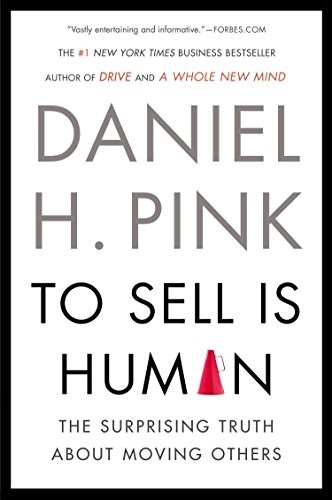
To Sell Is Human is Daniel Pink's case that selling — in the broad sense of moving people to think or act differently — is central to what most of us do at work every day, whether or not our job title includes the word "sales." Drawing on Bureau of Labor Statistics data, Pink estimates that Americans spend roughly 40% of their work time in non-sales selling: persuading, convincing, and nudging.
Daniel H. Pink · 2012 · 4h 30m
Full summary and key takeaways →The 12 questions
- 1.
How much of your actual work day involves trying to move someone else to a different position or action? Is that more or less than you assumed before reading this?
- 2.
Pink argues the traditional hard-sell approach backfires when buyers have as much information as sellers. Where in your experience is information still asymmetric, and how does that shape the interaction?
- 3.
Of the three new ABCs — Attunement, Buoyancy, Clarity — which comes most naturally to you and which is the real challenge?
- 4.
The book finds that ambiverts outperform extroverts in sales. Does that match what you've observed in people who are effective at persuading others?
- 5.
Pink draws on Seligman's explanatory style research. How do you typically explain setbacks when a pitch doesn't land? Does your framing help or hurt your recovery?
- 6.
Think of someone in your life who moves others effectively without seeming pushy. What specifically do they do differently?
- 7.
When was the last time you changed your mind after someone tried to persuade you? What made their approach work?
- 8.
Pink distinguishes between clarity in the sense of information delivery and clarity in the sense of reframing the problem. Can you think of a recent situation where reframing would have been more effective than presenting more data?
- 9.
The book argues that servant selling — focusing on making the other person better off — is both more ethical and more effective. Where in your experience is that true, and where is it too idealistic?
- 10.
How does the idea of non-sales selling change how you think about which colleagues are actually influencing outcomes in your organization?
- 11.
Interrogative self-talk is counterintuitive. When have you found that questioning yourself was more useful than positive affirmation before a difficult conversation?
- 12.
If you were redesigning a pitch or presentation to be more attuned, buoyant, and clear, what would you change about the one you currently use most often?
How to run the discussion
- Pick six to eight, not all of them. An hour of real discussion covers fewer questions than anyone expects, and racing the list is what makes a book club feel like homework.
- Open with what people noticed, not what they concluded. Asking for a verdict first hardens opinions before anyone has heard each other.
- Let the disagreement run. The questions below that split a room are the ones worth the time; the ones everyone answers the same way can be skipped.
- Ask the quiet person a specific question. A direct, narrow question is far easier to answer than an open invitation to contribute.
Themes worth steering toward
If the conversation stalls, these are the threads that usually restart it.
Common questions
What are good book club questions for To Sell Is Human?
Here are 12 book club questions for To Sell Is Human by Daniel H. Pink, ordered to open easily and end somewhere worth arguing about. The strongest openers ask what each reader noticed rather than what they concluded, and the discussion usually turns on sales, persuasion, motivation.
How long should a book club discussion of To Sell Is Human last?
Most groups run 60 to 90 minutes of actual discussion. That is roughly six to eight questions, not all of them, so pick the ones that suit your group rather than working down the list in order.
What are the main themes in To Sell Is Human?
Sales, Persuasion, Motivation, Communication, Human behavior. Those are the threads most likely to divide a room, which makes them the useful places to steer a discussion that has gone quiet.
Picking the next one? See books like To Sell Is Human or questions for other book club picks.
