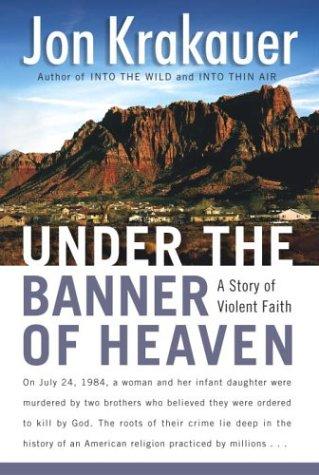
Under the Banner of Heaven: A Story of Violent Faith by Jon Krakauer is a 2003 memoir book about religion, violence, fundamentalism. Ron and Dan Lafferty committed the 1984 murders of Brenda Lafferty and her infant daughter after Ron received what he called a revelation commanding it. The murders are central to the book's argument about the relationship between absolute faith and violence.
Summary
Under the Banner of Heaven opens with a specific crime: in 1984, Ron and Dan Lafferty — members of a fundamentalist Mormon splinter group — murdered their sister-in-law Brenda and her infant daughter, acting on a "revelation" they believed came directly from God. Krakauer uses this crime as a lens to examine both the history of the Church of Jesus Christ of Latter-day Saints and the broader question of what happens when religious conviction becomes absolute and immune to outside scrutiny.
The book moves between two timelines. One follows the Lafferty brothers from their conversion to fundamentalism through their arrest and trial. The other traces the history of Mormonism from Joseph Smith's founding visions through the practice of polygamy, the church's violent confrontations with the federal government, and the ongoing existence of fundamentalist splinter groups that the mainstream LDS church disavows. Krakauer is a thorough researcher and the historical sections are among the strongest in his work — detailed, largely fair to his sources, willing to let the complexity of Mormon history speak for itself.
The book drew angry responses from the LDS church and from Mormon scholars when it was published. Critics argued that Krakauer conflates mainstream Mormonism with its extremist offshoots, and that presenting the founding events of the church through a lens of skepticism is a form of anti-Mormon bias. Those criticisms have merit. Krakauer's framing consistently returns to questions about Joseph Smith's character and the historicity of his revelations in ways that a comparable treatment of other traditions might not. Readers should hold that limitation in mind while reading.
What the book does well is harder to dismiss: it places the Lafferty murders in a specific theological and sociological context, makes the psychology of fundamentalist violence legible without excusing it, and asks how any society balances religious freedom against the protection of the people — especially women and children — who live inside closed religious communities. Those questions remain live, and the book asks them with Krakauer's characteristic narrative force.
Talk to Under the Banner of Heaven: A Story of Violent Faith like its author wrote you back.
Get the ideas that fit your life — not generic summaries.
- Chat with the book
- Audiobook-style main ideas
- Adapts to your life and goals
- Helps you take action
Key takeaways
- 1.
Ron and Dan Lafferty committed the 1984 murders of Brenda Lafferty and her infant daughter after Ron received what he called a revelation commanding it. The murders are central to the book's argument about the relationship between absolute faith and violence.
- 2.
Fundamentalist Mormon splinter groups practicing polygamy and claiming direct divine revelation have existed since Brigham Young's era. The mainstream LDS church's disavowal of them does not make them theologically incoherent on their own terms.
- 3.
Joseph Smith's founding of Mormonism — the revelations, the golden plates, the polygamy — is treated by Krakauer as historically problematic. Mormon scholars dispute this reading, and the book's reliability is weakest where it relies on the most skeptical sources.
- 4.
The concept of blood atonement — that some sins require the spilling of the sinner's blood — is historically documented in early Mormon teaching. Krakauer argues it informed the Lafferty brothers' theology.
- 5.
Religious freedom as a legal principle offers weak protection to the people inside religious communities, particularly women and children, whose choices are shaped by environments they didn't choose.
- 6.
Dan Lafferty, sentenced to life in prison, remained a believing fundamentalist and continued to defend the murders as God's will decades later. His certainty is among the most disturbing elements of the book.
- 7.
The mountain meadows massacre of 1857 — in which Mormon settlers killed over a hundred emigrants — is documented at length as evidence of how collective religious violence operates under prophetic authority.
- 8.
Krakauer is at pains to separate his critique of fundamentalism from an attack on faith as such, but the line he draws is not always convincing. Readers will disagree about where fair questioning ends and bias begins.
Discussion questions
Use these on your own, with a book club, or as chat starters in Superbook. Book club version, ready to copy or print →
- 1.
Krakauer was criticized for conflating mainstream Mormonism with its fundamentalist offshoots. Do you think he maintains the distinction, or does the book blur it?
- 2.
The Lafferty brothers were not mentally ill by clinical definition. What does it mean to receive a 'revelation' commanding murder, and how should the law handle that defense?
- 3.
How should secular societies balance religious freedom against the rights of children raised inside closed religious communities?
- 4.
The book traces Joseph Smith's founding of Mormonism with skeptical scrutiny. Would a comparable treatment of Islam's founding or Christianity's be published in the same way? Does that matter?
- 5.
Ron Lafferty's radicalization followed a recognizable pattern: financial stress, marital conflict, ideological escalation, and finally isolation. At what point could intervention have changed the outcome?
- 6.
The mountain meadows massacre was suppressed in LDS institutional memory for over a century. How do religious institutions handle historical violence in their own founding, and how should they?
- 7.
Dan Lafferty believed the murders were divinely commanded and felt no remorse. Is there a meaningful distinction between that certainty and the certainty of religiously motivated violence in other traditions?
- 8.
Krakauer identifies a pattern in fundamentalist movements: charismatic leaders claiming direct divine revelation, polygamy as a form of social control, and violence against those who challenge authority. Does that pattern have secular analogs?
- 9.
The book's victims — Brenda Lafferty and her daughter — receive less attention than the perpetrators. Is that an editorial choice you accept or resist?
- 10.
What does the existence of ongoing fundamentalist Mormon communities practicing polygamy suggest about the state's ability and willingness to enforce laws inside religious communities?
- 11.
Krakauer makes the case that belief in divine revelation is structurally dangerous because it is immune to argument. Do you find that argument compelling or too broad?
- 12.
If you were designing a legal framework for how societies handle religiously motivated violence, what principles would you want it to rest on?
Themes
Frequently asked questions
-
Is Under the Banner of Heaven anti-Mormon?
The LDS church and many Mormon scholars said yes. Krakauer's scrutiny of Joseph Smith and his tendency to view Mormon history through a skeptical lens does go beyond what he would likely apply to more established faiths. That said, the book's central argument about fundamentalist violence is distinct from an attack on mainstream Mormonism.
-
How long does it take to read Under the Banner of Heaven?
Around six to seven hours at average reading pace for the roughly 370-page book. The narrative moves between the Lafferty case and the history of Mormonism, so the pace varies.
-
What happened to the Lafferty brothers?
Ron Lafferty was sentenced to death and remained on Utah's death row for decades. Dan Lafferty received two consecutive life sentences. Both maintained that the murders were divinely commanded.
-
Do I need to know anything about Mormonism to read this book?
No. Krakauer provides extensive historical context. Readers who already know Mormon history may find the historical sections slower, but the narrative around the Lafferty case is accessible to anyone.
-
Is Under the Banner of Heaven still relevant?
Yes. The questions it raises about religious freedom, the rights of people inside closed communities, and the relationship between absolute belief and violence have not become less pressing since 2003.