Talk to Understanding Media like its author wrote you back.
Get the ideas that fit your life — not generic summaries.
- Chat with the book
- Audiobook-style main ideas
- Adapts to your life and goals
- Helps you take action
What it argues
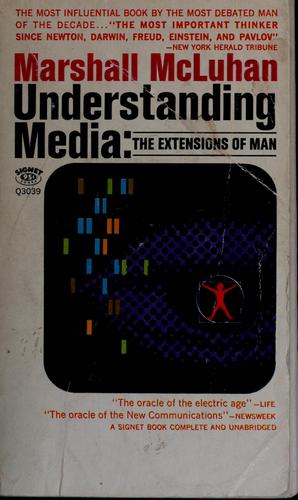
Understanding Media, published in 1964, is Marshall McLuhan's most developed work and the book that made "the medium is the message" a catchphrase of the twentieth century. McLuhan was a Canadian literary critic and communications theorist who argued that scholars, journalists, and citizens were making a fundamental error when they focused on the content of media — what television programs said, what newspapers reported — rather than on the form of the medium itself and what it does to human perception and social organization.
The book's core argument is that every medium extends some human faculty — print extends the eye, radio extends the ear, clothing extends the skin — and in doing so, it also amputates or numbs the faculties not extended. Literacy, in McLuhan's account, did not merely change what people could read; it rewired the sensorium toward linear, sequential, visual processing and away from the oral, acoustic, communal modes of pre-literate culture. The printing press did not just spread content; it created the conditions for nationalism, individualism, and modern science by training millions of people to think in straight lines.
What it gets right
- 1.
'The medium is the message': the form of a medium shapes perception and social organization more profoundly than any content it carries. We attend to content and miss the form's effects.
- 2.
Every medium extends a human faculty and simultaneously amputates others. Print extended vision and sequential thinking; it also diminished oral, communal, and multi-sensory engagement.
- 3.
Hot media (film, radio) are high-definition and demand low participation from the audience. Cool media (telephone, television) are low-definition and require the audience to complete them actively.
What it covers
Who wrote it
Marshall McLuhan (1911–1980) was a Canadian literary critic and media theorist who spent most of his career at the University of Toronto. He trained as an English scholar and wrote his early work on literature before turning to what he called the "grammar of media." Understanding Media (1964) and The Medium is the Massage (1967) made him a celebrity intellectual of the 1960s, widely covered in the mainstream press. His ideas fell out of fashion during the 1970s and were revived in the 1990s with the rise of the internet, which seemed to confirm his predictions. Wired magazine named him its patron saint.
