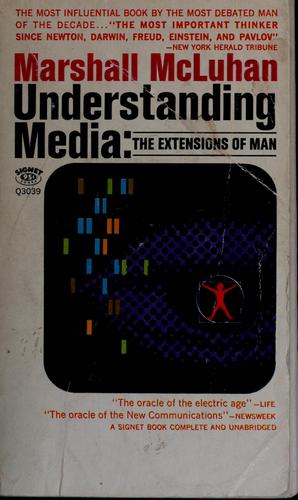
Talk to Understanding Media like its author wrote you back.
Get the ideas that fit your life — not generic summaries.
- Chat with the book
- Audiobook-style main ideas
- Adapts to your life and goals
- Helps you take action
Understanding Media, in detail
Understanding Media, published in 1964, is Marshall McLuhan's most developed work and the book that made "the medium is the message" a catchphrase of the twentieth century. McLuhan was a Canadian literary critic and communications theorist who argued that scholars, journalists, and citizens were making a fundamental error when they focused on the content of media — what television programs said, what newspapers reported — rather than on the form of the medium itself and what it does to human perception and social organization.
The book's core argument is that every medium extends some human faculty — print extends the eye, radio extends the ear, clothing extends the skin — and in doing so, it also amputates or numbs the faculties not extended. Literacy, in McLuhan's account, did not merely change what people could read; it rewired the sensorium toward linear, sequential, visual processing and away from the oral, acoustic, communal modes of pre-literate culture. The printing press did not just spread content; it created the conditions for nationalism, individualism, and modern science by training millions of people to think in straight lines.
McLuhan distinguishes "hot" media (high-definition, low-participation, like film and radio) from "cool" media (low-definition, high-participation, like television and telephone). A hot medium fills in all the data; a cool medium requires the audience to complete the picture. Television, famously, McLuhan called cool — its low-resolution image requires active engagement to make sense of, which is why it produces the communal, tribal responses it does. This taxonomy is counterintuitive and not always convincing, but it generates surprising observations throughout the book.
The second part of Understanding Media is a chapter-by-chapter survey of individual media: roads, money, clocks, comics, film, radio, television, weapons. These chapters are uneven and often deliberately provocative. McLuhan wrote in a deliberately aphoristic, non-linear style that many readers find either stimulating or infuriating. He does not build careful arguments from evidence; he juxtaposes observations and invites the reader to make connections. Reading him requires a tolerance for intellectual improvisation. What the book offers in return is a set of questions about technology and perception that have aged better than almost any other media criticism of the period, and that apply with striking relevance to the internet, smartphones, and social media.
The big ideas
- 1.
'The medium is the message': the form of a medium shapes perception and social organization more profoundly than any content it carries. We attend to content and miss the form's effects.
- 2.
Every medium extends a human faculty and simultaneously amputates others. Print extended vision and sequential thinking; it also diminished oral, communal, and multi-sensory engagement.
- 3.
Hot media (film, radio) are high-definition and demand low participation from the audience. Cool media (telephone, television) are low-definition and require the audience to complete them actively.
