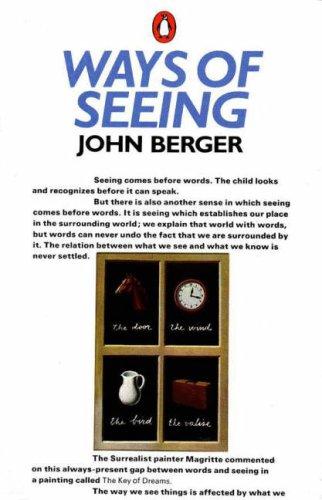
Ways of Seeing by John Berger is a 1972 philosophy book about visual culture, power and representation, capitalism and art. Seeing comes before words. The child looks before it can speak. Visual perception is always prior to, and shapes, language.
Summary
Ways of Seeing began as a BBC television series in 1972 and was published the same year as a slim, deliberately designed paperback. Berger's argument is that how we look at images is never neutral. Every act of seeing is shaped by what we know, what we believe, and by the social conditions we inhabit. The book's opening move — that seeing comes before words, and that cameras forever changed our relationship to painted images by stripping them from their original location — sets the terms for everything that follows.
The most influential section concerns oil painting in the European tradition. Berger argues that paintings in this tradition were primarily a way of showing the owner's ownership — of land, of objects, of women. The genre of the nude is his central case: the distinction between nakedness (being oneself, without clothes) and the nude (being displayed for the male spectator) collapses centuries of aesthetic justification into a structural argument about who looks and who is looked at. The gaze is not innocent; it encodes power.
The book then extends this logic to advertising. Berger's claim is that publicity images use the visual grammar of oil painting — glamour, display, aspiration — but replace the premise of ownership with the premise of purchase. Where oil painting said "I own this," advertising says "you could be like this, if you buy." The spectator-buyer is always shown a slightly better version of themselves, always just out of reach. This envy is, he argues, the emotional engine of capitalism.
Ways of Seeing is a polemical book, not a scholarly one. Berger is not interested in every nuance; he's interested in opening a crack in the way people look at images. At 166 pages — including sections with images and no text at all — it is one of the more economical provocations in art criticism. It does not resolve its arguments so much as force them on the reader. Whether or not every claim survives scrutiny, the questions it raises about seeing, power, and reproduction are still entirely live.
Talk to Ways of Seeing like its author wrote you back.
Get the ideas that fit your life — not generic summaries.
- Chat with the book
- Audiobook-style main ideas
- Adapts to your life and goals
- Helps you take action
Key takeaways
- 1.
Seeing comes before words. The child looks before it can speak. Visual perception is always prior to, and shapes, language.
- 2.
The camera removed art from its original context. A painting can now be reproduced infinitely, which destroys its unique presence — what Berger calls its 'aura,' drawing on Walter Benjamin.
- 3.
In European oil painting, the primary subject is property. Landscapes show land owned; still lifes show objects owned; portraits show the owner, or what they wish to own.
- 4.
The distinction between nakedness and the nude: nakedness is being yourself without clothes; the nude is being displayed as an object for someone else's gaze.
- 5.
In the traditional nude, the woman's gaze is directed at the spectator — acknowledging and performing for him. The male spectator is never quite shown inside the frame.
- 6.
Publicity images use the conventions of oil painting — beauty, display, desire — but replace ownership with envy. They sell a future self, always just purchasable enough to seem possible.
- 7.
Women have internally split selves in a visual culture built around the male gaze: they watch themselves being watched, becoming simultaneously surveyor and surveyed.
- 8.
Mystification in art criticism — explaining paintings in terms of transcendence, mystery, genius — functions to block social and political readings of images.
Discussion questions
Use these on your own, with a book club, or as chat starters in Superbook. Book club version, ready to copy or print →
- 1.
Berger argues that cameras have permanently changed how we see paintings. Has your own experience of seeing a famous painting in person felt different from seeing it reproduced — and if so, how?
- 2.
The book was written in 1972. Do you think advertising has changed its visual grammar since then, or does Berger's analysis of the spectator-buyer relationship still hold?
- 3.
Berger draws a sharp line between oil painting as a tradition and its social function. Is it possible to appreciate the paintings he critiques aesthetically while also accepting his political reading?
- 4.
The chapter on the nude makes a structural argument about the male gaze. Where do you see this logic operating in contemporary visual media — or where has it broken down?
- 5.
Berger claims mystification is a deliberate strategy — that art criticism obscures the social meaning of paintings behind the language of genius and beauty. Do you think critics do this consciously?
- 6.
The book includes pages of images with no text, inviting readers to look before they read. Did you notice your responses to images changing after reading his arguments?
- 7.
What does Berger mean when he says 'publicity images dream of the past'? Is his comparison between oil painting and advertising persuasive?
- 8.
If seeing is always shaped by who we are and where we stand, does that mean there's no such thing as an innocent or objective view of an image?
- 9.
Berger's analysis is explicitly Marxist. Does knowing that affect how you read his arguments — does it make them more or less persuasive?
- 10.
Pick any advertisement you've seen recently. Apply Berger's framework: who is being shown, who is doing the looking, and what is being promised?
- 11.
The book was made to be cheap and widely accessible — small format, inexpensive. Does the physical form of a book about art change how you read it?
- 12.
Berger says the relationship between the 'ideal' self in advertising and the 'actual' self creates envy as an economic emotion. Do you feel this mechanism at work on yourself?
Themes
Frequently asked questions
-
What is Ways of Seeing about?
It's a short, polemical book arguing that how we look at visual images — especially European oil paintings and modern advertising — is shaped by social power, particularly gender and class. Berger's central claim is that images are never neutral: they reflect and reinforce who has the power to look and who is looked at.
-
Is Ways of Seeing still relevant?
Yes. The book's frameworks around the male gaze, the commodification of desire in advertising, and the relationship between images and ownership remain actively used in media studies, art history, and cultural criticism. Its analysis of advertising is, if anything, more pointed in the age of social media.
-
How long does it take to read Ways of Seeing?
Around two to three hours. The book is 166 pages and includes sections with images and no text at all. It's very readable — Berger wrote it to be accessible, not academic — though the argument repays slow reading.
-
Who should read Ways of Seeing?
Anyone interested in art history, media criticism, visual culture, or feminist theory. It's one of those rare books that permanently changes how you look at images, including ones you encounter every day. It works well as a first serious encounter with critical theory, since the prose stays concrete.
-
What is the difference between nakedness and nudity in Berger's argument?
Berger distinguishes between being naked — simply being without clothes, as a complete subject — and the painted or photographed nude, which is a body arranged for display to an external (typically male) spectator. The nude performs for someone; the naked person simply is.