Science · Book club
Weapons of Math Destruction book club questions
Here are 12 book club questions for Weapons of Math Destruction by Cathy O'Neil, ordered to open easily and end somewhere worth arguing about. Copy them, print them, or bring them up one at a time.
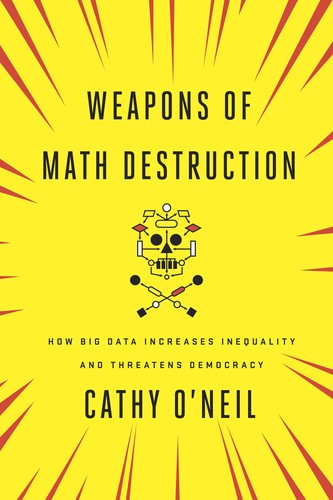
Weapons of Math Destruction is mathematician and data scientist Cathy O'Neil's investigation of how algorithms — statistical models used to make decisions about people's lives — can perpetuate and amplify inequality rather than reduce it.
Cathy O'Neil · 2016 · 5h 15m
Full summary and key takeaways →The 12 questions
- 1.
O'Neil argues algorithms can be more discriminatory than human decision-makers because they scale faster and are harder to challenge. Does that argument seem right to you?
- 2.
The feedback loop problem — biased data producing biased outputs that generate new biased data — is described in predictive policing. Can you think of other domains where this pattern operates?
- 3.
She defines WMDs by opacity, scale, and damage. Which feature do you think is most essential to the harm she describes?
- 4.
Proxy discrimination — using variables that correlate with protected characteristics without explicitly using those characteristics — is technically legal but practically discriminatory. How should law address it?
- 5.
How much transparency do you think is necessary for an algorithmic decision to be legitimately challengeable by the person affected?
- 6.
US News college rankings have distorted university behavior significantly. What other examples of metric optimization that undermines the underlying goal can you identify?
- 7.
O'Neil came from inside the data science industry. Does that background make her critique more or less credible to you?
- 8.
Should people have a right to know when an algorithm has affected a significant decision about their life, and to challenge it?
- 9.
The book was published in 2016, before large language models became widespread. How does her WMD framework apply to current AI systems like GPT?
- 10.
She distinguishes between models used to allocate scarce benefits among the wealthy — used by investment banks — and models used to allocate scarce resources among the poor. Is that distinction morally significant?
- 11.
What specific regulatory requirements would you propose for algorithms used in high-stakes domains like criminal justice or employment?
- 12.
Do you use any of the algorithmic systems she criticizes — credit scoring, personalized feeds, predictive systems — and has reading the book changed how you think about them?
How to run the discussion
- Pick six to eight, not all of them. An hour of real discussion covers fewer questions than anyone expects, and racing the list is what makes a book club feel like homework.
- Open with what people noticed, not what they concluded. Asking for a verdict first hardens opinions before anyone has heard each other.
- Let the disagreement run. The questions below that split a room are the ones worth the time; the ones everyone answers the same way can be skipped.
- Ask the quiet person a specific question. A direct, narrow question is far easier to answer than an open invitation to contribute.
Themes worth steering toward
If the conversation stalls, these are the threads that usually restart it.
Common questions
What are good book club questions for Weapons of Math Destruction?
Here are 12 book club questions for Weapons of Math Destruction by Cathy O'Neil, ordered to open easily and end somewhere worth arguing about. The strongest openers ask what each reader noticed rather than what they concluded, and the discussion usually turns on algorithms, inequality, data science.
How long should a book club discussion of Weapons of Math Destruction last?
Most groups run 60 to 90 minutes of actual discussion. That is roughly six to eight questions, not all of them, so pick the ones that suit your group rather than working down the list in order.
What are the main themes in Weapons of Math Destruction?
Algorithms, Inequality, Data science, Ethics, Technology. Those are the threads most likely to divide a room, which makes them the useful places to steer a discussion that has gone quiet.
Picking the next one? See books like Weapons of Math Destruction or questions for other book club picks.
