Psychology · Book club
When Prophecy Fails book club questions
Here are 12 book club questions for When Prophecy Fails by Leon Festinger, ordered to open easily and end somewhere worth arguing about. Copy them, print them, or bring them up one at a time.
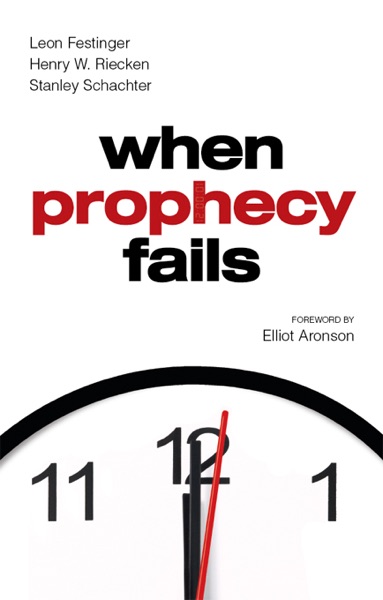
When Prophecy Fails is the account of an observational study Leon Festinger and his colleagues conducted by infiltrating a small doomsday cult in the American Midwest in the early 1950s.
Leon Festinger · 1956 · 5h 15m
Full summary and key takeaways →The 12 questions
- 1.
The researchers joined the cult as undercover observers. Is that methodologically and ethically defensible? What is the alternative?
- 2.
Festinger predicted the group would proselytize after failure, and they did. Does the prediction's success validate the cognitive dissonance framework, or could other explanations account for the same behavior?
- 3.
The core members who had quit their jobs became more committed after the prophecy failed. Where in your own life have you seen that pattern — investment increasing resistance to revision?
- 4.
The peripheral members left when the prophecy failed. Why were they more willing to update their beliefs, and what does that tell you about commitment and belief?
- 5.
The new revelation — that God had spared the earth because of the group's faith — was accepted by core members immediately. What made that narrative satisfying when the literal prediction had failed?
- 6.
Cognitive dissonance was proposed in 1956. Where do you see it operating most visibly in contemporary life?
- 7.
The book is about a fringe doomsday group, but Festinger explicitly argued the dynamics apply broadly. Is there a risk that the exotic case makes it too easy to see in others and too hard to see in yourself?
- 8.
The methodology relied on researchers becoming members of the group. How did their presence affect the group's behavior? Is this a problem that undermines the findings?
- 9.
The group's leader, Dorothy Martin, was a real person who continued to lead groups for decades after the 1954 failure. What does that long career say about the durability of belief systems built on failed predictions?
- 10.
Failed prophecies in history — from religious millenarianism to financial predictions — often follow similar patterns. What conditions determine whether failure kills a belief or intensifies it?
- 11.
How do you personally detect when you're in the grip of motivated reasoning rather than genuine assessment of evidence?
- 12.
The book was published in 1956. Does the behavior it describes feel culturally specific to its era, or would the same study yield similar results today?
How to run the discussion
- Pick six to eight, not all of them. An hour of real discussion covers fewer questions than anyone expects, and racing the list is what makes a book club feel like homework.
- Open with what people noticed, not what they concluded. Asking for a verdict first hardens opinions before anyone has heard each other.
- Let the disagreement run. The questions below that split a room are the ones worth the time; the ones everyone answers the same way can be skipped.
- Ask the quiet person a specific question. A direct, narrow question is far easier to answer than an open invitation to contribute.
Themes worth steering toward
If the conversation stalls, these are the threads that usually restart it.
Common questions
What are good book club questions for When Prophecy Fails?
Here are 12 book club questions for When Prophecy Fails by Leon Festinger, ordered to open easily and end somewhere worth arguing about. The strongest openers ask what each reader noticed rather than what they concluded, and the discussion usually turns on belief, cognitive dissonance, confirmation bias.
How long should a book club discussion of When Prophecy Fails last?
Most groups run 60 to 90 minutes of actual discussion. That is roughly six to eight questions, not all of them, so pick the ones that suit your group rather than working down the list in order.
What are the main themes in When Prophecy Fails?
Belief, Cognitive dissonance, Confirmation bias, Social influence, Rationalization. Those are the threads most likely to divide a room, which makes them the useful places to steer a discussion that has gone quiet.
Picking the next one? See books like When Prophecy Fails or questions for other book club picks.
