Economics · Book club
Why Nations Fail: The Origins of Power, Prosperity, and Poverty book club questions
Here are 12 book club questions for Why Nations Fail: The Origins of Power, Prosperity, and Poverty by Daron Acemoglu and James A. Robinson, ordered to open easily and end somewhere worth arguing about. Copy them, print them, or bring them up one at a time.
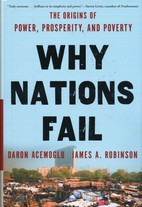
Daron Acemoglu and James Robinson argue that the fundamental difference between rich and poor countries is not geography, culture, or bad luck.
Daron Acemoglu and James A. Robinson · 2012 · 9h 45m
Full summary and key takeaways →The 12 questions
- 1.
The authors argue that geography and culture don't explain prosperity, but institutions do. Does that feel right to you? What evidence in your own experience pushes back against it?
- 2.
Can you think of a country that has maintained extractive political institutions while building genuinely inclusive economic ones? Does it contradict the argument?
- 3.
The Nogales example is the book's most striking. What other border pairs — physical, historical, or political — show similar divergence?
- 4.
Acemoglu and Robinson say foreign aid mostly fails because it is absorbed by extractive institutions. If that's right, what should rich countries do instead?
- 5.
What was the most recent critical juncture in your country's history? Did it reinforce or weaken inclusive institutions?
- 6.
The book says short-run growth under extractive systems is real but unsustainable. Does China fit this model, and how would you know when the stagnation arrives?
- 7.
How do you distinguish a country building inclusive institutions from one whose elite is performing inclusion while protecting its position?
- 8.
The authors are historians by method. How much confidence do case studies give you in a causal claim of this scope?
- 9.
They argue that the Industrial Revolution succeeded in Britain because of prior institutional change. Is that persuasive, or does it explain too much with hindsight?
- 10.
What would it take, concretely, to break an entrenched extractive system? The book identifies critical junctures but doesn't fully explain how to create them.
- 11.
Is there a risk that the inclusive/extractive framing naturalizes Western political arrangements as the global ideal? How might that distort the analysis?
- 12.
Which institution in your own country most resembles an extractive arrangement, and who are the beneficiaries?
How to run the discussion
- Pick six to eight, not all of them. An hour of real discussion covers fewer questions than anyone expects, and racing the list is what makes a book club feel like homework.
- Open with what people noticed, not what they concluded. Asking for a verdict first hardens opinions before anyone has heard each other.
- Let the disagreement run. The questions below that split a room are the ones worth the time; the ones everyone answers the same way can be skipped.
- Ask the quiet person a specific question. A direct, narrow question is far easier to answer than an open invitation to contribute.
Themes worth steering toward
If the conversation stalls, these are the threads that usually restart it.
Common questions
What are good book club questions for Why Nations Fail: The Origins of Power, Prosperity, and Poverty?
Here are 12 book club questions for Why Nations Fail: The Origins of Power, Prosperity, and Poverty by Daron Acemoglu and James A. Robinson, ordered to open easily and end somewhere worth arguing about. The strongest openers ask what each reader noticed rather than what they concluded, and the discussion usually turns on institutions, political economy, development.
How long should a book club discussion of Why Nations Fail: The Origins of Power, Prosperity, and Poverty last?
Most groups run 60 to 90 minutes of actual discussion. That is roughly six to eight questions, not all of them, so pick the ones that suit your group rather than working down the list in order.
What are the main themes in Why Nations Fail: The Origins of Power, Prosperity, and Poverty?
Institutions, Political economy, Development, Power, Inequality. Those are the threads most likely to divide a room, which makes them the useful places to steer a discussion that has gone quiet.
Picking the next one? See books like Why Nations Fail: The Origins of Power, Prosperity, and Poverty or questions for other book club picks.
