Work Rules!: Insights from Inside Google That Will Transform How You Live and Lead by Laszlo Bock is a 2015 business book about organizational culture, talent management, people analytics. Unstructured job interviews are poor predictors of performance. Structured interviews with predetermined criteria and consistent scoring improve both fairness and predictive validity.
Summary
Work Rules! is Laszlo Bock's account of the people management practices he developed as Google's Senior Vice President of People Operations from 2006 to 2016. The book is unusual in the genre because Bock actually ran one of the largest and most analytically rigorous HR organizations in the world, and the practices he describes were tested on tens of thousands of employees over a decade. Where most books about workplace culture are speculative or anecdotal, this one is built on data.
The central argument is that most organizations give managers far too much unchecked authority over hiring, pay, and promotion, and that the result is a systematic perpetuation of bias and mediocrity. Google's response was to strip managers of unilateral control and route major people decisions through committees, calibration panels, and analytic review. Bock describes in detail how structured interviews with predetermined criteria outperform unstructured conversations, how calibration sessions reduce pay disparity, and how post-hire analysis allowed Google to discover which interview questions actually predicted performance.
Bock also covers the practices that gave Google its employer brand: extreme transparency about business strategy and financials, surveys that measured whether managers were behaving as the data said good managers should, and the Project Oxygen research that identified the eight behaviors of Google's highest-rated managers. The finding that coaching quality was the most predictive management behavior — not technical expertise or strategic vision — was genuinely surprising and changed how Google trained managers.
The book has a promotional tone that occasionally undermines the substance. Bock is proud of what Google built and describes it enthusiastically. Some of the practices described require resources — engineering time, data infrastructure, HR analytical capacity — that are not available to most organizations. And Google in 2006 to 2016 operated in a specific labor market environment that has since shifted. But the underlying argument — that people decisions should be made with the same analytical rigor as product or financial decisions — holds up, and the research Bock describes is genuinely useful for anyone designing a people function.
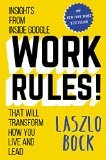
Talk to Work Rules!: Insights from Inside Google That Will Transform How You Live and Lead like its author wrote you back.
Get the ideas that fit your life — not generic summaries.
- Chat with the book
- Audiobook-style main ideas
- Adapts to your life and goals
- Helps you take action
Key takeaways
- 1.
Unstructured job interviews are poor predictors of performance. Structured interviews with predetermined criteria and consistent scoring improve both fairness and predictive validity.
- 2.
Google's Project Oxygen found that the best managers coach, empower rather than micromanage, care about employee well-being, and communicate clearly — technical expertise ranked last among the eight behaviors.
- 3.
Transparency about business strategy and financial performance treats employees as owners, not resources, and tends to produce more responsible behavior than secrecy.
- 4.
Peer feedback and calibration panels reduce the impact of individual manager bias on pay and promotion decisions. Systemic processes outperform individual judgment on these decisions.
- 5.
The top performers in any organization deserve disproportionately more attention than average performers — in mentoring, stretch assignments, and compensation — because their marginal contribution is much higher.
- 6.
Nudging through default behaviors — automatic 401k enrollment, opt-in rather than opt-out benefits — changes outcomes more reliably than persuasion alone.
- 7.
Measuring management quality through employee surveys and holding managers accountable to those results closes the feedback loop that is usually missing from management development.
- 8.
Post-hire analysis of interview scores versus actual performance lets an organization learn which parts of its hiring process actually predict success — most don't.
Discussion questions
Use these on your own, with a book club, or as chat starters in Superbook. Book club version, ready to copy or print →
- 1.
Bock argues managers should lose unilateral authority over hiring and pay. What would that require culturally, and where would it produce the most resistance?
- 2.
Google found that interview performance had low correlation with job performance in many roles. How should that finding change how you hire?
- 3.
Which of Project Oxygen's eight management behaviors do you see most consistently modeled by effective managers you know? Which is most often missing?
- 4.
Bock emphasizes radical transparency about business strategy. Where have you seen that work well, and where have you seen it backfire?
- 5.
If you applied the same analytic rigor to your organization's people decisions as it applies to its product or financial decisions, what would you want to measure first?
- 6.
Nudging through defaults is powerful but also paternalistic. Where is that tradeoff acceptable and where does it become manipulation?
- 7.
Google was in a specific talent market — highly competitive, with employees who had strong outside options. How much of what Bock describes is transferable to different labor market conditions?
- 8.
What does it cost, politically and operationally, to implement calibration panels and peer feedback? Is the cost worth the benefit in every context?
- 9.
Bock describes giving employees significant freedom to define how they work. What is the failure mode of that approach, and when does it break down?
- 10.
Google's employee surveys measured manager quality and shared results with employees. Would that practice change management behavior at organizations you know?
- 11.
The book was written in 2015. What has changed at Google since then, including reported employee relations issues, that would update or complicate Bock's account?
- 12.
Bock argues top performers should get disproportionate rewards. What are the risks of that philosophy for team cohesion and organizational culture?
Themes
Frequently asked questions
-
Is Work Rules! worth reading?
Yes, especially for HR professionals, executives designing people functions, and anyone skeptical that management can be studied analytically rather than just intuited. Bock's data-grounded approach is a genuine counterweight to the anecdote-heavy majority of management books.
-
How long does it take to read Work Rules!?
About six hours at average reading pace. The book is long and detailed, with chapters covering distinct practices. It rewards reading in sections tied to specific management challenges rather than straight through.
-
What is the main finding of Work Rules!?
That most organizations make people decisions — hiring, pay, promotion, management assessment — with far less analytical rigor than they apply to other business decisions, and that applying data and structured processes to these decisions consistently produces better outcomes than relying on managerial judgment alone.
-
What was Project Oxygen?
A research project Google conducted to identify what distinguished its highest-rated managers from its lowest-rated ones. Using performance reviews, employee surveys, and double-blind interviews, the research produced eight behaviors that predicted management quality — with coaching and psychological safety ranked highest and technical expertise ranked lowest.
-
Does Work Rules! apply to smaller companies without Google's resources?
Partially. The core principles — structured hiring, calibration, transparency, measuring management quality — can be adapted with much simpler tools. The data infrastructure Bock describes requires significant investment, but the underlying logic translates even when the implementation is more modest.
Similar books
Powerful: Building a Culture of Freedom and Responsibility
Patty McCord
No Rules Rules: Netflix and the Culture of Reinvention
Reed Hastings and Erin Meyer
First, Break All the Rules
Marcus Buckingham and Curt Coffman
Radical Candor
Kim Scott
