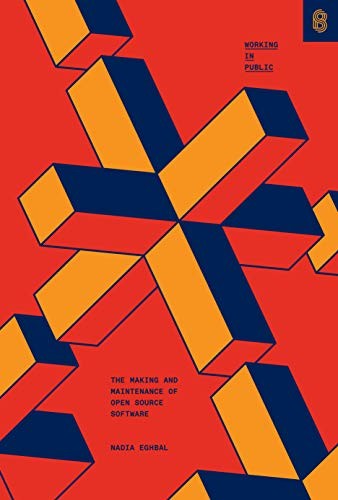
Working in Public by Nadia Eghbal is a 2020 business book about open source, creator economy, online communities. Most open source software is maintained by one person or a tiny group, not by the large collaborative communities that the open source mythology suggests.
Summary
Working in Public is Nadia Eghbal's examination of open source software as a window into a broader shift in how creative and technical work is organized online. Published in 2020 by Stripe Press, the book started as a research report Eghbal wrote at GitHub and grew into a full account of what open source has become — not the collaborative utopia its early advocates envisioned, but something stranger and more instructive.
Eghbal's key observation is that the standard mental model of open source — a community of contributors working together toward a shared goal — describes only a minority of projects. Most successful open source software is maintained by one person or a very small group, with a large periphery of users who consume the work but rarely contribute to it. She introduces a taxonomy of project types: federations (many contributors, high user growth), clubs (many contributors, low user growth), stadiums (one or few contributors, high user growth), and toys (one or few contributors, low user growth). The stadium is the dominant form: a single maintainer, often overwhelmed, serving a massive user base.
The economics of this situation are troubling. A maintainer of a critical open source library might have millions of dependents — companies whose infrastructure relies entirely on their work — and receive nothing in return. Eghbal draws on the attention economy literature to explain why: users' contributions to a project are governed by the same logic as social media consumption. Watching, starring, and following are low-cost forms of engagement. Submitting a pull request, reviewing code, answering issues — these are high-cost. Most users rationally choose to free-ride.
The second half of the book broadens from open source to the creator economy more generally. Eghbal argues that individual creators who work in public face an analogous attention economics problem: a small group does all the production, a large group consumes it, and the distribution of attention tends to concentrate at the top. Platform dynamics — recommendation algorithms, follower counts — accelerate that concentration. The book ends with observations about how creators manage their attention and what sustainability might look like, but Eghbal is more diagnostic than prescriptive. Working in Public is short and precise, the work of someone who thought carefully about a specific problem and decided not to pad the analysis.
Talk to Working in Public like its author wrote you back.
Get the ideas that fit your life — not generic summaries.
- Chat with the book
- Audiobook-style main ideas
- Adapts to your life and goals
- Helps you take action
Key takeaways
- 1.
Most open source software is maintained by one person or a tiny group, not by the large collaborative communities that the open source mythology suggests.
- 2.
Eghbal's taxonomy identifies four project types by contributor count and user count: federations, clubs, stadiums, and toys. The stadium — one creator, massive audience — is the dominant and most problematic form.
- 3.
The cost asymmetry between producing and consuming explains free-riding. Filing a good bug report or submitting a pull request costs far more than starring a repo. Most users rationally choose the cheap option.
- 4.
Critical open source infrastructure is often maintained by unpaid individuals whose burnout or departure can break software that billions of people depend on. This is a systemic risk that the industry hasn't solved.
- 5.
Attention economics govern creator work: a large user base generates enormous management overhead (issues, feature requests, support) that absorbs time without producing the work itself.
- 6.
The creator economy replicates open source dynamics at scale. Platform algorithms concentrate attention at the top, making the attention of millions of followers simultaneously valuable and burdensome.
- 7.
Successful solo maintainers don't manage communities — they curate them. The most sustainable approach is to be selective about which interactions to engage with, not to try to respond to everything.
- 8.
Open source challenges the assumption that more contributors always improve a project. With the wrong contributor base, more participation creates more management burden without proportional value.
Discussion questions
Use these on your own, with a book club, or as chat starters in Superbook. Book club version, ready to copy or print →
- 1.
Eghbal argues that the collaborative utopia of open source was always more myth than reality. Does that match your experience of open source projects you've used or contributed to?
- 2.
The stadium dynamic — one creator serving a massive passive audience — appears across open source, newsletters, podcasts, and social media. Why does this form keep emerging, and is it sustainable?
- 3.
If you maintain or contribute to open source software, how does your project fit Eghbal's taxonomy? If you're a user, which type of project do most of your dependencies fall into?
- 4.
The book argues that most users rationally choose to free-ride because contributing is costly. Is there a design or incentive change that could shift this, or is it a structural feature of the attention economy?
- 5.
Eghbal draws parallels between open source maintainers and internet creators (newsletter writers, YouTubers). Where does that analogy hold up, and where does it break down?
- 6.
Who is responsible for the sustainability of critical open source infrastructure — the companies that profit from it, the platforms that host it, the foundation ecosystem, or something else?
- 7.
The book describes how successful maintainers manage their attention by being selective about engagement. What's the equivalent of that in your own work — where do you need to deliberately not respond?
- 8.
Eghbal distinguishes 'producing' from 'maintaining.' How much of your own creative or technical work is new production versus maintenance of what already exists?
- 9.
Platform dynamics concentrate attention at the top of the creator hierarchy. Is that a flaw in how platforms are built, or an inevitable feature of attention markets?
- 10.
The book ends without a strong prescription for fixing the maintainer sustainability problem. Does that feel like intellectual honesty or an evasion?
- 11.
If a creator's attention is the scarce resource, what are the right and wrong ways to manage it? What would good boundaries look like for a solo open source maintainer with a large user base?
Themes
Frequently asked questions
-
What is Working in Public about?
It's a study of open source software as a model for understanding how creative and technical work is organized online. Eghbal argues that open source is not the collaborative community the mythology suggests, but mostly stadiums — single maintainers serving massive passive user bases — with significant implications for sustainability and the creator economy.
-
Do I need to be a software developer to benefit from Working in Public?
No. The first half is specifically about open source and will be more resonant if you've worked in software, but the second half applies to anyone working as a creator online — newsletter writers, podcasters, educators, and others dealing with audience management and attention economics.
-
Is Working in Public a short book?
Yes. It's around 240 pages and takes most readers three to four hours. Stripe Press books tend to be precisely edited without padding. Eghbal doesn't overstretch her argument.
-
What's the most important practical insight for someone who maintains open source software?
That you are not obligated to manage your user base as a community. You can set explicit terms of engagement, reduce the surface area of interaction, and treat your attention as the scarce resource it is. Trying to respond to everything is a path to burnout, not to better software.
-
How does the book relate to the broader creator economy discussion?
Eghbal argues that open source maintainers were the first creators to face the dynamics that all internet creators now deal with: massive asymmetry between producer and consumer, attention concentration, and the difficulty of extracting value from an audience that treats your work as free infrastructure.
Similar books
Zero to One: Notes on Startups, or How to Build the Future
Peter Thiel
The Innovator's Dilemma
Clayton M. Christensen

An Elegant Puzzle
Will Larson
The Cathedral and the Bazaar
Eric S. Raymond
