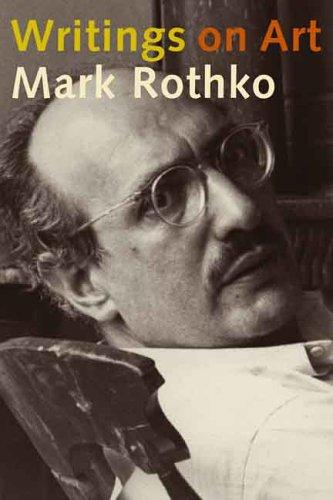
Writings on Art by Mark Rothko is a 2006 philosophy book about abstract expressionism, art and emotion, creative philosophy. Rothko believed painting should be capable of tragedy, not merely beauty — he wanted his work to produce a confrontation with mortality and suffering, not pleasure.
Summary
Mark Rothko spent decades writing about painting before most people knew his name. This volume, edited by Miguel López-Remiro and published posthumously, collects his essays, statements, and letters from roughly 1934 to 1969 — tracing his thinking from his figurative Social Realist period through the development of the transcendent color-field work that made him famous. The writing is dense and philosophical, far removed from any how-to manual about painting.
The core argument running through almost everything Rothko wrote is that painting should produce an emotional and even spiritual experience in the viewer — not illustration, not decoration, not formal exercise. He was deeply influenced by Nietzsche's analysis of tragedy and by Jungian ideas about myth, and he believed that art capable of moving people had to connect to something ancient and universal. His famous later canvases — those hovering rectangles of color — were his attempt to create conditions for that experience without representation getting in the way.
Rothko was scornful of critics who read his work as purely formal or optical. He wanted presence, not aesthetics. His letters and public statements push back repeatedly against collectors who treated his paintings as decoration and against the art world's tendency to flatten meaning into style. His famous refusal to sell paintings to the Four Seasons restaurant — recounted here through correspondence — is one of the better-documented cases of an artist refusing to let his work be misused.
Reading Rothko's prose alongside his biography adds a layer of pathos. He grew increasingly convinced that the transcendent project he'd committed to was being misunderstood, co-opted, or simply ignored. The late writings carry a heaviness that mirrors the darkening of his palette in the Seagram Murals and the Harvard Reds. For anyone interested in what an abstract painter actually thought he was doing, and why he believed it mattered, this collection is an essential primary source.
Talk to Writings on Art like its author wrote you back.
Get the ideas that fit your life — not generic summaries.
- Chat with the book
- Audiobook-style main ideas
- Adapts to your life and goals
- Helps you take action
Key takeaways
- 1.
Rothko believed painting should be capable of tragedy, not merely beauty — he wanted his work to produce a confrontation with mortality and suffering, not pleasure.
- 2.
His shift from figurative to abstract painting was not a formal experiment but a response to his conviction that representation had become inadequate to express what he needed to express.
- 3.
Nietzsche and myth were central references: Rothko read The Birth of Tragedy carefully and saw color-field painting as the modern equivalent of ancient ritual experience.
- 4.
He was deeply opposed to his paintings being used as decoration and repeatedly documented his disgust when they were treated that way — including the Four Seasons refusal.
- 5.
The viewer, for Rothko, was not passive. His paintings required active emotional participation, not interpretation or connoisseurship.
- 6.
Silence and scale were deliberate tools. Large canvases at close range were meant to envelop, not impress — he wanted the viewer inside the painting, not outside looking in.
- 7.
His correspondence reveals a man increasingly isolated and disappointed, convinced that the spiritual ambition of his project had been missed or trivialized by the market and critics.
Discussion questions
Use these on your own, with a book club, or as chat starters in Superbook. Book club version, ready to copy or print →
- 1.
Rothko insists that abstract painting can produce tragedy. Do you find that credible? Has any work of visual art ever produced a genuinely tragic experience for you?
- 2.
He was influenced by Nietzsche's distinction between the Apollonian and the Dionysian. How does that framework map onto what you understand about his paintings?
- 3.
Rothko's refusal to let his paintings function as decoration was a principled stand. When does artistic intent actually override how people experience art?
- 4.
His prose is dense and at times difficult. Does reading what a painter meant to do change how you see the paintings themselves? Or does it constrain the experience?
- 5.
He worried that the art market was absorbing and neutralizing his work. Is that a problem that can be solved? Or is it inherent to art entering commercial circulation?
- 6.
What does Rothko mean when he says he wants the viewer to 'experience' a painting rather than 'understand' it? Is that distinction coherent?
- 7.
His letters show a man in real psychic pain about the reception of his work. How much of an artist's suffering should figure into how we evaluate the work?
- 8.
Rothko placed enormous weight on scale — viewing distance and canvas size. Is that kind of control over the viewing experience legitimate? Or is it coercive?
- 9.
He had deep reservations about art criticism. Are those reservations still valid, or has the discourse around abstract painting become more capable of addressing what he was after?
- 10.
The collection spans thirty-five years of his thinking. Where do you see his ideas shifting most significantly, and what drove those changes?
- 11.
Rothko was preoccupied with myth and the archaic. Is that a productive orientation for a modern artist, or does it create a certain nostalgia and elitism?
Themes
Frequently asked questions
-
What is Writings on Art by Rothko about?
It is a collection of Rothko's own essays, statements, lectures, and letters from 1934 to 1969, tracing his philosophical development from Social Realism through Abstract Expressionism. The central theme is his belief that painting must produce genuine emotional and spiritual experience, not aesthetic pleasure.
-
Is Writings on Art worth reading if I'm not a painter?
Yes, if you're interested in what serious artists actually think about their work. Rothko's writing is philosophical, not technical, and his questions — about emotion, myth, tragedy, and the viewer's role — apply well beyond painting. It is harder going than most art memoirs but more substantive.
-
How long is Writings on Art by Rothko?
The collection runs to roughly 200 pages in the Yale University Press edition. It reads slowly because the prose is dense and rewards rereading, but a focused reader can finish it in two to three sittings.
-
Who should read this book?
Painters, art students, curators, and anyone interested in the philosophy behind Abstract Expressionism. It is also useful for readers of Nietzsche who want to see his ideas applied to a visual art practice, or anyone interested in the relationship between art and emotional experience.
-
What is the most important idea in Rothko's writing?
That painting should be capable of tragedy — not illustration of tragedy, but the production of a tragic experience in the viewer. This conviction drove everything from his rejection of representation to his control over how his paintings were displayed and sold.