Science · Book club
Zero: The Biography of a Dangerous Idea book club questions
Here are 12 book club questions for Zero: The Biography of a Dangerous Idea by Charles Seife, ordered to open easily and end somewhere worth arguing about. Copy them, print them, or bring them up one at a time.
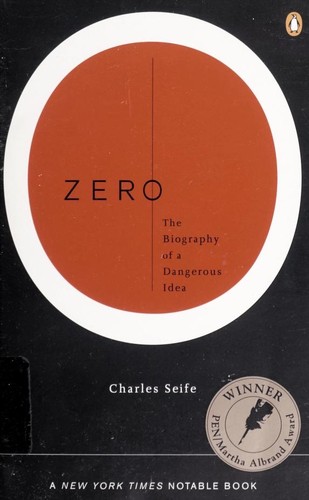
The number zero seems self-evidently harmless, but Charles Seife's history argues that zero has been, at various points, theologically threatening, mathematically subversive, and philosophically destabilizing.
Charles Seife · 2000 · 4h 45m
Full summary and key takeaways →The 12 questions
- 1.
Why do you think the ancient Greeks resisted the concept of zero? What does that tell us about how philosophical commitments shape mathematics?
- 2.
Seife pairs zero and infinity throughout the book. Before reading, had you thought of them as related? Does the pairing feel natural to you now?
- 3.
The Church's resistance to zero is often cited as an example of religion obstructing science. Is that a fair reading of the history Seife presents?
- 4.
Calculus was developed on philosophically shaky foundations — the infinitesimal — and worked brilliantly before those foundations were made rigorous. What does that suggest about how mathematics actually progresses?
- 5.
Physics generates infinities in its most accurate theories, and manages them through renormalization. How do you feel about a physical theory that requires this kind of mathematical housekeeping?
- 6.
Seife argues that zero represents genuine mathematical mystery, not just complexity. Is there a difference between a problem that's hard and one that's genuinely mysterious?
- 7.
The Hindu-Arabic numeral system — including zero — was a prerequisite for modern commerce and science. What contemporary tools do we use without thinking about the conceptual breakthroughs behind them?
- 8.
What other ideas can you think of that were resisted for cultural or religious reasons before being accepted as obviously correct?
- 9.
The book claims division by zero is not just technically undefined but philosophically significant. Does that argument convince you?
- 10.
How does the history of zero change how you think about mathematical concepts that seem simple and self-evident?
- 11.
Seife ends with quantum gravity and the Big Bang — places where zero and infinity collide in physics. Does that make the book feel complete, or like it runs out of space?
- 12.
The book is sometimes criticized for oversimplifying the physics. How much oversimplification is acceptable in popular science writing?
How to run the discussion
- Pick six to eight, not all of them. An hour of real discussion covers fewer questions than anyone expects, and racing the list is what makes a book club feel like homework.
- Open with what people noticed, not what they concluded. Asking for a verdict first hardens opinions before anyone has heard each other.
- Let the disagreement run. The questions below that split a room are the ones worth the time; the ones everyone answers the same way can be skipped.
- Ask the quiet person a specific question. A direct, narrow question is far easier to answer than an open invitation to contribute.
Themes worth steering toward
If the conversation stalls, these are the threads that usually restart it.
Common questions
What are good book club questions for Zero: The Biography of a Dangerous Idea?
Here are 12 book club questions for Zero: The Biography of a Dangerous Idea by Charles Seife, ordered to open easily and end somewhere worth arguing about. The strongest openers ask what each reader noticed rather than what they concluded, and the discussion usually turns on mathematics, history of ideas, infinity.
How long should a book club discussion of Zero: The Biography of a Dangerous Idea last?
Most groups run 60 to 90 minutes of actual discussion. That is roughly six to eight questions, not all of them, so pick the ones that suit your group rather than working down the list in order.
What are the main themes in Zero: The Biography of a Dangerous Idea?
Mathematics, History of ideas, Infinity, Philosophy, Physics. Those are the threads most likely to divide a room, which makes them the useful places to steer a discussion that has gone quiet.
Picking the next one? See books like Zero: The Biography of a Dangerous Idea or questions for other book club picks.
