Book comparison
Sapiens vs Guns, Germs, and Steel
Read Sapiens for the whole span of human history and the ideas that hold it together, and Guns, Germs, and Steel if you specifically want to know why conquest ran in the direction it did — bearing in mind that Diamond’s answer is disputed by working historians.

Sapiens
Yuval Noah Harari
2014 · 8h 45m
Sapiens traces the full arc of human history from the emergence of Homo sapiens in Africa roughly 70,000 years ago to the present.
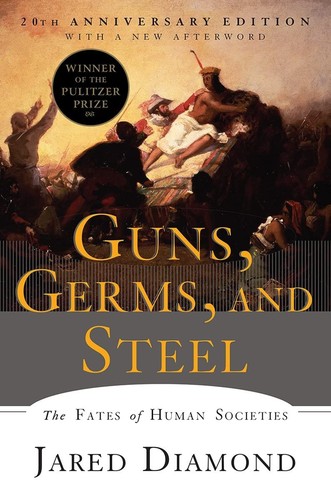
Guns, Germs, and Steel
Jared Diamond
1997 · 11h 15m
Guns, Germs, and Steel is Jared Diamond's attempt to answer a question posed to him by a Papua New Guinean politician named Yali.
Where they agree
Both are single-volume big-history books written for a general reader, and both set out to explain the shape of the human past without reaching for any claim about innate differences between peoples. Each replaces that explanation with a structural one, and each has been the book that made a lot of readers interested in history at all.
Where they differ
Diamond asks a narrow question — why did Europeans end up conquering the Americas rather than the reverse — and answers it with environment: which regions happened to have domesticable plants and large animals, how Eurasia’s east-west axis let crops and techniques travel, and how living alongside livestock produced the epidemic diseases that did most of the killing. Harari asks a much larger question, how one unremarkable ape came to run the planet, and answers it with shared fiction: money, nations, laws, gods and companies exist because enough people agree they do, which lets humans cooperate flexibly in numbers no other species manages. Diamond is defending one thesis at length; Harari is synthesising and provoking, and he editorialises freely, notably in calling the agricultural revolution a bad bargain for the people who lived through it. Diamond’s book is also the more contested of the two: historians and anthropologists have criticised it for geographic determinism, for treating human choice as almost irrelevant, and for selecting evidence to fit the model.
Which to read first
Sapiens, if you are choosing one. It is the more readable book and it covers far more ground, so it gives you somewhere to put everything else. Start with Guns, Germs, and Steel instead if colonialism and conquest are the actual subject you came for — but read it as one argued position rather than the settled account.
Read Sapiens if
You want the full sweep from cognition to capitalism to the near future, and you enjoy a book that keeps turning over things you had never thought to question.
Read the summary →Read Guns, Germs, and Steel if
You want one causal argument about why power ended up where it did, worked out in detail — and you are willing to read the criticism of it alongside the book.
Read the summary →Common questions
Should I read Sapiens or Guns, Germs, and Steel?
Read Sapiens for the whole span of human history and the ideas that hold it together, and Guns, Germs, and Steel if you specifically want to know why conquest ran in the direction it did — bearing in mind that Diamond’s answer is disputed by working historians.
What is the difference between Sapiens and Guns, Germs, and Steel?
Diamond asks a narrow question — why did Europeans end up conquering the Americas rather than the reverse — and answers it with environment: which regions happened to have domesticable plants and large animals, how Eurasia’s east-west axis let crops and techniques travel, and how living alongside livestock produced the epidemic diseases that did most of the killing. Harari asks a much larger question, how one unremarkable ape came to run the planet, and answers it with shared fiction: money, nations, laws, gods and companies exist because enough people agree they do, which lets humans cooperate flexibly in numbers no other species manages. Diamond is defending one thesis at length; Harari is synthesising and provoking, and he editorialises freely, notably in calling the agricultural revolution a bad bargain for the people who lived through it. Diamond’s book is also the more contested of the two: historians and anthropologists have criticised it for geographic determinism, for treating human choice as almost irrelevant, and for selecting evidence to fit the model.
Which should I read first, Sapiens or Guns, Germs, and Steel?
Sapiens, if you are choosing one. It is the more readable book and it covers far more ground, so it gives you somewhere to put everything else. Start with Guns, Germs, and Steel instead if colonialism and conquest are the actual subject you came for — but read it as one argued position rather than the settled account.
More like these: books like Sapiens, books like Guns, Germs, and Steel, or every comparison.
