Memoir · Book club
10% Happier book club questions
Here are 12 book club questions for 10% Happier by Dan Harris, ordered to open easily and end somewhere worth arguing about. Copy them, print them, or bring them up one at a time.
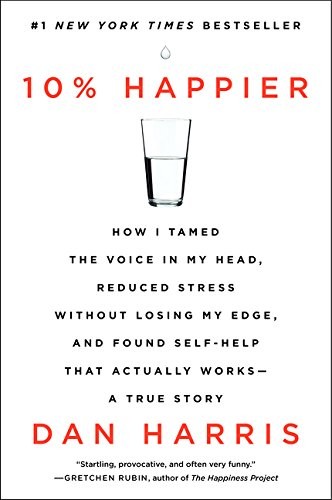
10% Happier is Dan Harris's account of discovering meditation after a panic attack live on Good Morning America in 2004 forced him to confront an anxiety problem he'd been managing with cocaine and a punishing work schedule.
Dan Harris · 2014 · 5h 20m
Full summary and key takeaways →The 12 questions
- 1.
Harris's entry point to meditation was a panic attack on live television. What would your equivalent forcing event be — the moment when you'd have to take your inner life more seriously?
- 2.
The book is written for skeptics. Did Harris's skeptical framing make meditation more or less appealing to you than more earnest presentations do?
- 3.
He distinguishes between striving and suffering — arguing that ambition is compatible with not making yourself miserable about outcomes. Is that distinction actually achievable in practice?
- 4.
Harris covers his cocaine use as self-medication for anxiety. Do you recognize the pattern of reaching for external stimulation to manage an internal state?
- 5.
The inner narrator is a central figure in the book. When you notice your inner narrator most strongly, what is it usually saying?
- 6.
He argues that the 'price of security' — the anxiety that drove his success — was worth examining but not eliminating. How do you think about the relationship between your productive anxieties and your wellbeing?
- 7.
The book covers multiple teachers and spiritual figures. How do you evaluate teachers whose personal behavior doesn't consistently match their teaching?
- 8.
Harris started meditating reluctantly and found it genuinely useful. Is there a practice you've resisted that you suspect would be beneficial if you gave it a real try?
- 9.
The ten percent framing sets a low bar deliberately. Does that modesty make the practice more appealing or does it seem like underselling something that may be more significant?
- 10.
He covers the neuroscience of meditation briefly — neural changes with practice, reduced amygdala reactivity. How much does scientific validation matter to your willingness to try a contemplative practice?
- 11.
The book became a gateway to meditation for many competitive, driven professionals. What is it about that demographic that makes the mainstream mindfulness framing inadequate for them?
- 12.
If you meditate, what has your experience been? If you don't, what specifically has prevented you from starting?
How to run the discussion
- Pick six to eight, not all of them. An hour of real discussion covers fewer questions than anyone expects, and racing the list is what makes a book club feel like homework.
- Open with what people noticed, not what they concluded. Asking for a verdict first hardens opinions before anyone has heard each other.
- Let the disagreement run. The questions below that split a room are the ones worth the time; the ones everyone answers the same way can be skipped.
- Ask the quiet person a specific question. A direct, narrow question is far easier to answer than an open invitation to contribute.
Themes worth steering toward
If the conversation stalls, these are the threads that usually restart it.
Common questions
What are good book club questions for 10% Happier?
Here are 12 book club questions for 10% Happier by Dan Harris, ordered to open easily and end somewhere worth arguing about. The strongest openers ask what each reader noticed rather than what they concluded, and the discussion usually turns on meditation, mindfulness, anxiety.
How long should a book club discussion of 10% Happier last?
Most groups run 60 to 90 minutes of actual discussion. That is roughly six to eight questions, not all of them, so pick the ones that suit your group rather than working down the list in order.
What are the main themes in 10% Happier?
Meditation, Mindfulness, Anxiety, Ambition, Self-improvement. Those are the threads most likely to divide a room, which makes them the useful places to steer a discussion that has gone quiet.
Picking the next one? See books like 10% Happier or questions for other book club picks.
